

Joint Commission Wound Care Standards: Compliance Checklist
Meeting Joint Commission wound care standards isn’t just about passing a survey, it’s about building the clinical infrastructure that keeps patients safe and wounds healing. For facilities managing complex cases like diabetic ulcers, pressure injuries, and post-surgical wounds, TJC accreditation requirements shape everything from documentation protocols to staff competency expectations.
The challenge is that these standards are detailed, cross-referenced, and updated regularly. Falling out of compliance can mean more than a citation; it can mean delayed patient recovery and increased liability. Whether you’re a skilled nursing facility preparing for a survey or a case manager tightening your wound care referral process, knowing exactly what The Joint Commission expects is non-negotiable.
At Philadelphia Wound Care, we work directly inside SNFs, assisted living communities, and private homes across the Philadelphia region, which means we see firsthand how compliance gaps affect patient outcomes. This article breaks down the core TJC wound care standards into a practical checklist, covering documentation, assessment protocols, and quality benchmarks your team can act on immediately.
What Joint Commission expects for wound care
The Joint Commission doesn’t publish a single standalone wound care chapter. Instead, joint commission wound care standards are embedded across multiple chapters, including Provision of Care (PC), Record of Care (RC), and the National Patient Safety Goals (NPSG). Your facility needs to understand how these chapters connect, because a surveyor tracing a patient with a pressure injury will pull documentation from all of them at the same time.
Treating wound care compliance as a single-department responsibility is one of the most common mistakes facilities make; it requires cross-functional ownership across nursing, physician, and administrative teams.
Assessment and reassessment requirements
TJC expects your facility to perform a structured wound assessment at admission and at defined intervals throughout the patient’s stay. This is not informal observation. The standard requires a systematic approach that captures wound type, location, dimensions, tissue type, exudate, periwound condition, and pain level. Reassessment frequency must be documented and tied to clinical changes, not just a fixed calendar schedule.

For pressure injuries, TJC aligns closely with National Pressure Injury Advisory Panel staging criteria. Your team should apply a validated tool consistently across every staff member performing wound evaluations. A key TJC expectation is that the same validated staging system is used at admission, during care, and at discharge.
- Admission skin assessment completed within a defined timeframe (typically 24 hours)
- Wound staging using a standardized, validated classification system
- Documented reassessments triggered by clinical change or wound deterioration
- Pain assessment linked directly to current wound status
Staff competency and treatment protocols
TJC surveyors will ask your staff to demonstrate wound care competency, not just reference a policy binder. That means nurses, aides, and any contracted wound care providers need documented training records, observed skills validations, and evidence that competency was re-verified on a scheduled basis. Facilities frequently pass the policy review portion of a survey and then fail on competency documentation gaps.
Your treatment protocols also need to be evidence-based and facility-approved. Using a treatment approach outside an active physician order is a direct compliance risk. Every dressing change, debridement method, and advanced therapy application, including biological or allograft products, must connect to a current signed physician order and a documented clinical rationale. If your wound care partner does not provide documentation that integrates cleanly into your medical record, that gap becomes your liability during a survey, not theirs.
Why these standards matter for safety and payment
Joint commission wound care standards exist for two reasons that affect your facility directly: protecting patients from preventable harm and protecting your organization from financial and legal exposure. When wound care processes break down, the consequences are concrete and measurable, not abstract.
The direct link to patient outcomes
Unmanaged wounds escalate quickly. A stage 2 pressure injury that receives inconsistent treatment can progress to a stage 4, requiring surgical intervention and exposing the patient to systemic infection risk and prolonged hospitalization. TJC standards are designed to interrupt that progression by requiring structured assessments, defined reassessment triggers, and evidence-based treatment protocols. When your team follows these requirements consistently, you catch wound deterioration early and respond before complications take hold.
A facility that documents every wound assessment correctly but lacks a clear escalation protocol for wound deterioration still carries significant patient safety risk.
Staff accountability and treatment continuity are the two variables TJC standards force facilities to control. Patients with chronic wounds often interact with multiple caregivers across multiple shifts. Without standardized documentation and competency requirements, care becomes fragmented and wound status gets misread or ignored between handoffs.
Payment consequences you cannot ignore
Wound-related complications directly affect Medicare reimbursement rates and star ratings for skilled nursing facilities. Hospital-acquired pressure injuries are classified as Never Events under CMS policy, meaning they can result in non-payment for related treatment costs. A poor TJC survey outcome can also trigger additional oversight, reduce referral volume from hospitals, and put your facility’s accreditation status at risk, which affects payer contracts across the board. Compliance is not an administrative overhead; it is a revenue protection strategy.
How to run a Joint Commission-ready wound program
Running a wound program that holds up under TJC scrutiny requires building three interconnected systems: a standardized clinical workflow, a consistent documentation process, and a staff accountability structure. These don’t need to be complex, but they must be deliberate. Most facilities that struggle during surveys aren’t failing on clinical quality; they’re failing because internal processes break down across shifts and departments.
Building your wound program around joint commission wound care standards from the start is far easier than retrofitting compliance after a citation.
Assign clear program ownership
Every compliant wound program needs a designated wound care lead who owns the clinical protocols, competency records, and quality data. This person needs formal authority to drive accountability across departments. Without a named owner, documentation gaps and protocol deviations go unaddressed until they surface during a survey.
Your wound care lead should serve as the primary contact for contracted wound care partners and visiting physicians. When outside providers treat your patients, their orders and documentation must integrate directly into your medical record. A clean handoff between your internal team and external providers is one of the clearest markers of a well-structured wound program.
Build a quality tracking system
Track wound incidence, progression, and closure rates at the facility level monthly. This data tells you whether your clinical protocols are working and gives you concrete evidence of program performance to present during a TJC survey. Surveyors respond well to facilities that show trend data, not just current snapshots.
Schedule a monthly review where your wound care lead presents key metrics to clinical leadership. If your data shows a rising pressure injury rate, document your corrective action before a surveyor does. This kind of proactive quality review signals program maturity to TJC.
Wound care documentation checklist for compliance
Joint commission wound care standards require your documentation to tell a complete clinical story for every wound. A surveyor reviewing a patient record should be able to trace the wound from admission through current status without filling in any gaps themselves. If they have to guess what happened between assessments, your documentation has already failed.
What every wound record must contain
Your wound assessment entries need to capture specific, measurable data points rather than general observations. Vague language like "wound improving" carries no clinical or compliance weight without objective measurements to support it.
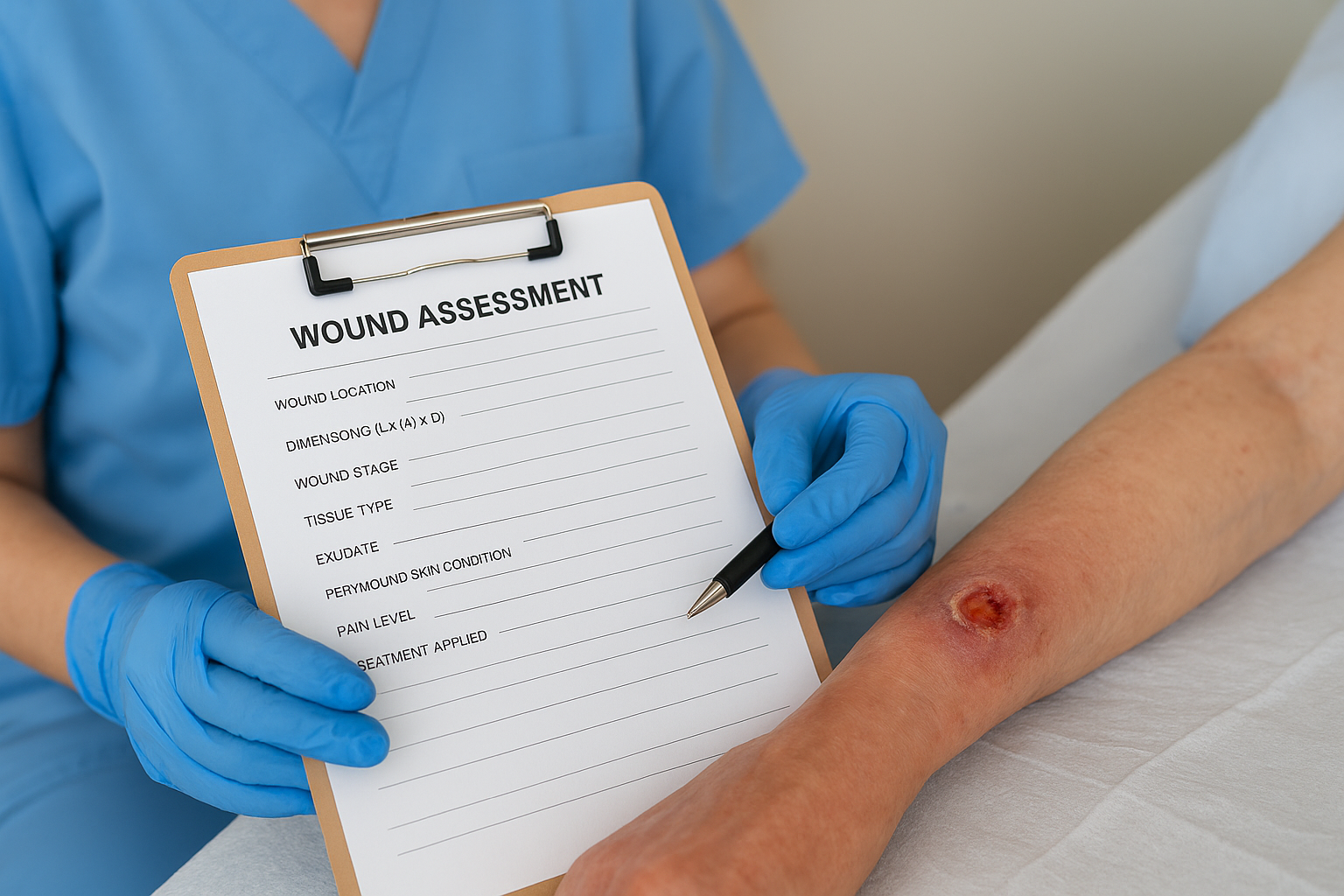
Every wound entry in your records should include:
- Wound location using anatomical terminology
- Dimensions (length x width x depth in centimeters)
- Wound stage or classification using a validated system
- Tissue type present in the wound bed
- Exudate amount and characteristics
- Periwound skin condition
- Pain level tied to the current wound assessment
- Treatment applied with product names and technique
Incomplete wound entries are one of the top citations TJC surveyors issue during facility surveys, and they are almost entirely preventable with a structured documentation template.
Documenting treatment orders and clinical response
Every treatment your team applies to a wound must connect directly to a current, signed physician order that specifies the dressing type, frequency, and any adjunctive therapies. When the order changes, your record must show both the updated order and the clinical reason that drove the change, whether that was wound deterioration, an allergic response, or progression toward closure.
Your documentation also needs to capture the patient’s response to treatment at each reassessment interval. Recording objective wound measurements alongside the patient’s reported pain level creates the kind of longitudinal record that demonstrates active clinical management rather than routine task completion.
Survey prep: tracer method and common pitfalls
The tracer method is how TJC surveyors actually evaluate your facility. They select a patient with a complex condition, like a pressure injury, and trace that patient’s care experience across every department and documentation system that touched them. For wound care, this means a surveyor will pull admission skin assessments, nursing notes, physician orders, treatment records, and staff competency files all in sequence. If any part of that chain breaks, the gap becomes a citation.
How the tracer method works in wound care surveys
When a surveyor selects a wound care patient as a tracer, they will interview the staff who directly cared for that patient, review the full medical record, and potentially observe a dressing change in real time. Your team needs to answer questions about the wound classification system used, the rationale behind current treatment orders, and when the last reassessment occurred. This is not a policy review; it is a live test of whether your documented protocols match actual practice at the bedside.
Surveyors following the tracer method are specifically looking for disconnects between what your policy says should happen and what your records show actually happened.
Common pitfalls that trigger citations
Facilities preparing against joint commission wound care standards consistently run into a predictable set of documentation failures. Knowing these ahead of time gives you a direct advantage before a surveyor walks through your door.
- Missing reassessment entries when a wound changes between scheduled intervals
- Unsigned or undated physician orders for dressing changes or advanced therapies
- Competency records that are expired or incomplete for contracted wound care staff
- No documented escalation response when wound deterioration was recorded in the chart
Walk your own records using the tracer method before a surveyor does. Find the gaps yourself and close them on your schedule, not theirs.
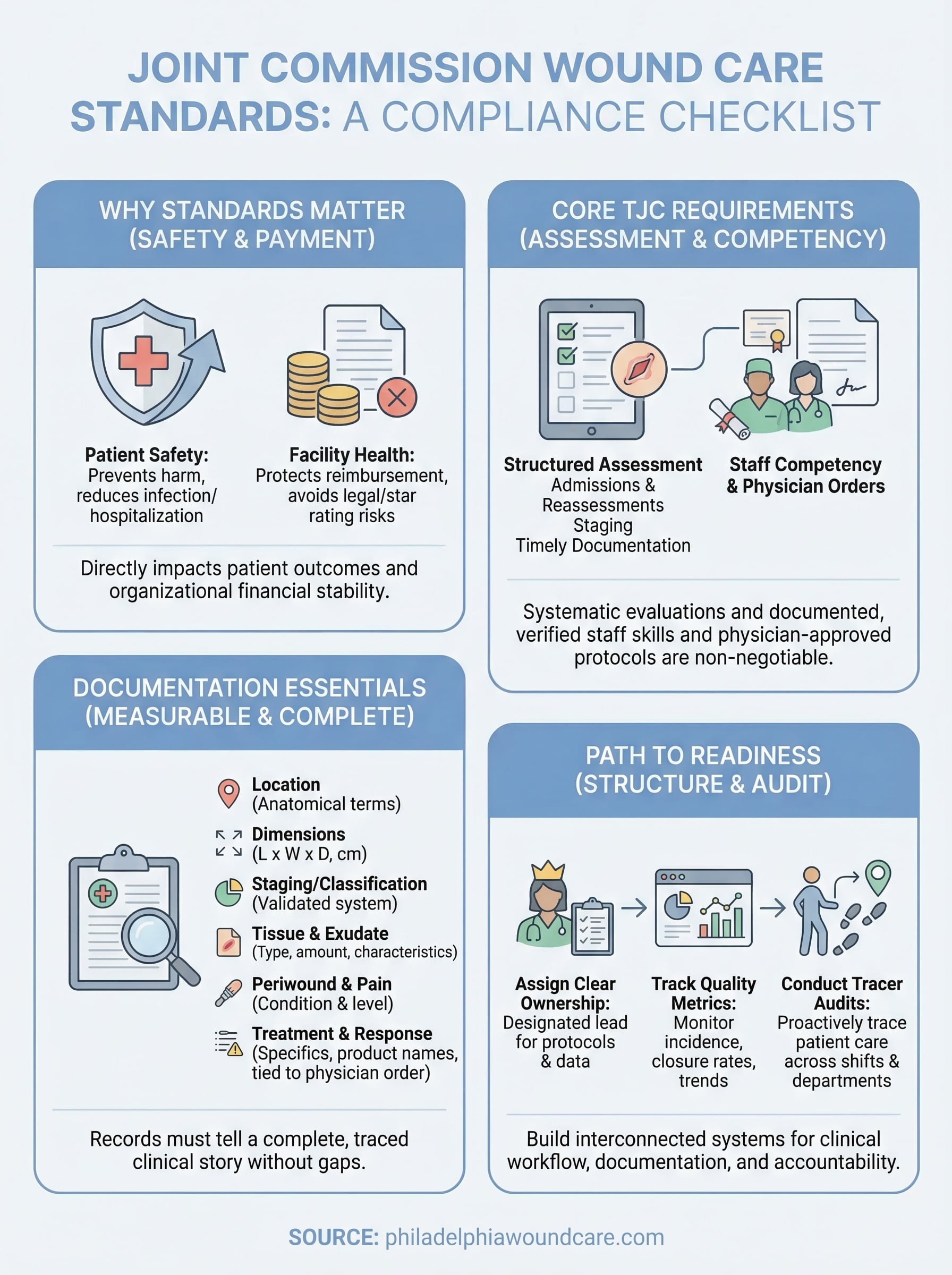
Keep your wound care survey-ready
Meeting joint commission wound care standards consistently comes down to one discipline: running the same structured processes between surveys that you would run during one. Your team, documentation systems, and quality tracking tools should be in the same state on a random Tuesday as they are the week a surveyor arrives. Reactive compliance is not compliance; it is a temporary performance that eventually breaks down under scrutiny.
Start by closing the gaps this article identified. Assign your wound care program a named owner, build a monthly quality review into your clinical calendar, and audit your records using the tracer method before anyone else does. Proactive preparation protects your patients and your accreditation status at the same time.
If you need a physician-led wound care partner who documents to survey-ready standards and integrates directly into your facility workflow, contact our mobile wound care team to discuss what that looks like for your patients and your facility.