

Can An Infected Wound Heal On Its Own? What To Do At Home
You noticed redness spreading around a cut, or maybe some swelling and warmth that wasn’t there yesterday. Now you’re wondering: can an infected wound heal on its own, or do you need to see a doctor? It’s a fair question, especially when getting to a clinic feels like a hassle, or when mobility makes it nearly impossible.
The short answer is that some very mild infections can resolve with proper home care, but many cannot. Waiting too long to act is one of the most common reasons minor wound problems turn into serious medical emergencies, particularly for older adults or anyone managing diabetes, vascular disease, or a weakened immune system.
At Philadelphia Wound Care, our physician-led mobile practice exists for exactly these situations, bringing advanced wound treatment directly to patients at home, in skilled nursing facilities, or in hospice settings across the Philadelphia area. We see firsthand how quickly an untreated infection can escalate, and we also know that not every wound needs a trip to the emergency room.
This article breaks down when home care is enough, what warning signs demand professional attention, and the specific steps you can take right now to give your wound the best chance at healing safely.
Can an infected wound heal on its own?
Whether can an infected wound heal on its own depends on one key factor: how deep and how widespread the infection is. Your immune system can fight off small bacterial colonies at the skin surface, especially if the wound is shallow and you are otherwise healthy. Think of a minor scrape that turns slightly pink and crusty but improves within a day or two with basic cleaning. That kind of surface-level response often resolves without medical treatment.
Most infections do not stay on the surface for long, and the window for safe home management is shorter than most people expect.
What makes an infection "mild"
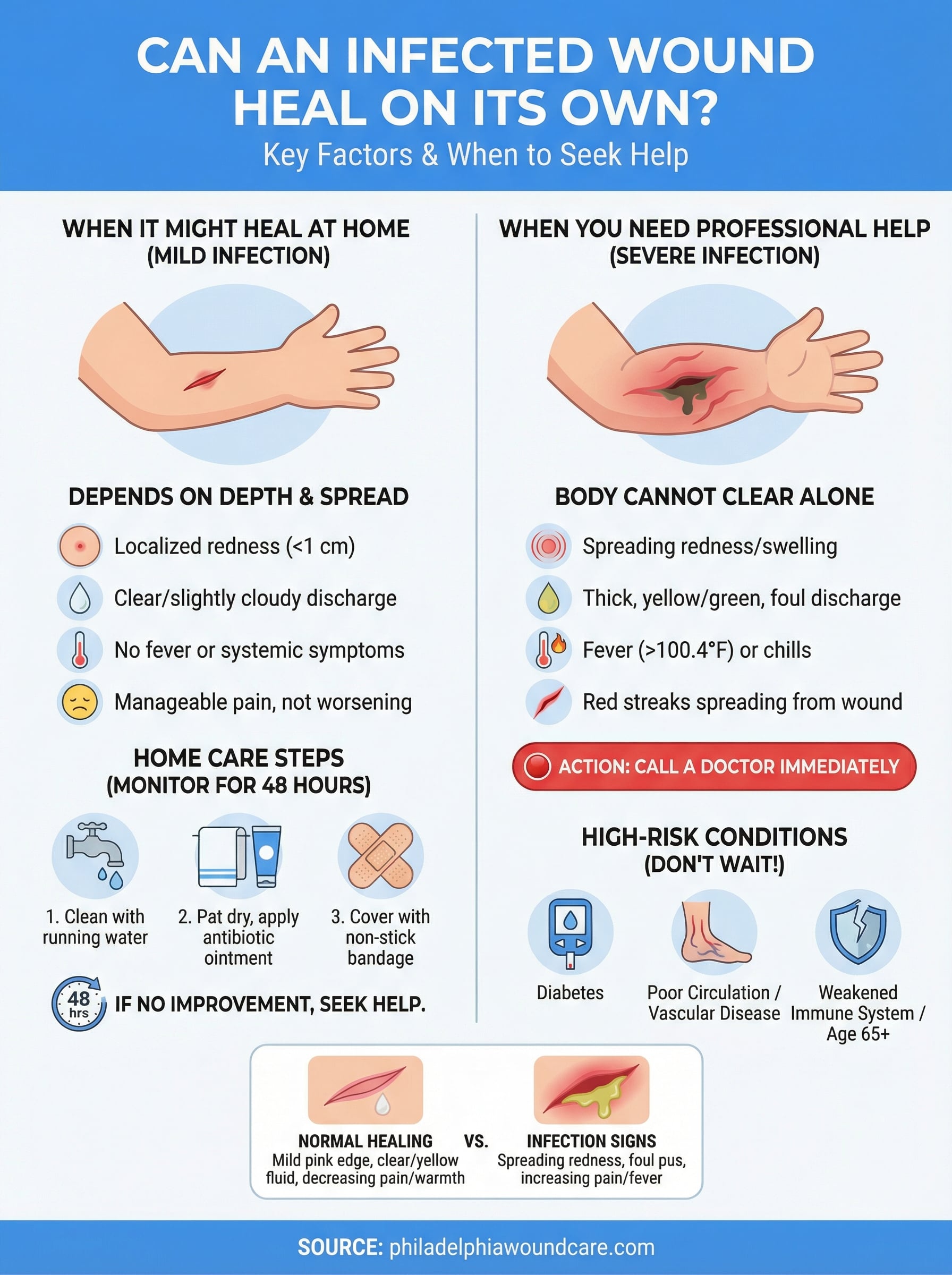
A mild infection typically stays localized to the immediate area around the wound. You might notice minor redness, a small amount of cloudy discharge, and some tenderness. The skin is warm, but the redness has clear, stable borders that are not spreading outward. Your overall health is unaffected, meaning no fever, no chills, and no red streaking lines moving away from the wound site. This narrow category is where careful home care may buy you some time.
A mild infection often looks like this:
- Redness confined to less than 1 cm around the wound edge
- Minimal discharge that is slightly cloudy but not foul-smelling
- No fever or systemic symptoms
- Pain that is manageable and not getting worse
When your body cannot clear an infection alone
Certain conditions make it nearly impossible for your immune system to handle even a moderate wound infection without outside help. If you have diabetes, peripheral vascular disease, or a suppressed immune system, your body’s ability to deliver infection-fighting white blood cells to the wound is already reduced. Poor circulation means less oxygen reaches the tissue, bacteria multiply faster, and the infection can advance to deeper layers within hours rather than days.
Age is another significant factor. Adults over 65 tend to mount a slower immune response overall, which gives bacteria more time to establish before the body reacts in any meaningful way.
Signs your wound is healing vs getting infected
Knowing the difference between normal healing and an infection that is taking hold helps you decide how quickly you need to act. Your wound will send clear, readable signals, and learning to interpret them is one of the most useful things you can do for your recovery.
What normal healing looks like
In the first one to three days, mild pink or red coloring right at the wound edge is completely normal. Your body is sending blood and immune cells to begin repair. You should also expect some clear or slightly yellow fluid in small amounts, as this is part of the natural healing process. The area may feel warm and tender, but both sensations should decrease gradually over several days.
Signs the infection is not clearing
An infected wound that is worsening shows very different signals from the ones described above. Watch for redness that spreads beyond the wound edges, discharge that becomes thick, yellow or green, and foul-smelling, and pain that increases rather than fades. A fever over 100.4°F confirms your body is fighting something it cannot handle alone.
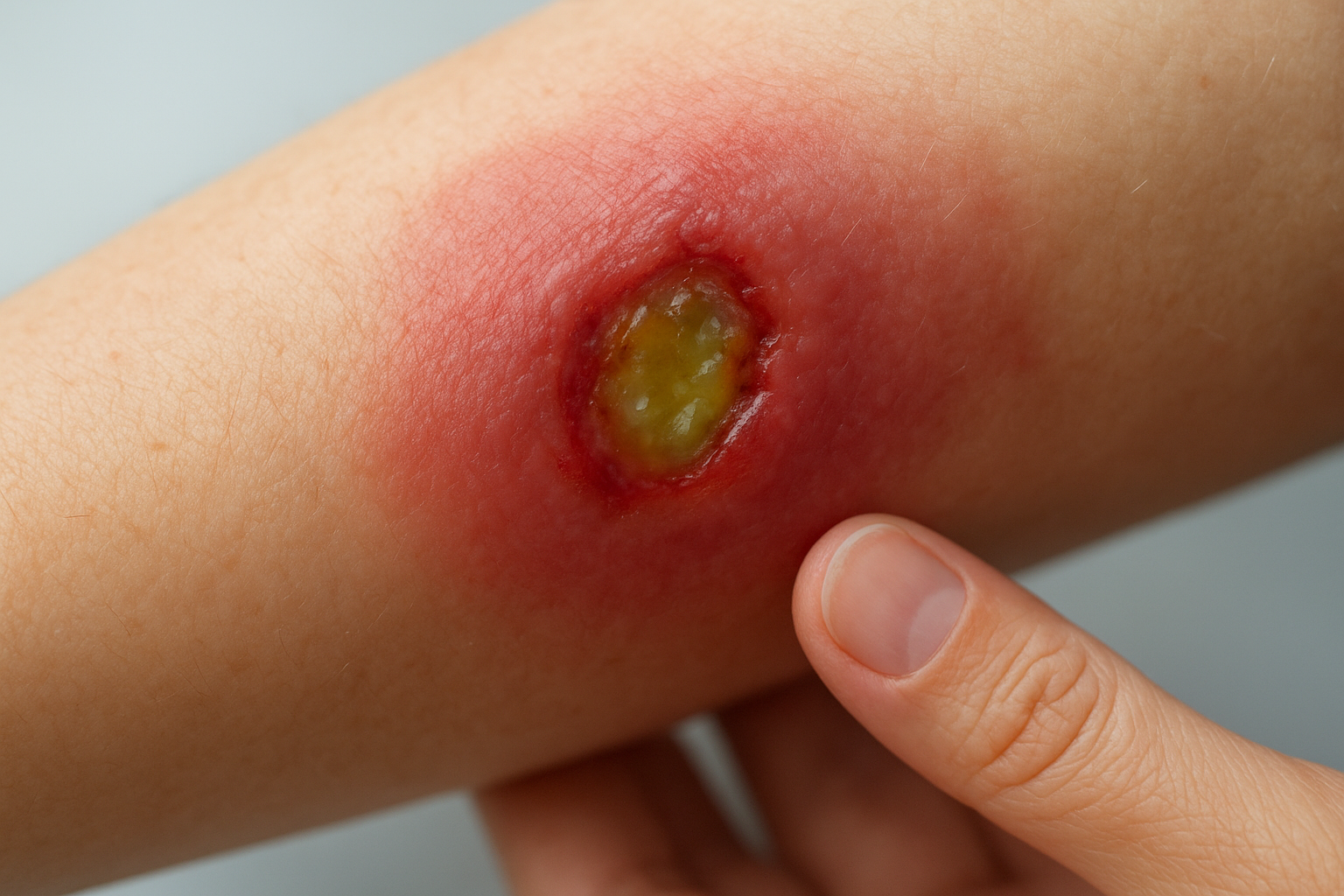
If red streaks are moving away from the wound toward your body, this is a medical emergency, and the question of can an infected wound heal on its own is no longer the right one to ask.
What to do at home right now for mild infections
If your wound shows only the mild signs described above, you can take several immediate steps to support healing. Proper wound cleaning is the first priority. Rinse the area thoroughly with clean, running water for at least one to two minutes. Avoid hydrogen peroxide or iodine directly inside the wound, as both can damage the tissue that is working to repair itself.
Clean and cover the wound correctly
Gently pat the area dry with a clean cloth after rinsing, then apply a thin layer of over-the-counter antibiotic ointment such as bacitracin. Cover it with a fresh, non-stick bandage and change the dressing at least once daily or whenever it becomes wet or dirty. Keeping the wound moist but not soggy gives your skin cells the best environment to close the gap.
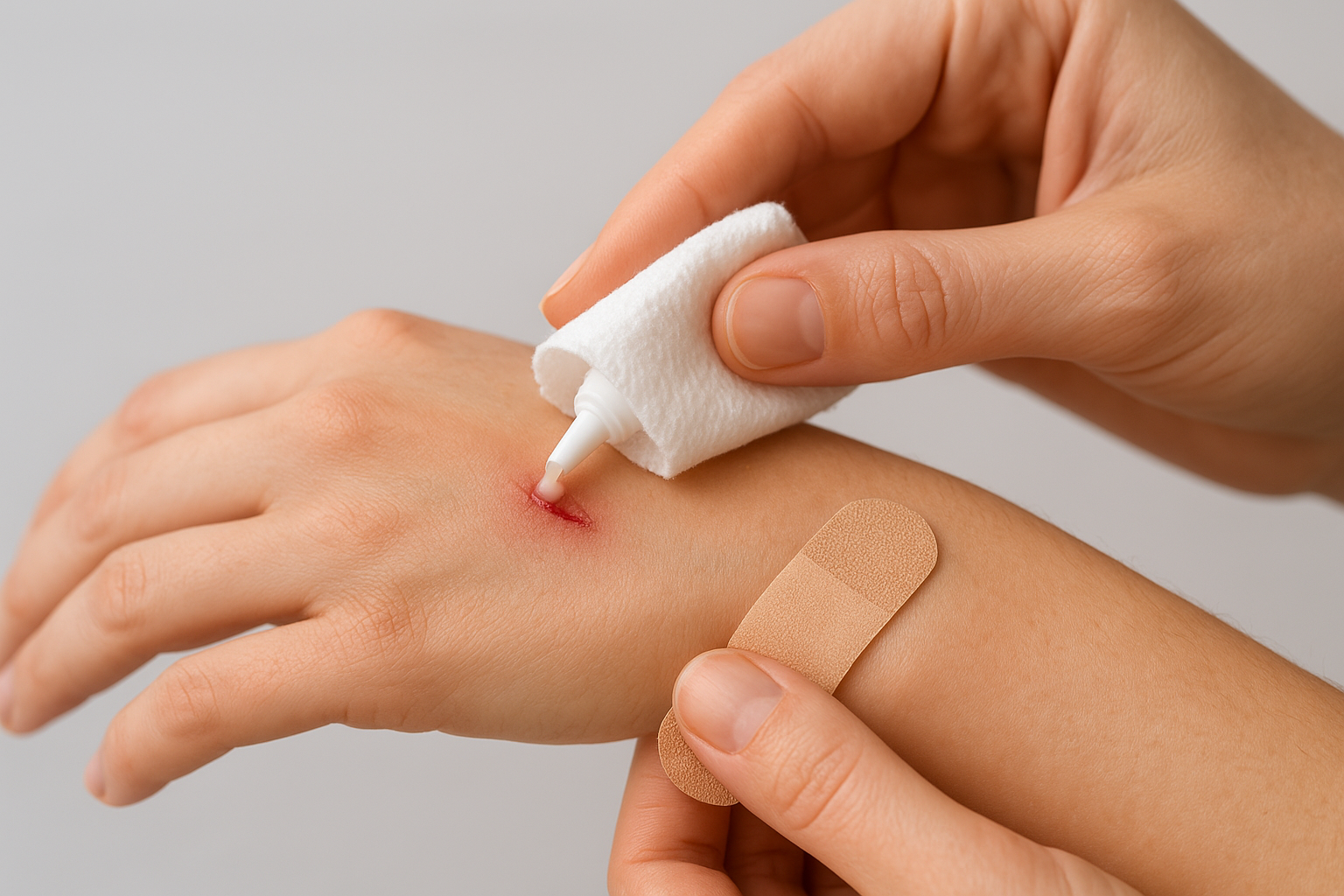
Monitor closely over the next 24 to 48 hours
Whether can an infected wound heal on its own with home care alone depends on what happens in this short window. Check the wound every morning and evening for changes in redness, discharge, and pain levels. If all three are decreasing, your home management is working.
If any symptom worsens instead of improving within 48 hours, stop home treatment and contact a medical professional.
When to call a doctor or go to urgent care
Home care has real limits, and recognizing those limits protects you from a far more serious outcome. If you are still asking can an infected wound heal on its own after 48 hours of careful home treatment with no improvement, that question has already answered itself. The point of monitoring is to act on what you observe, not to wait indefinitely.
Symptoms that require same-day attention
Several signs mean you should call a doctor or visit urgent care today, not tomorrow. Do not wait to see if things improve on their own once any of these appear:
- Red streaks extending from the wound toward the body
- Fever above 100.4°F with or without chills
- Significant swelling that is increasing rather than stabilizing
- Pus that is thick, green, or carries a foul odor
- Numbness, unusual discoloration, or tissue that looks dark or sunken
Red streaking from a wound indicates a spreading bacterial infection that can reach the bloodstream within hours and become life-threatening.
Conditions that change the timeline
If you have diabetes, poor circulation, or a compromised immune system, your threshold for calling a doctor should be much lower than average. Do not attempt 48 hours of home monitoring under these conditions. Contact a medical provider at the first sign of infection, because your body cannot buy the same time that a healthy person might have.
Who should get wound care early in Philadelphia
Some people face a much narrower window when managing a wound infection, and waiting to see if can an infected wound heal on its own is simply not a safe option for them. Philadelphia Wound Care works specifically with patients who face real barriers to getting into a traditional clinic, whether that means limited mobility, complex health conditions, or full-time residence in a care facility.
Patients who benefit most from early mobile care
If you are managing diabetes, peripheral vascular disease, or a history of non-healing wounds, early professional intervention dramatically reduces your risk of complications like cellulitis, deep tissue infection, or amputation. Our physician-led team comes directly to your home or facility, so transportation and geography never delay the care you need.
Getting ahead of an infection by 24 to 48 hours can be the difference between a straightforward outpatient treatment and a hospital admission.
Caregivers and facility staff
If you coordinate care for elderly patients or residents in a skilled nursing facility, assisted living community, or hospice setting in the Philadelphia area, you do not need to wait for a wound to worsen before making a referral. Early evaluation from a licensed General Surgeon means faster treatment decisions and far less risk of a transfer to the emergency room, which protects both your patient and your facility’s care standards.
Next steps for peace of mind
You now have a clear framework for answering can an infected wound heal on its own and knowing when that answer is no. The most important thing you can do right now is act on what you observe, not what you hope will happen. Minor infections caught early are manageable. Infections left to progress past that window become serious medical problems that are far harder to treat.
If you are in the Philadelphia area and facing a wound that is not improving, or if you are managing a condition like diabetes or poor circulation that puts you at higher risk, do not wait for your situation to escalate before seeking help. A physician-led evaluation at your home or care facility can change your outcome dramatically. Reach out today and request mobile wound care in Philadelphia to get the right care without leaving your front door.