

Medicare Guidelines for Wound Care: Coverage & Eligibility
Medicare covers a wide range of wound care services, but figuring out exactly what qualifies, and under what conditions, is rarely straightforward. Medicare guidelines for wound care define everything from which treatments require prior authorization to what counts as medical necessity for surgical dressings and advanced therapies. If you or a loved one is managing a chronic or non-healing wound, understanding these rules can directly affect the care you receive and what you pay out of pocket.
At Philadelphia Wound Care, we work within these guidelines every day. As a physician-led mobile practice, we bring advanced wound management directly to patients at home, in skilled nursing facilities, and in hospice settings across the Philadelphia area. We coordinate Medicare and Medicare Advantage billing so our patients can access treatments like allograft therapy without unnecessary financial barriers.
This article breaks down the core Medicare coverage rules for wound care, including eligibility criteria, Local Coverage Determinations (LCDs), and the specific conditions that must be met for services and supplies to be covered. Whether you’re a patient, a caregiver, or a referring provider, this guide will help you understand what Medicare requires before wound care treatment begins.
Why Medicare wound care rules matter
Medicare processes millions of wound care claims each year, and a significant portion of those claims get denied or delayed because the documentation doesn’t meet required standards. For patients managing diabetic ulcers, pressure injuries, or post-surgical wounds, a denied claim isn’t just a billing inconvenience. It can mean delays in treatment, unexpected out-of-pocket costs, or being pushed toward lower-quality alternatives that don’t address the underlying problem.
Denials cost you time and money
When a wound care claim gets denied, the process of appealing it takes time that a chronic wound simply doesn’t have. Chronic wounds require consistent, timely treatment to avoid complications like infection, tissue necrosis, or amputation. If your provider doesn’t document the wound properly or fails to meet Medicare’s medical necessity criteria, you may end up paying the full cost of services that should have been covered.
Missing one required element in your wound care documentation can be enough to trigger a claim denial under Medicare’s Local Coverage Determinations.
Understanding the medicare guidelines for wound care upfront gives you and your care team a clear framework to work within from the start. When both parties know what Medicare expects, claims move through faster and care doesn’t stall over administrative issues.
Advanced therapies depend on meeting specific criteria
Not every wound care treatment falls under basic Medicare coverage. Regenerative therapies like allograft skin substitutes are covered under Medicare Part B, but only when very specific clinical conditions are documented and confirmed. If your provider hasn’t followed the required steps, such as showing that standard wound care failed over a defined treatment period, Medicare will deny the advanced therapy claim entirely. This matters because these treatments represent some of the most effective options for wounds that aren’t responding to conventional care, and losing access to them over a documentation gap can seriously affect your recovery timeline.
Your provider’s ability to navigate these rules directly shapes the quality of care you receive. A practice that understands Medicare’s coverage framework can make sure you get access to the right treatments at the right time, without surprise bills or unnecessary delays. The rules aren’t just administrative details. They determine what gets done for your wound and who pays for it.
What wounds qualify under Medicare
Medicare doesn’t cover every wound automatically. To qualify for covered services, your wound must meet medical necessity criteria as defined by your regional Medicare Administrative Contractor (MAC). In general, wounds that are chronic, non-healing, or complex are the ones most likely to qualify, though the specific requirements depend on the wound type and treatment involved.
Wound types Medicare recognizes
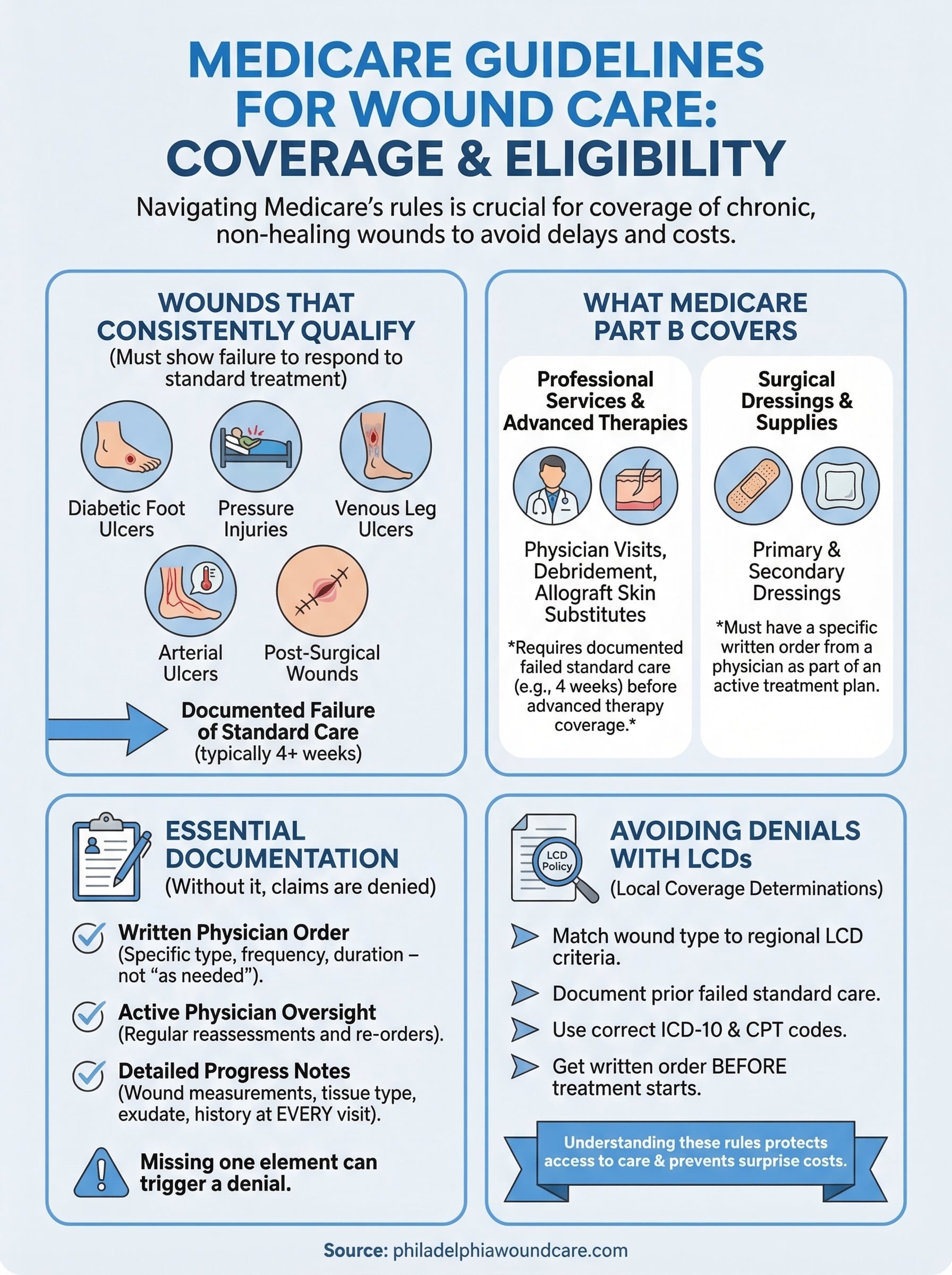
Several wound categories consistently qualify under Medicare’s standard coverage framework. Diabetic foot ulcers and pressure injuries make up the largest share of claims, but venous ulcers, arterial wounds, and post-surgical dehiscence also qualify when properly documented. Your provider needs to clearly identify which wound type you have before any treatment or supply claim can move forward.
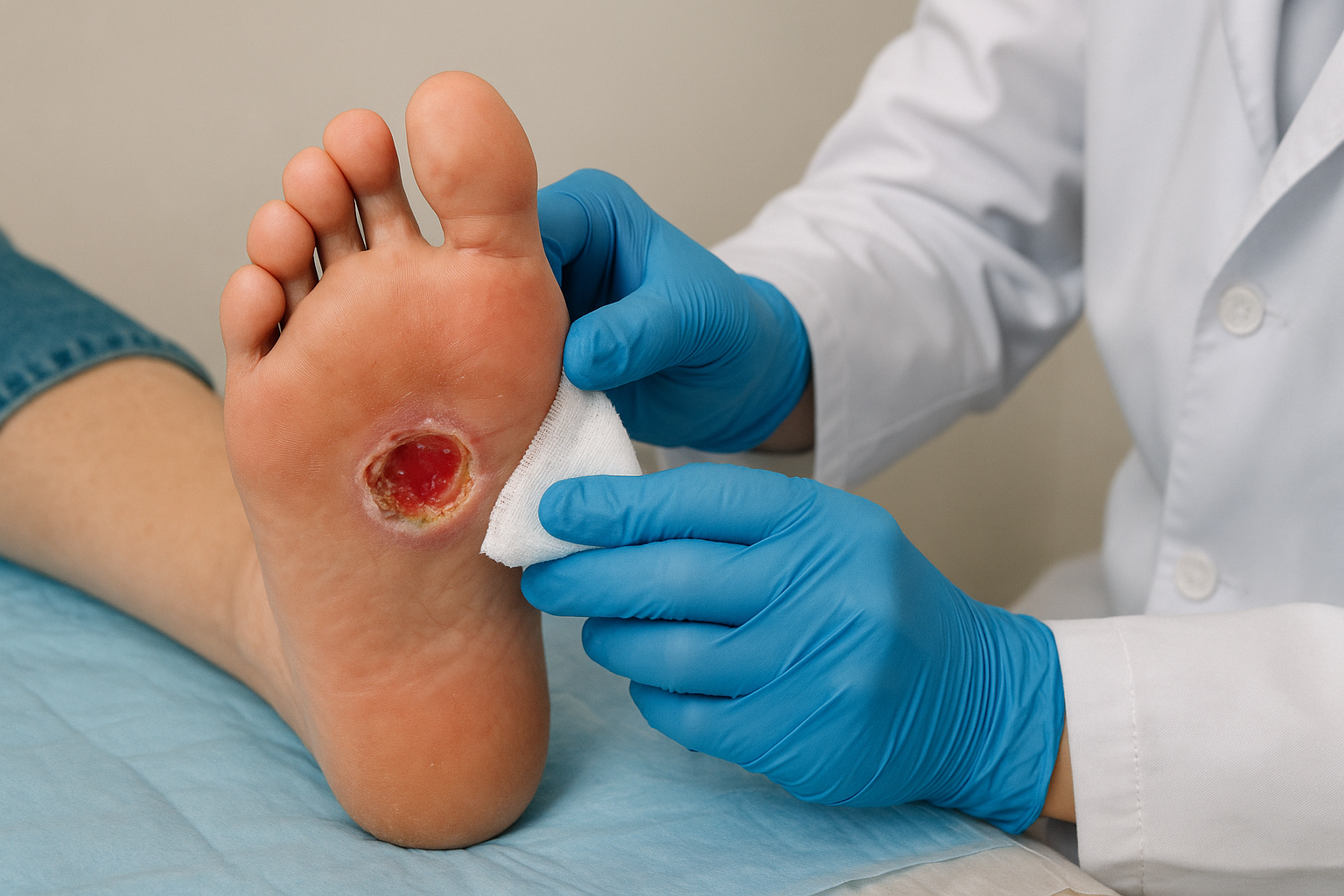
- Diabetic foot ulcers: Wounds caused by peripheral neuropathy or poor circulation in patients with diabetes
- Pressure injuries (bedsores): Stage 2 through Stage 4 wounds resulting from prolonged immobility
- Venous leg ulcers: Open wounds caused by chronic venous insufficiency
- Arterial or vascular ulcers: Wounds resulting from reduced blood flow to the extremities
- Post-surgical wounds: Non-healing incisions or dehisced wounds following a surgical procedure
What makes a wound "qualified"
Fitting into a wound category alone isn’t enough. Medicare requires that your wound shows a failure to respond to standard treatment over a documented period, typically four weeks or more. The medicare guidelines for wound care also require that your provider records wound measurements, tissue type, drainage, and treatment history at each visit. Without this level of detail, even a wound that clearly fits a covered category may not pass review.
A wound that hasn’t been consistently documented is treated the same as a wound that hasn’t been treated at all, from Medicare’s perspective.
What Medicare covers for wound care and supplies
Medicare Part B covers wound care services when a licensed physician or qualified practitioner orders and oversees the treatment. Under the medicare guidelines for wound care, coverage splits across professional services, advanced therapies, and wound care supplies, with each category carrying its own set of conditions you need to satisfy before claims are approved.
Professional services and advanced therapies
Medicare Part B pays for physician evaluation and management visits related to wound care, including debridement and the application of skin substitutes or allograft therapies. Your provider must hold the appropriate licensure and bill using the correct CPT procedure codes for each service performed. Allograft and cellular tissue-based products are covered under Part B, but only after your provider documents that standard wound care failed over a minimum four-week treatment period.
Medicare will not cover advanced therapies as a first-line treatment; your provider must attempt and document standard care before those claims will be approved.
Surgical dressings and supplies
Surgical dressings are covered under Medicare Part B when a physician orders them as part of an active treatment plan for a covered wound type. Your supplier must be enrolled as a Medicare-participating provider and bill correctly against the specific wound diagnosis on file. Coverage includes primary and secondary dressings, but quantities are restricted based on wound size, drainage level, and documented clinical need.

- Primary dressings that contact the wound bed directly
- Secondary dressings that secure or cover the primary layer
- Specialty dressings such as foams, hydrocolloids, and alginates when medically justified and documented
Documentation and orders Medicare requires
Before Medicare pays for wound care services or supplies, your provider needs to have specific documentation in place. The medicare guidelines for wound care treat missing paperwork the same as missing clinical justification: without it, claims get denied regardless of how legitimate the treatment is.
Written orders and physician involvement
Medicare requires a written order from a licensed physician before wound care services or surgical dressings can be billed. That order must include the wound type, the specific treatment or dressing type ordered, the frequency of application, and the anticipated duration of care. General or vague orders like "wound care as needed" are not sufficient and will not support a claim.
Your physician must also be actively involved in your care plan, not just a signature on the intake paperwork. Medicare expects ongoing physician oversight, which means your provider needs to reassess and re-order supplies and services at defined intervals based on how your wound is responding.
Progress notes and wound tracking
Every visit must generate a detailed progress note that documents wound dimensions, tissue type, exudate level, signs of infection, and any changes to the treatment plan. These notes build the clinical record that supports both current and future claims, including transitions to advanced therapies.
If your wound measurements and treatment history aren’t recorded consistently at each visit, Medicare has no basis to approve escalated care, even when it’s clearly needed.
Accurate visit-by-visit documentation is what separates a successfully covered care plan from one that stalls in the appeals process.
How to use LCDs and avoid claim denials
Local Coverage Determinations (LCDs) are policy documents issued by your regional Medicare Administrative Contractor that define exactly which wound types qualify for coverage, what clinical criteria must be met, and what documentation your provider must submit. The medicare guidelines for wound care rely heavily on LCDs to determine whether a specific service or supply will be paid. Your care team should reference the applicable LCD before treatment begins, not after a claim gets rejected.
Reviewing the relevant LCD before your first visit is the single most effective step you can take to prevent a denial before it happens.
Find your regional LCD
CMS publishes all active LCDs on its Medicare Coverage Database, which you can access at cms.gov. Each LCD is tied to a specific MAC jurisdiction, so you need to identify which contractor covers your geographic area before searching. Philadelphia-area patients fall under a specific MAC region, and your provider should already know which LCDs apply to the wound types they treat.
Steps to prevent a denial
Your provider can avoid most claim denials by following a clear pre-treatment checklist. Confirming that your wound type matches the LCD’s qualifying diagnoses and ensuring that all billing codes align with the diagnosis on file will address the most common reasons claims fail before they reach the review stage.
- Confirm the wound type matches the LCD’s qualifying diagnoses
- Document four or more weeks of prior standard wound care
- Use the correct ICD-10 and CPT codes for each service
- Obtain a written physician order before treatment starts
- Schedule reassessments at the intervals the LCD specifies
Next steps for getting covered wound care
Understanding the medicare guidelines for wound care is the first step, but acting on that knowledge is what actually protects your access to treatment. The most important action you can take right now is to confirm that your wound care provider documents every visit thoroughly, holds appropriate Medicare enrollment, and already knows which LCDs apply to your specific wound type. Gaps in any of these areas can delay your treatment or result in denied claims that take weeks to work through the appeals process.
For patients in the Philadelphia area who need a physician-led wound care team that handles Medicare billing from the very first visit, Philadelphia Wound Care can help. Our mobile practice brings advanced wound treatment directly to you, whether you are at home, in a skilled nursing facility, or in a hospice setting. Contact us today to request a wound care evaluation and get the covered, expert care your wound requires.