

Wound Healing Steps: The 4 Stages And What Happens In Each
When a wound refuses to close, it helps to know what your body is actually trying to do. Every wound healing step follows a biological script, and when that script stalls, chronic wounds like diabetic ulcers or bedsores drag on for months instead of weeks. Understanding the sequence gives you a way to judge whether healing is on track or stuck.
Wound repair moves through four distinct phases: hemostasis, inflammation, proliferation, and maturation. Each stage has its own job, its own timeline, and its own warning signs when something goes wrong. A surgical incision might move through all four in three weeks, while a venous ulcer on an immobile senior can stall in the inflammatory phase indefinitely without intervention.
Below, we break down what happens biologically in each stage, how long it should normally take, and what stalled healing looks like at each point. If you’re a caregiver watching a loved one’s wound and wondering why it’s not progressing, this is the framework our physicians use every day on house calls across Philadelphia to decide when a wound needs more than time, and when advanced treatments can restart the process.
Why knowing the wound healing steps matters
Understanding each wound healing step isn’t just academic. It’s the difference between catching a problem in week two and discovering it in month four, after a diabetic ulcer has tunneled deeper into tissue or a pressure ulcer has progressed from a shallow break in the skin to an open wound exposing muscle. Caregivers and patients who know the expected timeline can flag a stall early, before a treatable wound becomes a hospitalization.
Catching a stalled wound before it becomes a crisis
Most people assume a wound is healing simply because it’s being cleaned and bandaged daily. But a dressing change isn’t the same as biological progress. If you know that a healthy wound should visibly shrink and show new pink tissue by week three, you’ll notice when it doesn’t, instead of waiting months to raise the alarm. Chronic wound patients, especially those with diabetes or poor circulation, often get stuck in the inflammatory phase for weeks without anyone recognizing it.
A wound that looks the same at week two and week six isn’t healing slowly. It’s stuck.
That distinction matters because stuck wounds don’t just need more time. They need a clinical intervention, whether that’s debridement, offloading pressure, or advanced therapies like allografts. Time alone won’t fix a wound trapped in chronic inflammation. According to the National Institute of Diabetes and Digestive and Kidney Diseases, diabetic foot ulcers that don’t improve within four weeks of standard care often require specialist referral, which is exactly the point where knowing the healing steps saves precious time.
Why this knowledge matters most for high-risk patients
Some patients have almost no margin for a stalled healing step. Their bodies can’t compensate the way a healthy 30-year-old’s can, so delays that would be minor elsewhere become dangerous fast. This is especially true for:
- Diabetics, whose elevated blood sugar impairs white blood cell function during the inflammatory phase
- Immobile or bedbound seniors, whose sustained pressure disrupts blood flow needed for the proliferative phase
- Patients with vascular disease, whose poor circulation starves healing tissue of oxygen
- Anyone on immunosuppressive medication, which blunts the inflammatory response the body needs to fight infection
Family caregivers managing these patients at home are often the first to notice when something’s off, long before a scheduled clinic visit. Knowing what normal healing should look like at each stage turns a vague worry into a specific, actionable observation you can bring to a physician, or use to justify calling for a mobile wound care evaluation before the wound worsens further.
How to support your body through each stage
Supporting a wound through each wound healing step means matching your actions to what the body needs at that moment, not applying one generic strategy the whole time. Nutrition, pressure relief, and infection control all matter, but their importance shifts as the wound moves from clotting to closing.
Feed the repair process
Protein and micronutrients drive collagen production during proliferation, so a patient eating too little protein will stall there even with perfect dressing changes. Aim for adequate protein intake, often 1.2 to 1.5 grams per kilogram of body weight for wound patients, plus vitamin C and zinc, which support collagen synthesis and immune function. Hydration matters too, since dehydrated tissue heals slower across every phase, not just proliferation.
Protect the site without smothering it
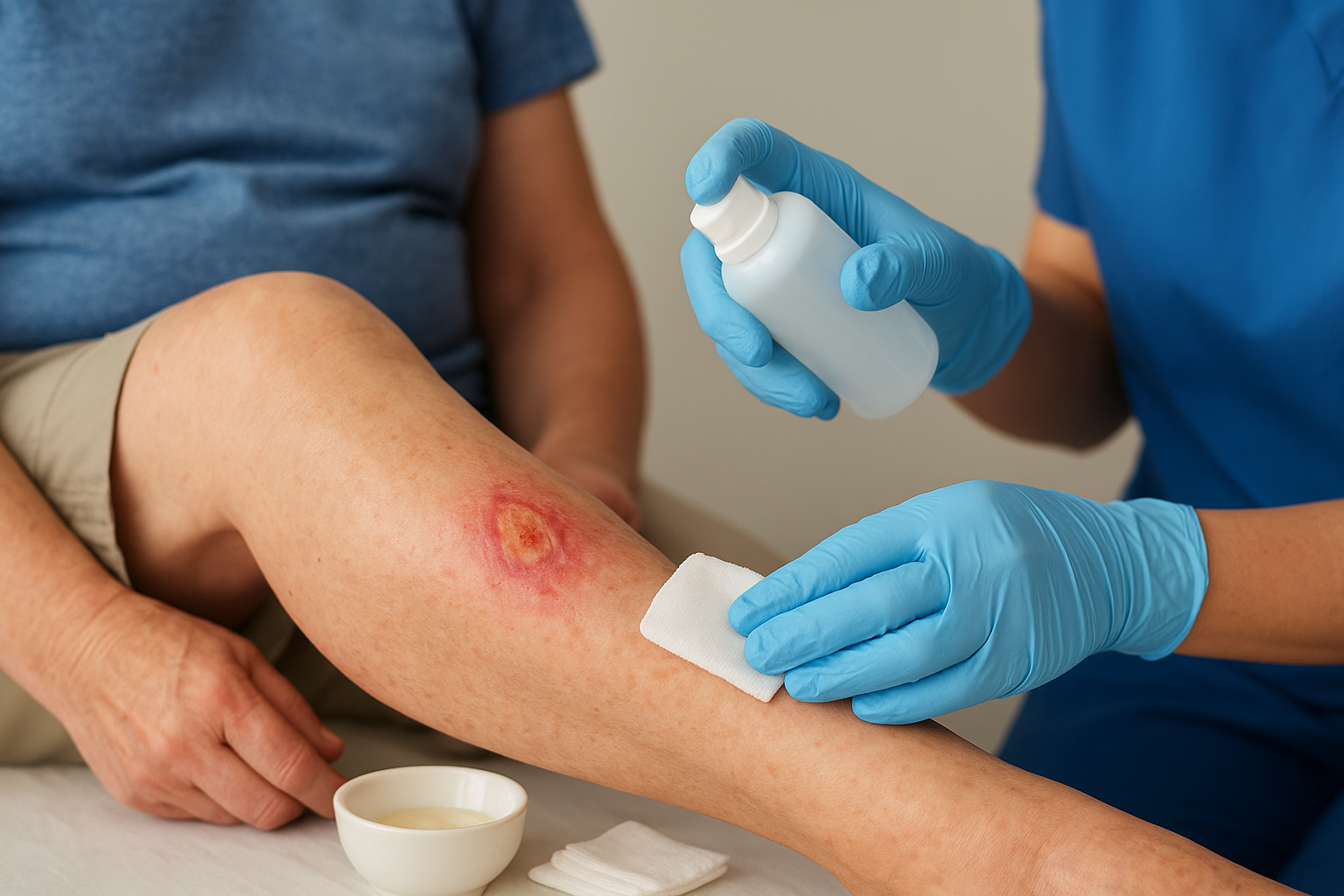
Balance is the goal here. Keep the wound bed moist but not soaked, since a dry wound bed slows migration of new cells during proliferation, while excess moisture invites maceration and infection.
Healing needs the right environment at the right time, not just a clean bandage.
- Offload pressure completely on bedsores and diabetic foot ulcers; even brief pressure interrupts blood flow to healing tissue
- Change dressings on schedule, not just when convenient
- Watch for infection signs at every stage, since infection can restart inflammation and erase proliferative progress
- Keep blood sugar controlled if diabetic, since elevated glucose blunts white blood cell function
Manage underlying conditions
Vascular disease, uncontrolled diabetes, and poor mobility don’t pause while a wound heals. Treating these conditions alongside the wound itself, rather than treating the wound in isolation, gives the body the physiological support it needs to move through each stage on schedule instead of stalling in inflammation month after month.
A realistic timeline for each stage of healing
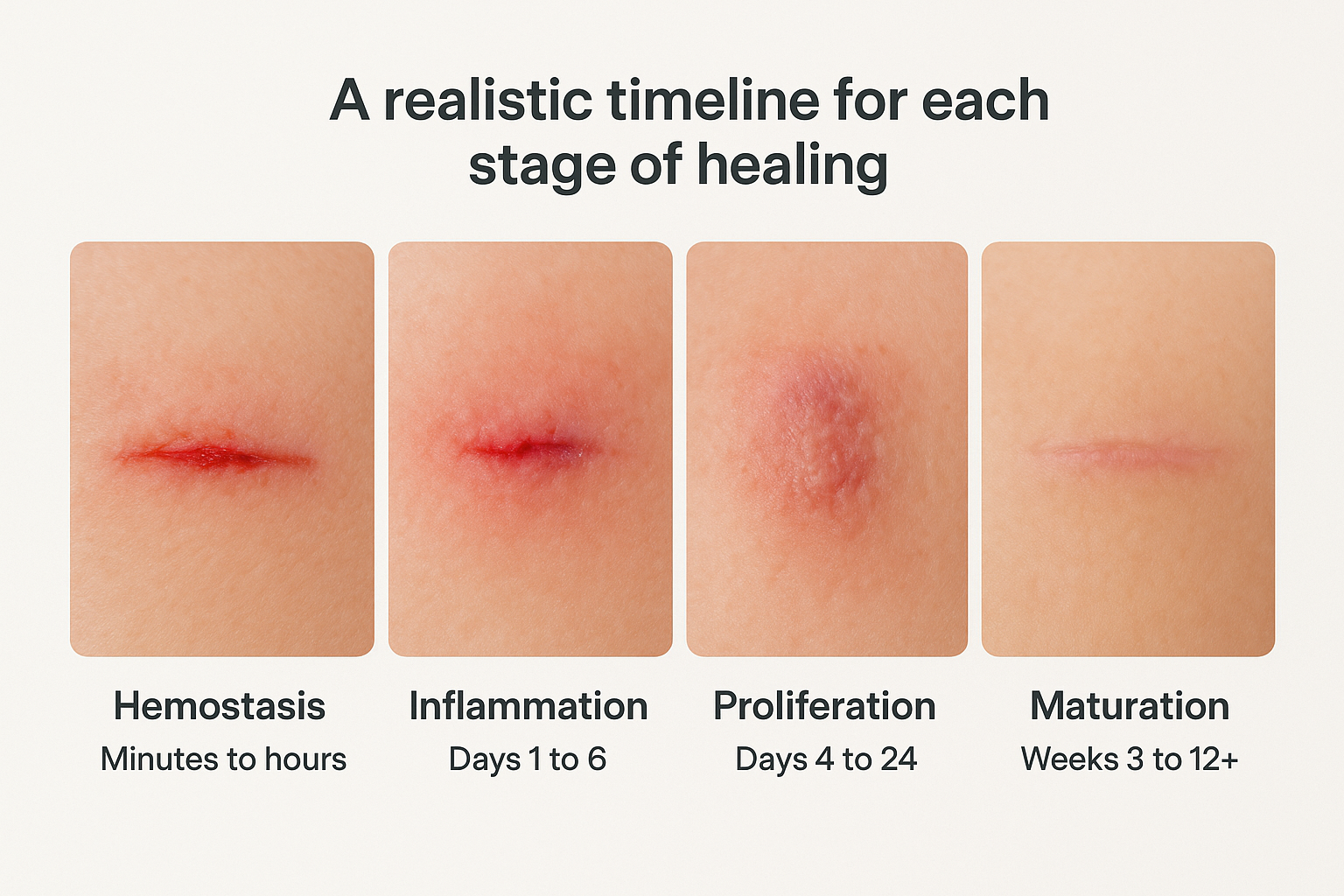
A healthy, uncomplicated wound moves through hemostasis, inflammation, proliferation, and maturation in a predictable sequence, though the pace depends heavily on wound size, depth, and the patient’s overall health. Knowing the expected windows for each phase gives you a benchmark to measure against, rather than guessing whether four weeks of slow progress is normal or a red flag.
Standard timeline for acute wounds
For a healthy adult with a clean surgical incision or minor injury, the four stages generally overlap and follow this rough schedule:
| Stage | Typical Duration | What You Should See |
|---|---|---|
| Hemostasis | Minutes to hours | Bleeding stops, clot forms |
| Inflammation | Days 1 to 6 | Redness, swelling, mild drainage |
| Proliferation | Days 4 to 24 | Pink granulation tissue, visible shrinkage |
| Maturation | Weeks 3 to 12+ | Scar forms, strength rebuilds |
If a wound hasn’t shown visible granulation tissue by week three, something is interfering with proliferation.
Why chronic wounds break the timeline
Chronic wounds, the kind our physicians see most often on house calls, rarely follow this schedule. A diabetic foot ulcer or a stage III pressure injury can sit in the inflammatory phase for months, never advancing to proliferation because underlying issues like poor circulation, uncontrolled blood sugar, or unrelieved pressure keep resetting the clock. Facility staff and family caregivers should treat any wound that hasn’t progressed in three to four weeks as a signal to escalate care, not a reason to keep waiting. Timelines matter because they turn "it’s taking a while" into a specific, measurable concern worth raising with a physician before the wound worsens further.
Signs a wound is stalled or healing abnormally
Recognizing a stalled wound early means knowing exactly what to look for, not just sensing that something feels off. Specific, observable signs separate normal healing variation from a wound that needs clinical intervention now.
Visual and physical warning signs
Beyond simple redness or swelling, watch for changes that persist beyond the expected window for that stage. Chronic wounds often show subtle signals before they become obvious emergencies:
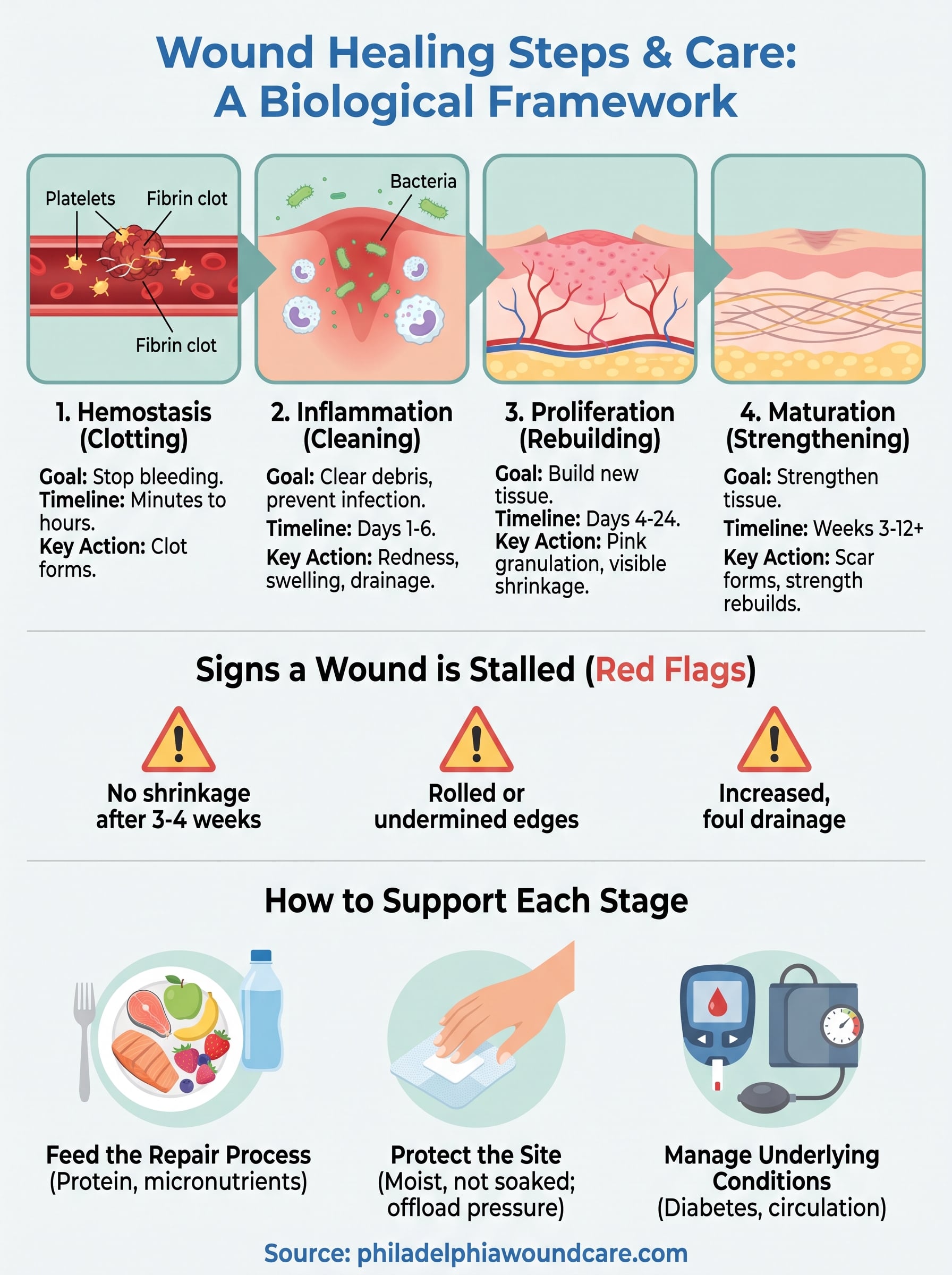
- No visible shrinkage or new granulation tissue after three to four weeks
- Wound edges that look rolled, hardened, or undermined rather than gradually closing
- Drainage that increases in volume, changes color, or develops a foul odor
- Surrounding skin that stays red, warm, or swollen well past the first week
- Dark, black, or leathery tissue (eschar) that isn’t shrinking with treatment
- A wound bed that stays pale, dry, or glassy instead of developing pink granulation tissue
A wound that’s draining more at week four than it was at week two isn’t healing. It’s losing ground.
Systemic signs that demand urgent attention
Sometimes the clearest signals come from the patient’s overall condition rather than the wound itself. Fever, new confusion in an elderly patient, increasing pain despite treatment, or spreading redness beyond the wound margin can indicate a systemic infection like cellulitis or sepsis. According to the Centers for Disease Control and Prevention, wound infections that spread systemically require immediate medical evaluation, not a scheduled follow-up days later.
Family caregivers and facility staff are often the first to notice these changes because they see the patient daily, while a physician might only visit weekly. Trust that instinct. If a wound looks worse, smells different, or the patient seems sicker than last week, don’t wait for the next scheduled check. Early escalation, whether through a call to the referring physician or a request for a mobile wound care evaluation, is almost always cheaper and safer than waiting for a crisis to force the issue.
Trusting the process while staying alert
Healing isn’t linear, and it shouldn’t be rushed. But every wound healing step has a job to do, and knowing what that job looks like gives you the confidence to tell the difference between normal variation and a wound that’s genuinely stuck. Hemostasis stops the bleeding, inflammation clears debris, proliferation rebuilds tissue, and maturation strengthens it. When any of those stages drags on past its window, that’s your signal to act, not to wait another week and hope.
Caregivers and facility staff who watch closely catch problems physicians see days or weeks later. If a wound you’re monitoring has stalled, or you’re a case manager coordinating care for someone who needs specialist eyes now, don’t wait for a crisis to force the issue. Request a mobile wound care evaluation and get a physician looking at the wound where the patient already is.