
Ankle Brachial Index Explained: Normal ABI And Next Steps
A simple blood pressure comparison between your arm and ankle can reveal serious circulation problems long before a wound refuses to heal. The ankle brachial index explained in straightforward terms is a ratio, a number derived from two painless measurements, that tells your doctor how well blood flows to your lower legs and feet. For anyone living with diabetes, vascular disease, or chronic wounds that won’t close, this test is one of the most reliable screening tools available for peripheral artery disease (PAD).
At Philadelphia Wound Care, we see firsthand how poor circulation complicates wound healing in the patients we treat across homes, skilled nursing facilities, and assisted living communities throughout the Philadelphia area. Many of our patients with diabetic ulcers or vascular leg wounds have underlying PAD that was identified, or should have been identified, through an ABI test. Understanding your results gives you real leverage in managing your recovery.
This article breaks down what the ABI test measures, how it’s performed, what a normal score looks like, and what to do if your numbers fall outside the healthy range. Whether you’re a patient, a caregiver, or a facility care team member, this guide will help you make sense of the results and understand the next steps toward better vascular health and wound outcomes.
Why the ankle-brachial index matters
The ankle brachial index gives clinicians a fast, objective window into arterial blood flow without needles, dyes, or imaging equipment. When blood struggles to reach your feet and lower legs, tissues become oxygen-deprived, and that oxygen deficit is one of the primary reasons wounds stall. A low ABI score tells a care team that the wound is not just a surface problem; it’s a circulation problem, and treating the surface alone won’t be enough.
The link between poor circulation and chronic wounds
Peripheral artery disease (PAD) narrows the arteries supplying your legs, reducing the blood volume and oxygen that tissues need to repair themselves. For patients managing diabetic foot ulcers, venous leg ulcers, or pressure injuries, PAD can silently undermine every treatment applied to the wound itself. You might receive dressings, debridement, and advanced therapies, yet the wound stalls because the underlying blood supply is inadequate.
Without adequate arterial circulation, even the most advanced wound treatments cannot deliver consistent healing outcomes.
This is precisely why the ankle brachial index explained in a clinical context goes well beyond a single number. It directly shapes the entire treatment plan. A care team that identifies low ABI early can pursue vascular referrals, adjust compression therapy decisions, and set realistic healing timelines before weeks of ineffective treatment pass.
Who needs this test
Patients over 65 with any history of cardiovascular disease, diabetes, or smoking carry elevated risk for PAD, and the American Heart Association recommends ABI screening for this population. You also need this test if you have a wound that isn’t healing on schedule, cold or pale feet, leg pain while walking, or a history of vascular surgery or arterial stenting.
For family caregivers and facility care teams, recognizing these risk factors early and requesting an ABI test can mean the difference between a wound that heals within weeks and one that deteriorates for months. Early screening protects patients from unnecessary complications, repeated hospitalizations, and the exhausting cycle of treatments that cannot work without sufficient blood flow.
How the ABI test works
The ABI test is entirely non-invasive and takes roughly 10 to 15 minutes in most clinical settings. A technician or physician uses a standard blood pressure cuff and a handheld Doppler probe to measure the systolic blood pressure at specific points in your arm and ankle. No incisions, no injections, and no special equipment beyond what most medical offices already have on hand.
The measurement process
Your clinician will take blood pressure readings from both of your arms and from the ankle arteries on each leg, typically the dorsalis pedis and the posterior tibial arteries. The Doppler probe detects blood flow sounds so the clinician can identify the exact moment pressure is released and blood moves through the vessel again. Both legs are measured separately, which matters because PAD can affect one leg more than the other.
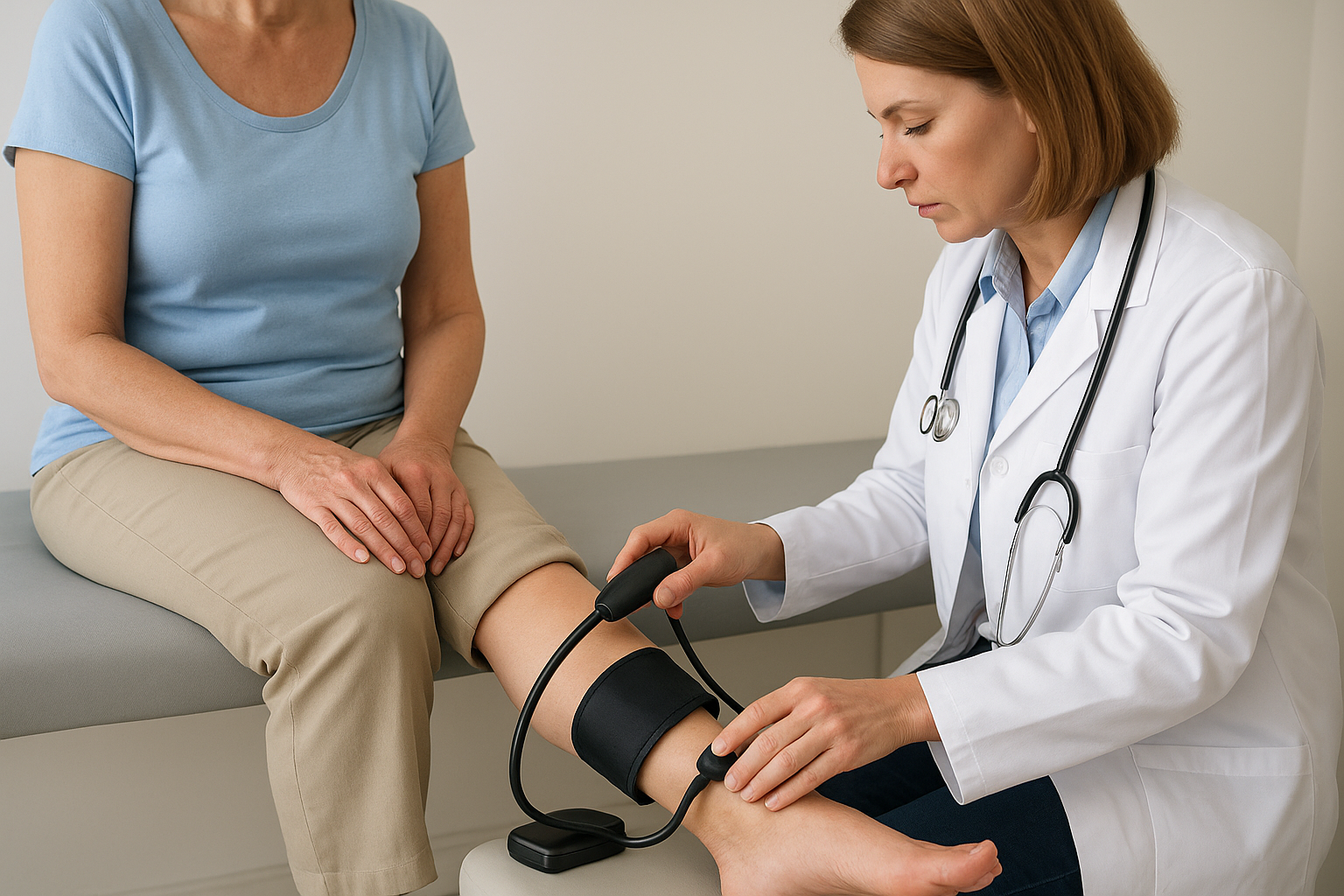
Getting bilateral readings is critical because a normal result in one leg does not rule out disease in the other.
Calculating the ratio
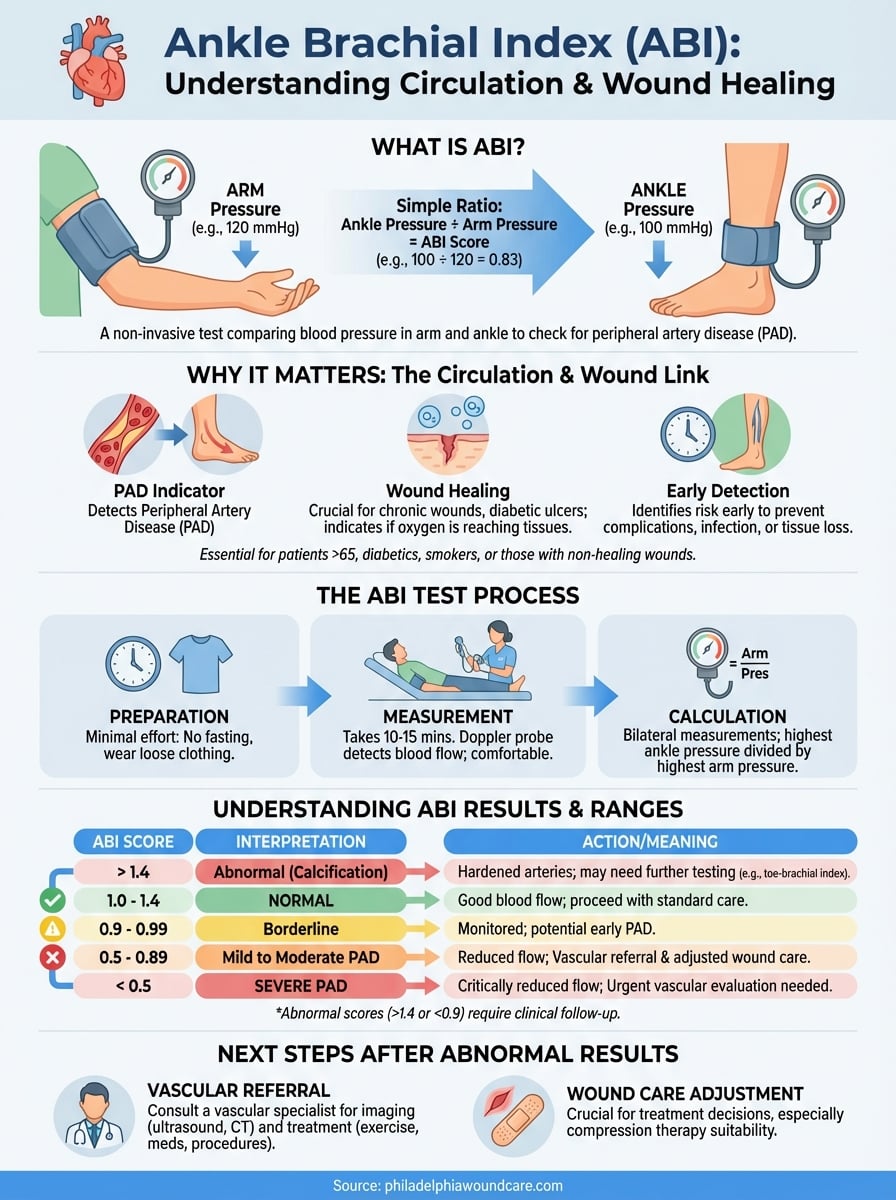
With the ankle brachial index explained at its core, the math is straightforward. Your clinician divides the highest ankle systolic pressure by the highest arm systolic pressure. If your ankle pressure reads 100 mmHg and your arm pressure reads 120 mmHg, your ABI is 0.83. A separate ratio is calculated for each leg, giving the care team a precise picture of blood flow on both sides of your body.
How to prepare and what to expect
Preparing for an ABI test requires minimal effort on your part. Unlike imaging tests or blood draws, there are no fasting requirements and no contrast materials involved. Your physician may ask you to avoid smoking for several hours before the appointment, since nicotine constricts blood vessels and can temporarily push your readings toward false-normal values.
What to wear and bring
You’ll want to wear loose, comfortable clothing that gives the technician easy access to your upper arms and lower legs. Bring a complete list of your current medications, particularly any blood thinners or blood pressure drugs, so your care team can factor in anything that might influence your readings. A few practical items to have ready include:
- A current medication list with dosages
- Insurance cards and a photo ID
- Any prior vascular test results, if available
- Comfortable, slip-on shoes to make removing footwear easier
What happens during the test
With the ankle brachial index explained as a straightforward ratio, the actual experience matches that simplicity. You will lie flat on an exam table while the technician wraps a standard blood pressure cuff around each arm and ankle in sequence. The handheld Doppler probe produces a soft whooshing sound as it picks up arterial flow, and the cuff inflates briefly before releasing.
Most patients describe the process as entirely comfortable, with no pain at any point during the evaluation.
The full bilateral test typically wraps up in under 15 minutes, with no recovery time needed afterward.
How to understand ABI results and ranges
With the ankle brachial index explained as a ratio, reading your results comes down to where your number falls on a well-established scale. A score of 1.0 to 1.4 is normal, meaning blood flow to your lower legs is unobstructed. Scores outside this range signal varying levels of concern that directly shape your treatment plan.
The standard ABI score ranges
Your result places you in one of several categories, each carrying specific clinical weight.
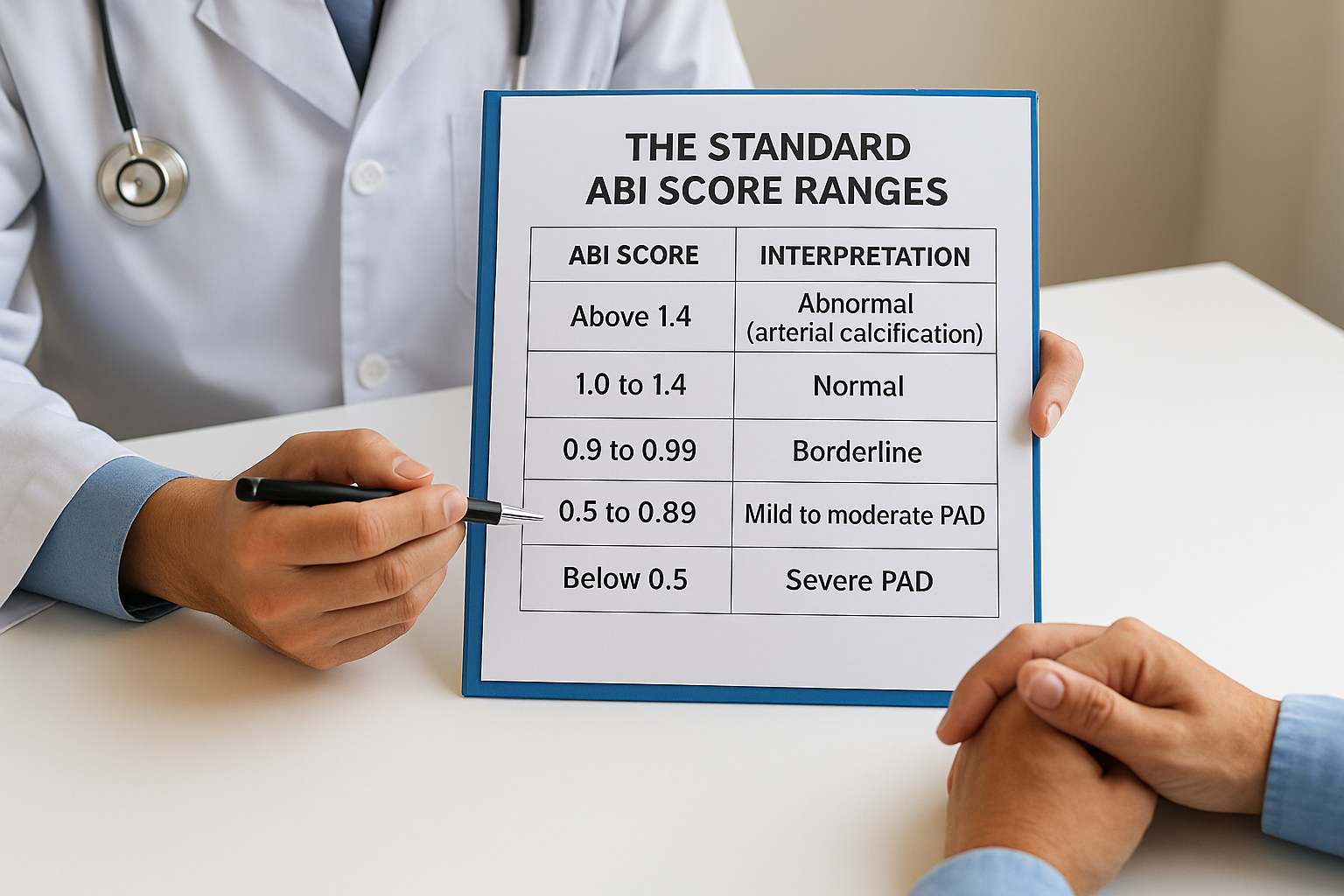
| ABI Score | Interpretation |
|---|---|
| Above 1.4 | Abnormal (arterial calcification) |
| 1.0 to 1.4 | Normal |
| 0.9 to 0.99 | Borderline |
| 0.5 to 0.89 | Mild to moderate PAD |
| Below 0.5 | Severe PAD |
Any reading below 0.9 is clinically significant and indicates reduced arterial blood flow to the lower extremities. A score below 0.5 points to severe disease and typically requires urgent vascular evaluation before wound treatments can proceed effectively.
What a high score means
A result above 1.4 may look reassuring on paper, but it signals arterial calcification, a condition common in patients with long-term diabetes. Hardened vessel walls resist cuff compression, which inflates the ankle pressure reading artificially.
An abnormally high ABI score carries the same clinical urgency as a low one and demands further vascular assessment.
Your physician will typically order additional vascular imaging, such as toe-brachial index testing, to confirm actual blood flow when calcification is suspected. This step prevents misdiagnosis and treatment delays that can allow wounds to deteriorate further.
Next steps after abnormal ABI results
An abnormal score doesn’t end the conversation; it starts a more focused one. With the ankle brachial index explained and your results in hand, your physician can now direct care toward the actual root cause rather than treating the wound in isolation. Acting quickly on an abnormal ABI significantly improves the odds of avoiding serious complications, including infection, tissue loss, or amputation.
Getting a vascular referral
Your physician will typically refer you to a vascular specialist when your ABI falls below 0.9 or rises above 1.4. That specialist will order additional imaging, often a duplex ultrasound or CT angiography, to locate the specific arteries that are narrowed or blocked. From there, treatment options range from supervised exercise programs and medication to minimally invasive procedures like angioplasty or stenting, depending on the severity of your disease.
Prompt vascular referral after an abnormal ABI is one of the most impactful steps you can take to protect a non-healing wound from getting worse.
Adjusting wound care based on circulation status
Your wound care team uses your ABI score to make critical treatment decisions, particularly around compression therapy. Compression bandaging benefits venous wounds but can severely harm patients with significant arterial disease, so knowing your ABI before applying it is non-negotiable. Mobile wound care providers like Philadelphia Wound Care coordinate directly with vascular specialists to align every treatment decision with your circulation status, ensuring no intervention works against your recovery.
Putting it all together
The ankle brachial index explained throughout this guide comes down to one core insight: a single ratio derived from two blood pressure readings can reveal life-altering circulation problems that directly determine whether your wound heals or stalls. Understanding your score, and acting on it quickly, is one of the most practical steps you or your care team can take toward real wound recovery.
Chronic wounds rarely exist in isolation. Vascular disease, diabetes, and poor circulation work together to create conditions where surface-level treatments fall short without addressing the blood flow driving tissue repair. Your ABI score gives every clinician involved in your care a shared, objective starting point for building a plan that actually works.
If you or someone you care for is managing a non-healing wound in the Philadelphia area, request a mobile wound care evaluation to connect with a physician-led team that treats the whole picture, not just the surface.