
Joint Commission Pain Management Standards: What To Know
Pain is a central concern in wound care. Patients recovering from chronic diabetic ulcers, pressure injuries, or post-surgical wounds often deal with persistent discomfort that directly affects healing outcomes. For any healthcare provider involved in that process, understanding the Joint Commission pain management standards is not optional, it’s a baseline expectation tied to accreditation and quality of care.
At Philadelphia Wound Care, our physician-led mobile practice brings advanced wound treatment to patients in homes, skilled nursing facilities, and hospice settings across the Philadelphia area. Many of the facilities we partner with are Joint Commission-accredited, which means pain assessment and management protocols shape how care is coordinated at every level. When wound care intersects with pain management, the standards matter to everyone involved, from the treating surgeon to the referring physician and facility administrator.
This article breaks down what The Joint Commission actually requires when it comes to pain management, including safe opioid prescribing practices, multimodal treatment expectations, and leadership responsibilities. Whether you’re a clinician, a care coordinator, or a family caregiver trying to understand what standards govern your loved one’s treatment, you’ll find the specifics laid out here.
What the Joint Commission requires for pain care
The Joint Commission pain management standards are built around one core principle: every patient has the right to have their pain assessed and treated appropriately. Accredited organizations must screen all patients for pain at the time of care, then respond to any pain identified with a documented, individualized care plan. This requirement applies across inpatient hospitals, outpatient clinics, long-term care settings, and home health agencies.
Screening alone is not enough. The Joint Commission requires that organizations act on what they find, not just record it.
Core assessment requirements
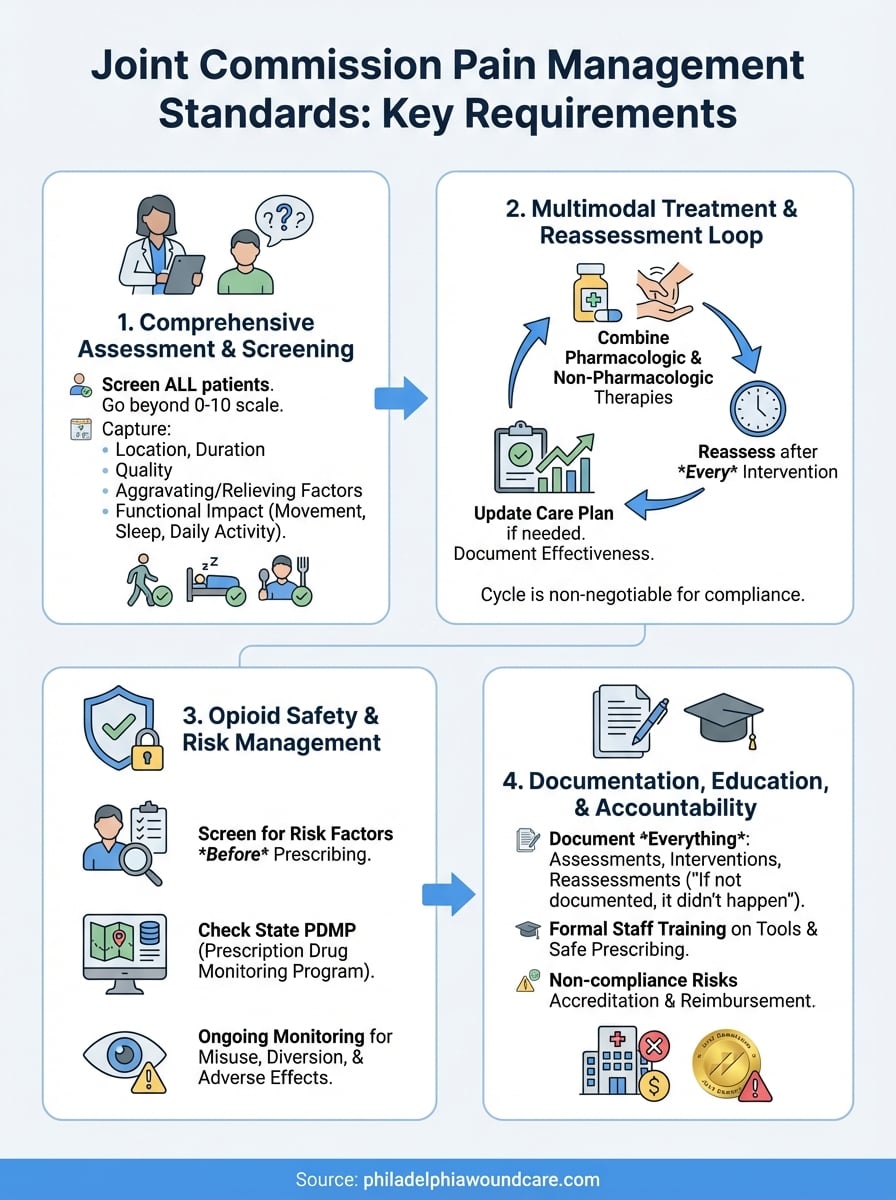
When a patient reports pain, you must conduct a comprehensive pain assessment that goes beyond a simple 0-to-10 numeric scale. The assessment needs to capture the pain’s location, duration, quality, and the factors that make it better or worse. It also needs to account for the patient’s functional status, meaning how the pain affects their ability to move, sleep, and participate in daily activities.

For patients with chronic wounds, this depth of assessment is especially important. These individuals often experience neuropathic pain, infection-related discomfort, and procedural pain during dressing changes, all of which require distinct clinical responses.
Multimodal treatment expectations
The Joint Commission does not mandate a single treatment approach. Instead, it expects organizations to use multimodal pain management strategies that combine pharmacologic and non-pharmacologic therapies. Options can include topical anesthetics, repositioning protocols, physical therapy, and when clinically appropriate, oral or injectable medications.
Your clinical team must also reassess pain after every intervention to determine whether the treatment was effective. If the pain level has not improved or the patient’s function remains unchanged, the care plan must be updated. This cycle of assess, treat, and reassess is a non-negotiable requirement for maintaining compliance and delivering quality care.
Why these standards matter for patients and staff
The Joint Commission pain management standards exist because undertreated pain carries real clinical consequences. For wound care patients specifically, uncontrolled pain slows recovery by reducing mobility, disrupting sleep, and increasing psychological stress, all of which impair tissue healing. When facilities follow the standards, patients receive consistent, documented care rather than fragmented or reactive treatment. That consistency is not just good practice; it is what separates a structured care environment from one that responds only when pain becomes a crisis.
Pain that goes unaddressed during wound care does not stay contained to comfort alone; it actively undermines the healing process.
Staff accountability and accreditation risk
For your clinical team, these standards define clear accountability at every level. Nurses, physicians, and administrators each carry specific responsibilities for ensuring pain is assessed, treated, and documented according to protocol. Failing to meet these requirements does not just affect individual patient outcomes; it puts your facility’s accreditation status at direct risk during a Joint Commission survey.
Facilities that fall short may face citations, required improvement plans, or in serious cases, loss of accreditation. That result has direct downstream effects on reimbursement eligibility and your organization’s ability to accept Medicare and Medicaid patients.
How to meet the standards in day-to-day care
Meeting the joint commission pain management standards in practice means integrating pain management into your routine clinical workflow, not treating it as a separate checklist item. Every patient encounter, from an initial wound assessment to a dressing change, should include a structured pain screen with a documented response.
Consistent documentation during routine care is what protects your facility during a survey.
Standardize your assessment process
Your team needs a repeatable assessment protocol that every clinician follows regardless of shift or setting. For wound care patients, this means using a validated pain scale appropriate to the patient’s cognitive ability and documenting both the pain score and functional impact at each visit.
- Use the same validated scale consistently across the care team
- Record the pain’s location, quality, and aggravating or relieving factors
- Document the patient’s ability to participate in wound care procedures
Close the loop on reassessment
After any pain intervention, whether pharmacologic or non-pharmacologic, your documentation must confirm that you circled back to evaluate whether it worked. If a patient still reports significant discomfort following a dressing change, update the care plan before the next visit rather than repeating the same approach.
- Document time elapsed between intervention and reassessment
- Note any change in the patient’s functional status after treatment
Opioid risk screening, monitoring, and PDMP access
The joint commission pain management standards require that any organization prescribing opioids puts structured safeguards in place before and during treatment. This means you must screen patients for opioid risk factors before initiating therapy, not after a problem surfaces.
Prescribing opioids without a documented risk assessment is a direct compliance gap that surveyors will flag during an accreditation review.
Prescription drug monitoring programs (PDMPs)
Clinicians must check their state’s PDMP before prescribing opioids to any patient. In Pennsylvania, this is a legal requirement under the state prescription monitoring program. Your prescribing physician needs to document that a PDMP query was completed, including the date and findings, as part of the medical record.

- Confirm no overlapping opioid prescriptions from other providers
- Record PDMP query results directly in the patient’s chart
Ongoing monitoring requirements
Once opioid therapy begins, your team must monitor the patient on a defined schedule that matches the clinical risk level. High-risk patients need more frequent reassessment, including documented checks for signs of misuse, diversion, or adverse effects. Adjust the opioid treatment plan whenever new risk factors surface.
- Reassess pain and function at each visit
- Screen for behavioral changes or misuse indicators
- Update the care plan when risk status changes
Documentation, education, and performance improvement
The joint commission pain management standards require more than strong bedside practice. Your organization must maintain complete, traceable documentation of every pain assessment, intervention, and reassessment to demonstrate compliance during a survey.
If it is not documented, it did not happen, and that principle applies directly to pain management records.
Staff education requirements
Your clinical staff must receive formal training on pain assessment tools and safe opioid prescribing before providing care independently. The Joint Commission expects you to record that education occurred, including the specific topics covered and the date of completion for each staff member, not just assume general competency across your team.
- Document individual training completion with dates
- Retain records in a format accessible during a survey review
- Update training whenever standards or protocols change
Performance improvement tracking
Your organization must run an active performance improvement process tied directly to pain management outcomes. Track data points such as reassessment completion rates and patient-reported pain score trends over time. When your data reveals a gap, build a documented corrective action plan with measurable targets and a scheduled follow-up review to confirm the issue is resolved before your next accreditation cycle.
Next steps for Joint Commission-ready pain care
Meeting the joint commission pain management standards starts with building consistent habits across your entire care team, not waiting until a survey cycle begins. Review your current pain assessment protocols now and identify any gaps in documentation, reassessment loops, or opioid monitoring procedures. Train staff on validated tools, confirm your PDMP query process is recorded properly, and make sure your performance improvement data connects directly to measurable outcomes.
For wound care patients in particular, unmanaged pain is a clinical barrier that delays healing and reduces cooperation with treatment. Your facility needs a clear, repeatable process that follows every patient from the first assessment through discharge.
Philadelphia Wound Care works directly with facilities and referring providers to deliver physician-led wound management that supports these compliance goals. If you’re coordinating care for a patient with a complex wound, reach out through our wound care referral page to get the process started.