

Visiting Nurse Association Philadelphia: History And Closure
For more than a century, the Visiting Nurse Association Philadelphia program stood as a cornerstone of home-based healthcare in the region. Its closure sent ripples through a community that depended on its home health and hospice services, leaving patients, families, and referring providers scrambling for alternatives.
At Philadelphia Wound Care, we witnessed that impact firsthand. Many of the patients we serve, seniors managing chronic wounds at home, in skilled nursing facilities, or in hospice, are the same population VNA once supported. The loss of such a deeply rooted organization reshaped how home-based medical care is accessed across the Philadelphia area, and it underscored the critical need for mobile physician-led services that can reach patients where they are.
This article covers the VNA’s long history in Philadelphia, the circumstances behind its shutdown, and what its absence means for patients and caregivers still seeking reliable care at home.
What the Visiting Nurse Association was
The Visiting Nurse Association of Greater Philadelphia was a nonprofit home health organization with roots stretching back to the late 1800s. It operated as a community-based healthcare provider, sending trained nurses and clinical staff directly into patients’ homes to deliver medical services that would otherwise require a clinic or hospital visit. At its peak, it ranked among the largest home health agencies in the entire region.
The VNA model was built on a straightforward premise: patients heal better in familiar surroundings, and care should come to them.
Core services it provided
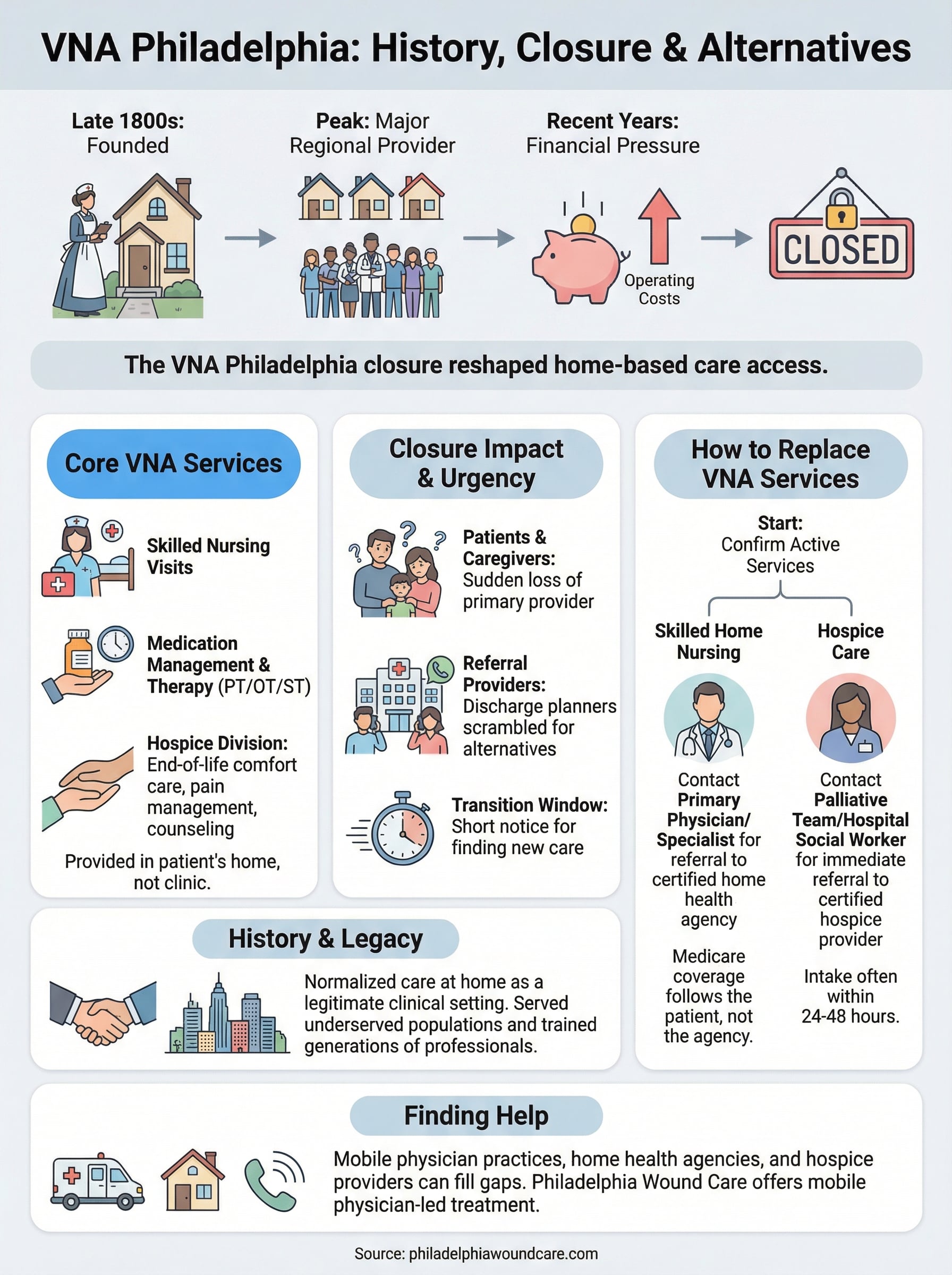
If you were a patient recovering from surgery or managing a chronic illness in Philadelphia, the visiting nurse association philadelphia program could send skilled clinicians directly to your door. Its core services included skilled nursing visits, physical and occupational therapy, and speech therapy, all delivered in the patient’s home rather than a clinic or hospital setting.
Beyond standard home health visits, the VNA operated a hospice division focused on end-of-life comfort care for patients with terminal diagnoses. Families received nursing support, pain management guidance, and coordinated emotional counseling through a dedicated care team that came to them.
Who it served
The VNA primarily served elderly patients and individuals managing complex chronic conditions, including heart failure, diabetes, and post-surgical recovery needs. Most patients carried Medicare or Medicaid coverage, which the VNA billed directly, removing financial barriers that otherwise blocked lower-income seniors from accessing professional care at home.
Referring physicians, hospital discharge planners, and social workers across Philadelphia regularly used the VNA as a trusted post-acute resource. Facility administrators at skilled nursing and assisted living communities also relied on it to fill clinical coverage gaps for residents whose care needs continued to grow.
Why people searched for VNA Philadelphia
When the VNA announced its closure, search traffic for the visiting nurse association philadelphia spiked. People were not browsing out of curiosity. They were actively trying to reach a provider they had appointments scheduled with, or confirm whether a loved one’s scheduled visits would continue.
For many patients, the VNA was not a backup option. It was the primary point of contact for skilled nursing and home hospice care.
Patients and caregivers looking for continuity
If you or someone you care for relied on regular nursing or hospice visits through the VNA, the closure forced an immediate decision. You needed a replacement provider, and you needed one fast.
Most of these searches carried real urgency behind them: active care plans suddenly without a provider, families trying to understand what Medicare would still cover, and patients mid-treatment with nowhere to turn.
Discharge planners and referring providers
Hospital case managers and social workers across Philadelphia also drove a large share of these searches. When a trusted post-acute partner shuts down, every discharge plan that referenced it becomes a problem you have to solve before the patient leaves the building.
These professionals searched for updated service status and alternative referral options so care transitions could still happen safely and on schedule.
How to replace VNA home health and hospice
When a provider like the visiting nurse association philadelphia closes, finding a replacement takes time you may not have. The good news is that several types of organizations can fill different parts of what the VNA offered, depending on what your specific care plan requires.
Start by confirming exactly which services were active so you can match them to the right replacement provider.
For skilled home nursing
If your care plan included regular skilled nursing visits for wound care, medication management, or post-surgical recovery, your first call should go to your primary care physician or specialist. They can issue a new referral to a certified home health agency that accepts your insurance.
Medicare’s home health coverage follows the patient, not the agency. Switching providers does not reset your eligibility or interrupt covered services as long as you remain homebound and medically qualified.
For hospice care
Replacing active hospice services requires moving quickly. Contact your patient’s palliative care team or hospital social worker and ask for an immediate referral to a Medicare-certified hospice provider in the Philadelphia area. Most certified hospices can complete an intake evaluation within 24 to 48 hours.
History and legacy in Philadelphia
The visiting nurse association philadelphia traces its origins to the late 19th century, when public health reformers began pushing for nurse-led care in low-income urban neighborhoods. What started as a response to poverty and infectious disease grew into a formally structured nonprofit that survived two world wars, the Great Depression, and multiple waves of healthcare reform.

Few healthcare organizations in Philadelphia managed to remain relevant across so many different eras of medicine.
A model built around access
For decades, the VNA operated on a mission-driven funding model that prioritized underserved populations, not just patients who could pay. It accepted Medicare, Medicaid, and sliding-scale arrangements, which made it a safety net provider as much as a clinical one. That positioning gave it staying power in communities where other home health agencies could not or would not operate.
What it left behind
The VNA’s lasting contribution to Philadelphia healthcare was normalizing the concept of care at home as a legitimate clinical setting, not a fallback option. It trained generations of home health professionals and built referral relationships across the region’s hospitals, clinics, and social service agencies that took decades to establish.
What we know about the closure and timeline
The visiting nurse association philadelphia did not shut down overnight. The organization had been under significant financial strain for years before its closure became public, a pattern that affected nonprofit home health agencies across the country as reimbursement rates tightened and operating costs climbed.
Nonprofit home health agencies nationwide have faced mounting pressure from shrinking Medicare reimbursements and rising staffing costs, and the VNA was not immune to those forces.
The financial pressure behind the decision
By the time the closure was announced, the VNA had been operating with a funding model that no longer covered its cost structure. Reduced Medicare reimbursement rates combined with workforce shortages made sustaining the organization’s scale increasingly difficult.
Several similar home health agencies across Pennsylvania faced comparable outcomes during the same period, signaling a broader industry shift rather than an isolated local failure.
What the timeline meant for patients
If you had active care plans through the VNA when the closure was announced, the transition window was short. Patients and families received notification, but the urgency to find replacement providers fell largely on caregivers and hospital discharge teams rather than on any coordinated transition system.
Your best path forward was contacting your referring physician or hospital social worker immediately to avoid any gap in covered services.
Quick recap and where to get help
The visiting nurse association philadelphia served this region for over a century before financial pressures forced its closure. It provided skilled nursing, therapy, and hospice services to thousands of patients who depended on care delivered directly to their homes. Its loss left a real gap for elderly and mobility-limited patients who had no easy path to a clinic or hospital.
Your options for replacing those services depend on what your care plan required. Home health agencies, hospice providers, and mobile physician practices can each cover a portion of what the VNA once offered, and Medicare coverage follows you to any certified provider.
If your care needs include chronic or non-healing wounds, Philadelphia Wound Care brings physician-led treatment directly to you at home, in a skilled nursing facility, or in hospice. You can request mobile wound care in Philadelphia or reach out to our team directly to discuss your situation.