

ICD-10 Code for Necrotic Tissue: Choosing the Right Dx
There is no single ICD-10 code for necrotic tissue that applies across the board. The correct diagnosis code depends on the type of necrosis, its anatomical location, and the underlying cause, and picking the wrong one can trigger claim denials, delayed reimbursements, or compliance flags. For clinicians and coders working with complex wound cases, precision here isn’t optional.
At Philadelphia Wound Care, our physician-led mobile practice treats necrotic wounds daily, diabetic ulcers with eschar, pressure injuries with slough, post-surgical sites that have broken down. We see firsthand how accurate documentation at the bedside directly affects the coding that follows. A vague or mismatched diagnosis code doesn’t just create a billing problem; it can obscure the clinical picture and compromise continuity of care across providers.
This article breaks down the primary ICD-10-CM codes associated with tissue necrosis, from skin necrosis (I96) to osteonecrosis (M87 series) to necrotizing soft tissue infections (M72.6). We’ll walk through how to differentiate between them, when to use combination coding, and what documentation details coders need from the clinical team to assign the most accurate code the first time.
Why choosing the right code matters
Diagnosis codes are not just administrative labels. When you assign the wrong ICD-10 code for necrotic tissue, that error ripples through every downstream process: payer adjudication, prior authorizations, quality reporting, and clinical handoffs. For mobile wound care practices and facility-based providers alike, a mismatched code is often the first thing a payer’s algorithm flags for review. Getting it right the first time is the most efficient path through the billing cycle.
Claim Denials and Delayed Reimbursement
Payers match your diagnosis code against the procedure codes on the same claim. If you bill a debridement procedure using a code that doesn’t align with an active, documented wound diagnosis, the claim will likely reject automatically. Medicare and commercial payers use code-editing software that checks for clinical logic, so a necrosis code tied to the wrong anatomical site or wrong pathological category can trigger an edit before a human reviewer ever sees the file.
This matters more than it might seem. Reworking a denied claim takes time and staff resources, and repeat denials on the same account can signal to payers that documentation practices need scrutiny. That scrutiny often leads to pre-payment review, which slows down every claim from that provider, not just the ones with errors. In a mobile practice that bills across multiple payers, that slowdown compounds quickly.
A single miscoded necrosis diagnosis can shift an entire claim into a higher-risk category, prompting a payer to request medical records before releasing payment.
Audit Exposure and Compliance Risk
Recovery Audit Contractors (RACs) and other post-payment review bodies look for patterns. If your practice consistently uses a broad or nonspecific code when the clinical notes clearly describe gangrene or osteonecrosis, that gap becomes a target. Improper payment recovery is a real consequence for providers who cannot demonstrate that their diagnosis codes match what the documentation actually says.
You don’t need to be the target of a formal audit to feel the impact. Internal compliance reviews and payer-initiated post-payment audits can disrupt cash flow and require significant administrative time to resolve. For small or mid-sized practices, a focused audit on wound care claims can freeze reimbursement on a meaningful portion of the revenue cycle for weeks. Using the most specific, accurate ICD-10 code from the start is the most direct way to reduce that exposure before it becomes a problem.
Specificity also matters for medical necessity documentation. Payers require that the diagnosis code you assign actually supports the treatment rendered. A general or vague necrosis code may not meet the threshold for advanced therapies like allograft application, even when the clinical notes clearly justify that treatment. Coding precision protects both the claim and the patient’s access to the care they need.
How Coding Accuracy Affects the Patient’s Care Team
Accurate coding does more than protect revenue. When a patient moves from a hospital to a skilled nursing facility or receives mobile wound care at home, care team members across different settings rely on diagnosis codes in shared records to understand what they are treating. A vague or incorrect code can lead a subsequent provider to underestimate the wound’s severity or miss the underlying cause entirely.
Referring physicians, facility nurses, and case managers all use structured data, including ICD-10 codes, as shorthand for clinical status. When those codes are accurate and specific, the picture they paint is clear. When they are not, gaps open up in the plan of care that can delay treatment decisions or result in duplicated testing that adds cost and confusion.
For practices coordinating care across multiple environments, from private residences to skilled nursing facilities to assisted living communities, this accuracy is foundational. The clinician who documented the wound and assigned the code at the point of care is setting the terms for how every provider who follows will understand that patient’s condition. A precise ICD-10 code for necrotic tissue isn’t just a billing requirement; it is a communication tool that keeps the entire care team aligned on what they are managing and why.
What clinicians mean by necrotic tissue
Before you can assign the correct ICD-10 code for necrotic tissue, you need a clear picture of what clinicians are actually describing when they document necrosis. Necrosis is the premature death of cells or tissues in a living organism, caused by factors like inadequate blood supply, infection, trauma, or toxin exposure. It is distinct from apoptosis, which is the body’s controlled and programmed cell death process. When necrosis occurs in a wound, the affected tissue can no longer be salvaged, and its presence actively impedes the healing of the surrounding tissue that remains viable.
The Biology Behind Tissue Death
Understanding what drives necrosis helps you match the clinical narrative to the right code. Ischemia is the most common driver in the wound care population, particularly among elderly patients with diabetes or peripheral vascular disease. When tissue is deprived of oxygen long enough, cells begin to die in an uncontrolled way, triggering an inflammatory response and structural breakdown. The result is dead tissue that the body cannot reabsorb efficiently, which is why clinical removal through debridement is so frequently required and documented in the notes you are coding from.
Other causes include bacterial infection that overwhelms local defenses, sustained mechanical pressure such as in pressure injuries, and chemical or thermal damage. Each of these causes produces necrosis, but the underlying mechanism shapes both the clinical presentation and the appropriate diagnosis code category you will ultimately select. Recognizing cause from the note is not optional; it is the first step in accurate code selection.
The cause of necrosis is not just a clinical detail; it is the deciding factor between entirely different ICD-10 code families.
How Necrosis Presents in a Wound
Clinicians use specific descriptive terms that translate directly into coding decisions. Eschar refers to dry, hard, leathery black or brown tissue, typically a product of dry gangrene or ischemic necrosis. Slough describes soft, wet, yellow or tan tissue that has lost its structural integrity and sits loosely in the wound bed. Both represent necrosis, but their presentations reflect different pathological processes, and a well-written clinical note will distinguish between them.
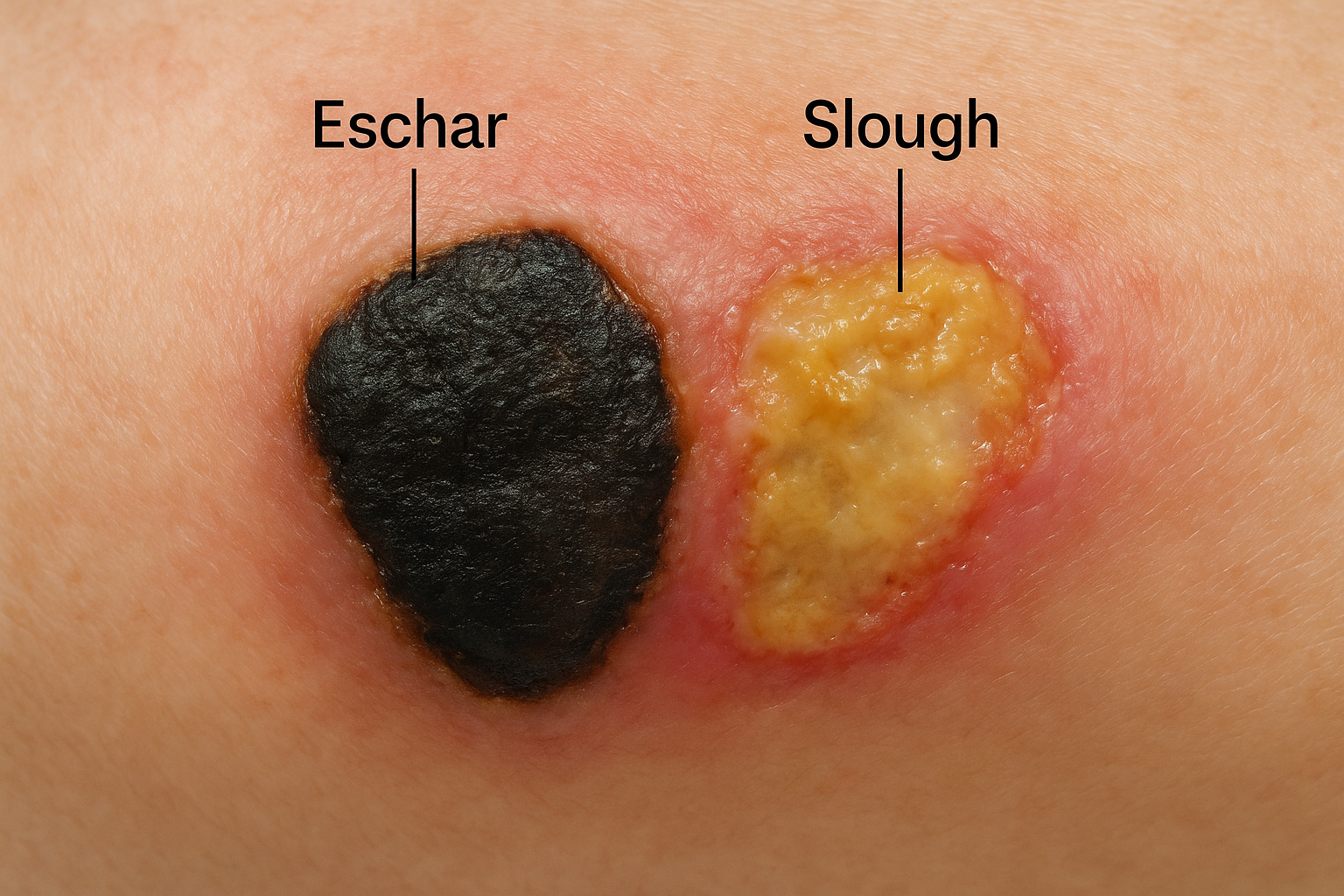
When you review documentation, look for these terms alongside location and depth descriptors. A note that captures "dry eschar on the plantar surface of the right heel" gives you very different coding guidance than one that says "wet, malodorous slough over the sacrum with signs of local infection." The tissue character, anatomical location, and any documented infection or vascular compromise are all details that push you toward one code and away from another. Your job as the coder is to extract that precision from the clinical record and apply it accurately to the claim.
The main ICD-10 codes used for necrosis
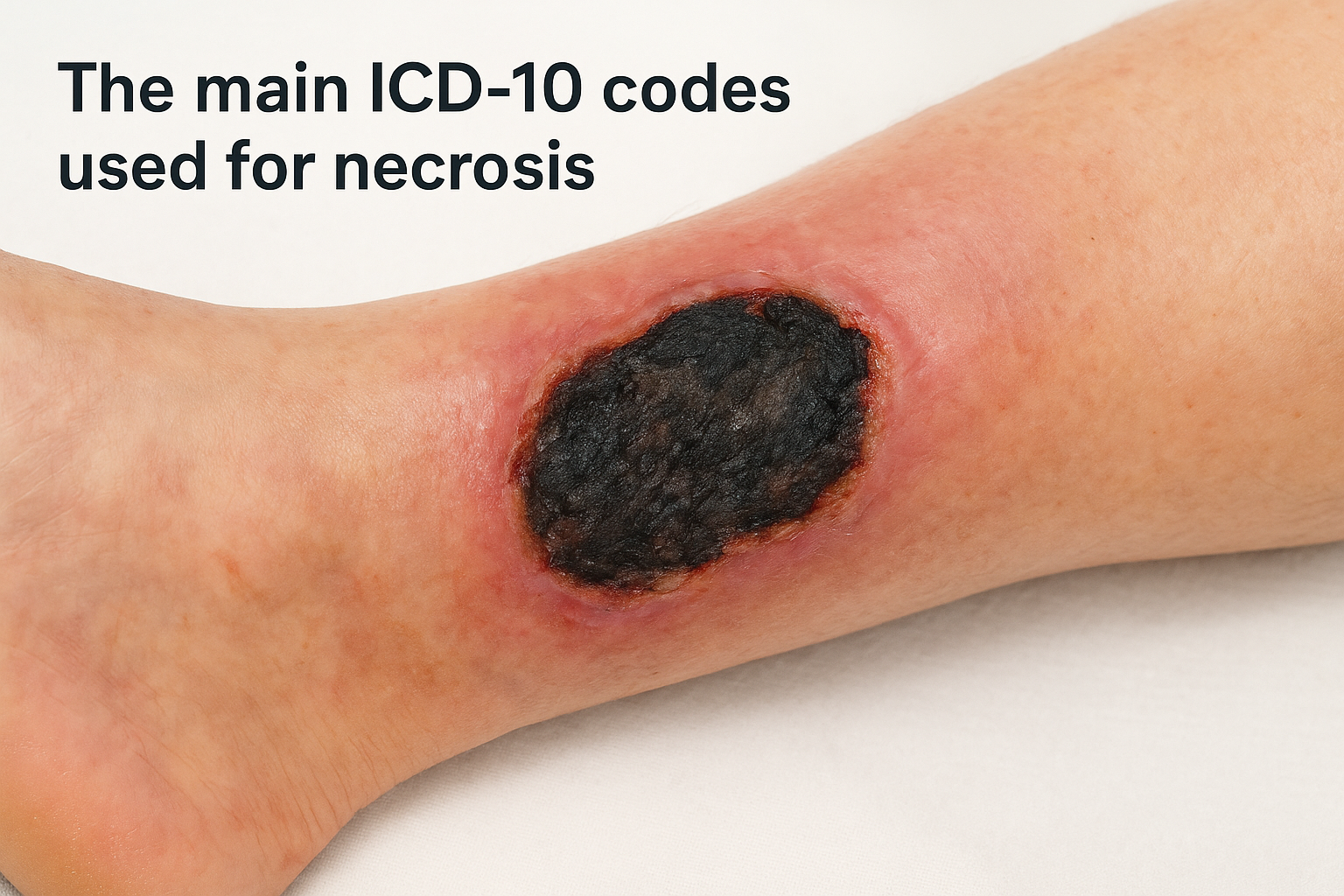
The ICD-10-CM system does not group all necrosis under a single umbrella. It distributes necrosis-related diagnoses across multiple code families based on tissue type, underlying cause, and anatomical location. When you are selecting an icd-10 code for necrotic tissue, your first task is identifying which code family applies, and that decision flows directly from what the clinical note documents about the wound’s nature, depth, and origin.
I96: Gangrene, Not Elsewhere Classified
I96 applies when the documentation explicitly names gangrene of the skin or soft tissue and no more specific code in the classification better captures the clinical picture. This code covers dry gangrene, wet gangrene, and gas gangrene in scenarios where the underlying pathology does not redirect the assignment to another code family. Because I96 is a relatively broad code, the clinical note needs to name gangrene directly rather than simply describe necrotic-appearing tissue such as eschar, dark discoloration, or slough without a clear clinical label attached.
Assign I96 only when the clinician explicitly documents gangrene; do not infer the diagnosis from wound appearance alone.
M87: Osteonecrosis
When necrosis extends to bone tissue, the M87 code family takes over from the soft tissue categories. This series organizes codes by etiology, with separate entries for drug-induced osteonecrosis (M87.1), traumatic osteonecrosis (M87.2), and other secondary osteonecrosis (M87.3), among others. Each subcategory then breaks down further by anatomical site, so the documentation must identify both the cause and the location before you can reach the most specific available code.
If the note identifies osteonecrosis without naming a cause, you assign M87.00 or the appropriate site-specific idiopathic variant. Always check whether the record links bone involvement to a drug, trauma, or systemic condition, because that distinction moves you to a completely different subcategory and carries significant weight during payer review or audit.
M72.6: Necrotizing Fasciitis
M72.6 covers necrotizing fasciitis, a rapidly progressing infection that destroys the fascia and the soft tissue surrounding it. This is clinically and procedurally distinct from localized wound necrosis, and the code requires the clinician to explicitly document a necrotizing infection rather than simply describe extensive tissue loss. You will frequently pair M72.6 with additional organism identification codes from category B95 or B96, because payers and quality reporting programs expect the full infectious picture when you are billing for this level of severity.
Necrosis Within Ulcer Codes
Pressure injuries and chronic lower limb ulcers carry built-in necrosis indicators within the L89 and L97 code families. A pressure injury in the L89 series can reflect full-thickness tissue loss with visible necrotic involvement through its character-level specificity, and L97 codes for non-pressure chronic ulcers include subcategories that specify necrosis of muscle or bone. In most cases these combination codes eliminate the need to attach a separate necrosis diagnosis to the ulcer claim, which reduces the claim’s complexity and lowers your exposure to code-edit rejections.
How to pick the best code from the note
Selecting the most accurate ICD-10 code for necrotic tissue is a sequential process, not a guessing exercise. You work through the clinical documentation in a specific order: tissue type and cause first, then anatomical location, then the available level of specificity. Skipping a step or jumping straight to a familiar code based on general impression increases your risk of a mismatch between the diagnosis you assign and the treatment the clinician actually documented.
Start with the Tissue Type and Cause
The first question you ask when reading the note is whether the clinician explicitly named a diagnosis or described a wound presentation. Those two scenarios lead to different starting points. If the provider wrote "gangrene of the right foot," you move toward I96 or a condition-specific gangrene code and work from there. If the provider described wound appearance without naming a diagnosis, such as "dry eschar with undermining on the plantar heel," you need to infer the underlying pathology from the full note before you assign anything.

Never code from appearance alone; the clinical interpretation belongs to the provider, and your job is to translate that interpretation accurately.
Look at the history of present illness and the assessment sections together. A note that describes dark, dry tissue on a diabetic patient with documented peripheral arterial disease gives you context that eschar on healthy tissue in a post-surgical patient does not. The cause of the tissue death, whether vascular, infectious, pressure-related, or trauma-related, determines which code family you enter.
Confirm the Anatomical Site
Once you have identified the cause and tissue type, anatomical specificity becomes your next filter. Many necrosis-related code families, including M87 for osteonecrosis and the L97 series for chronic lower limb ulcers, require a site-specific character or subcategory. If the note documents left tibial osteonecrosis due to prior trauma, you need both the correct M87.2 subcategory and the correct laterality character to build the complete code.
Always verify that the location the coder assumes matches the location the clinician documented. A note that says "heel wound" without specifying left or right forces you to query the provider rather than assign a default. Laterality errors are a common and preventable source of claim edits.
Apply the Specificity Hierarchy
After you have confirmed tissue type, cause, and location, your final step is selecting the most specific code the documentation supports. ICD-10-CM rewards specificity, and payers expect it. If the note gives you enough detail to reach a fifth or sixth character, you use it. Staying at a less specific code when the documentation clearly supports more detail is an error even when the broader code is technically valid.
Check whether the clinical picture supports a combination code within the ulcer families before you stack separate necrosis codes onto a claim. One well-matched combination code is cleaner, more defensible, and less likely to trigger an edit than two separate codes that payers have to reconcile against each other.
Documentation checklist for clean claims
Clean claims start with thorough clinical notes, not with the coder. When the documentation captures the right details at the point of care, the process of selecting the correct icd-10 code for necrotic tissue becomes straightforward. When it does not, the coder is left choosing between submitting a vague code and delaying the claim to send a provider query. Neither option is efficient, and both are avoidable with a consistent documentation standard applied before the note is finalized.
What the clinical note must include
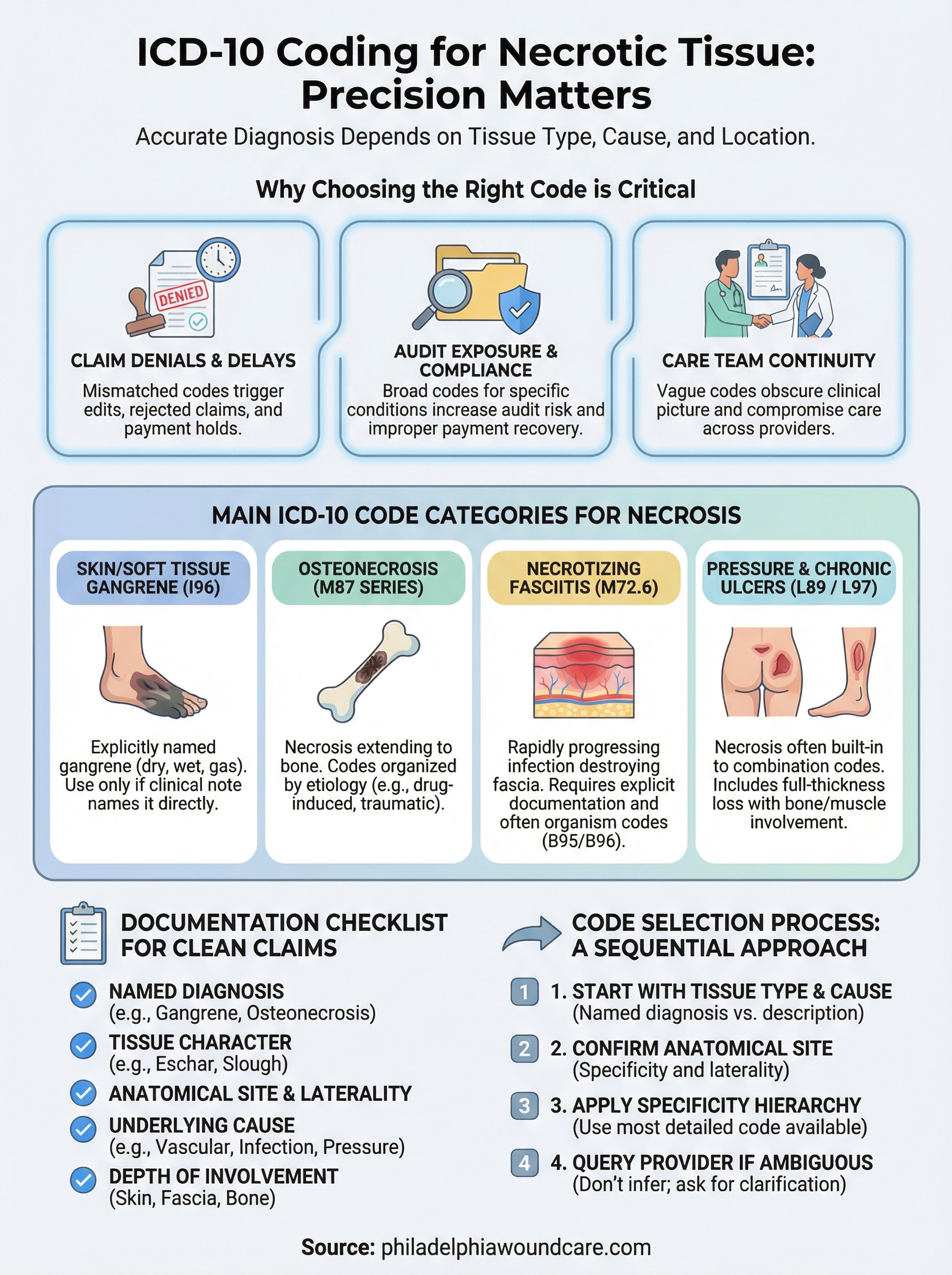
Every wound note that involves necrotic tissue should give the coder five specific data points: the named diagnosis or explicit clinical interpretation, the tissue type and character, the anatomical location with laterality, the underlying cause or contributing conditions, and the depth of involvement. When all five are present, the coder has what they need to reach the most specific available code without guessing or querying.
A note that describes the wound without providing the provider’s clinical interpretation leaves the coder unable to assign a code the claim can defend.
Use this checklist to confirm your documentation is complete before the note closes:
- Named diagnosis: The provider has written the clinical conclusion, such as gangrene, osteonecrosis, or necrotizing fasciitis, rather than leaving only a wound description.
- Tissue character: The note specifies eschar, slough, or another descriptor that confirms the necrotic presentation.
- Anatomical location and laterality: The site is identified with enough precision to reach a site-specific code, including left or right where the code family requires it.
- Underlying cause: The note links the necrosis to a vascular, infectious, pressure-related, or other documented etiology.
- Depth of involvement: The documentation indicates whether the necrosis involves skin, soft tissue, fascia, or bone, since depth determines which code family applies.
When to query the provider
Send a provider query any time the note leaves a required element ambiguous or absent. Common triggers include a wound description without a named diagnosis, a bilateral presentation with no indication of which side is being treated, and tissue involvement that suggests bone exposure without an explicit osteonecrosis diagnosis. A structured query resolves the gap without requiring the coder to infer clinical conclusions that belong to the provider.
Your query should be specific and closed-ended where possible, asking the provider to confirm or clarify a detail rather than asking them to rewrite the note. Documenting the query and the provider’s response in the record protects the claim during any subsequent audit and keeps the coding rationale transparent for any reviewer who examines the file later.
Common scenarios and coding examples
Reviewing real-world cases is the fastest way to internalize how the code selection process works in practice. The scenarios below reflect the types of wounds Philadelphia Wound Care encounters in mobile settings, and each one illustrates how the clinical details in a note drive you toward a specific code or code combination.
Diabetic Patient with Dry Eschar on the Plantar Heel
A physician visits a 74-year-old patient with type 2 diabetes and documented peripheral arterial disease. The note describes dry, hard black eschar covering the plantar surface of the right heel with no signs of active infection. The provider’s assessment reads "ischemic necrosis, right heel, in the setting of peripheral artery disease."
You have everything you need here. The clinician named ischemic necrosis, identified the site with laterality, and linked it to a vascular etiology. The correct primary code is L97.419, a non-pressure chronic ulcer of the right heel and midfoot with necrosis of bone, if bone involvement is confirmed, or L97.411 for limited-thickness skin loss. Pair that with E11.51 for type 2 diabetes with diabetic peripheral angiopathy without gangrene, and the claim reflects the full clinical picture.
When the provider names ischemic necrosis over a vascular-diseased heel, the L97 series with a necrosis character is almost always the right starting point.
Pressure Injury at Stage 4 with Exposed Bone
A resident at a skilled nursing facility presents with a stage 4 pressure injury over the sacrum. The wound note documents full-thickness tissue loss with visible and palpable bone at the wound base. The provider documents "stage 4 pressure ulcer, sacral region, with exposed bone and surrounding necrotic tissue."
Your primary code is L89.154, which captures stage 4 pressure ulcer of the sacral region. Because L89.154 already incorporates full-thickness tissue loss with bone involvement, you do not add a separate necrosis code. You avoid stacking an additional diagnosis that the ulcer code already accounts for, keeping the claim clean and reducing your edit risk.
Necrotizing Fasciitis After an Abdominal Procedure
A post-surgical patient develops spreading erythema, crepitus, and necrotic soft tissue at the abdominal incision site. The surgeon documents "necrotizing fasciitis of the abdominal wall, polymicrobial infection confirmed by intraoperative culture."
Assign M72.6 as the primary diagnosis for necrotizing fasciitis. Because the note confirms a polymicrobial infectious etiology, you add organism codes from categories B95 and B96 to identify the pathogens involved. The combination of M72.6 with specific organism codes satisfies both payer requirements and quality reporting expectations for this level of severity. Selecting the correct icd-10 code for necrotic tissue in this scenario requires reading the culture results documented in the operative note, not just the admission summary, to confirm which organisms appear and which secondary codes apply.
Next steps
Selecting the right icd-10 code for necrotic tissue comes down to one habit: reading the full clinical note before you touch a code set. Your accuracy depends on what the provider documented, and the provider’s documentation depends on capturing the cause, tissue type, location, and depth every time a wound is assessed. When those elements are present, the coding process is direct and the claim is defensible.
If you are a clinician, case manager, or facility administrator in the Philadelphia area dealing with complex necrotic wounds that are difficult to manage in place, specialized mobile care changes the equation. Philadelphia Wound Care brings physician-led wound evaluation and advanced treatment directly to your patient’s setting, with documentation built to support clean claims and coordinated follow-up. Reach out through our mobile wound care services page to learn how we can support your patients or your facility.