
Temple Health Wound Care: Services, Locations, And Options
If you’re searching for temple health wound care, you’re likely dealing with a chronic or complex wound that needs specialist attention, and you want to know exactly what’s available to you in Philadelphia. Temple Health operates one of the region’s established wound care programs, offering treatments like hyperbaric oxygen therapy and multidisciplinary wound management at its Episcopal Campus and other locations.
At Philadelphia Wound Care, we work alongside health systems like Temple Health as part of the broader wound care network in this region. Our physician-led mobile practice brings advanced wound treatments directly to patients at home, in skilled nursing facilities, and in hospice settings, often serving the same population that Temple’s clinics treat. We understand the options because we operate within the same referral ecosystem every day.
This article breaks down Temple Health’s wound care services, locations, treatment options, and what to expect as a patient. We’ll also cover how mobile wound care fits into the picture for patients who face barriers getting to a clinic. Whether you’re a patient, a caregiver, or a case manager weighing referral options, this guide gives you the practical details you need to make an informed decision.
What Temple Health wound care covers
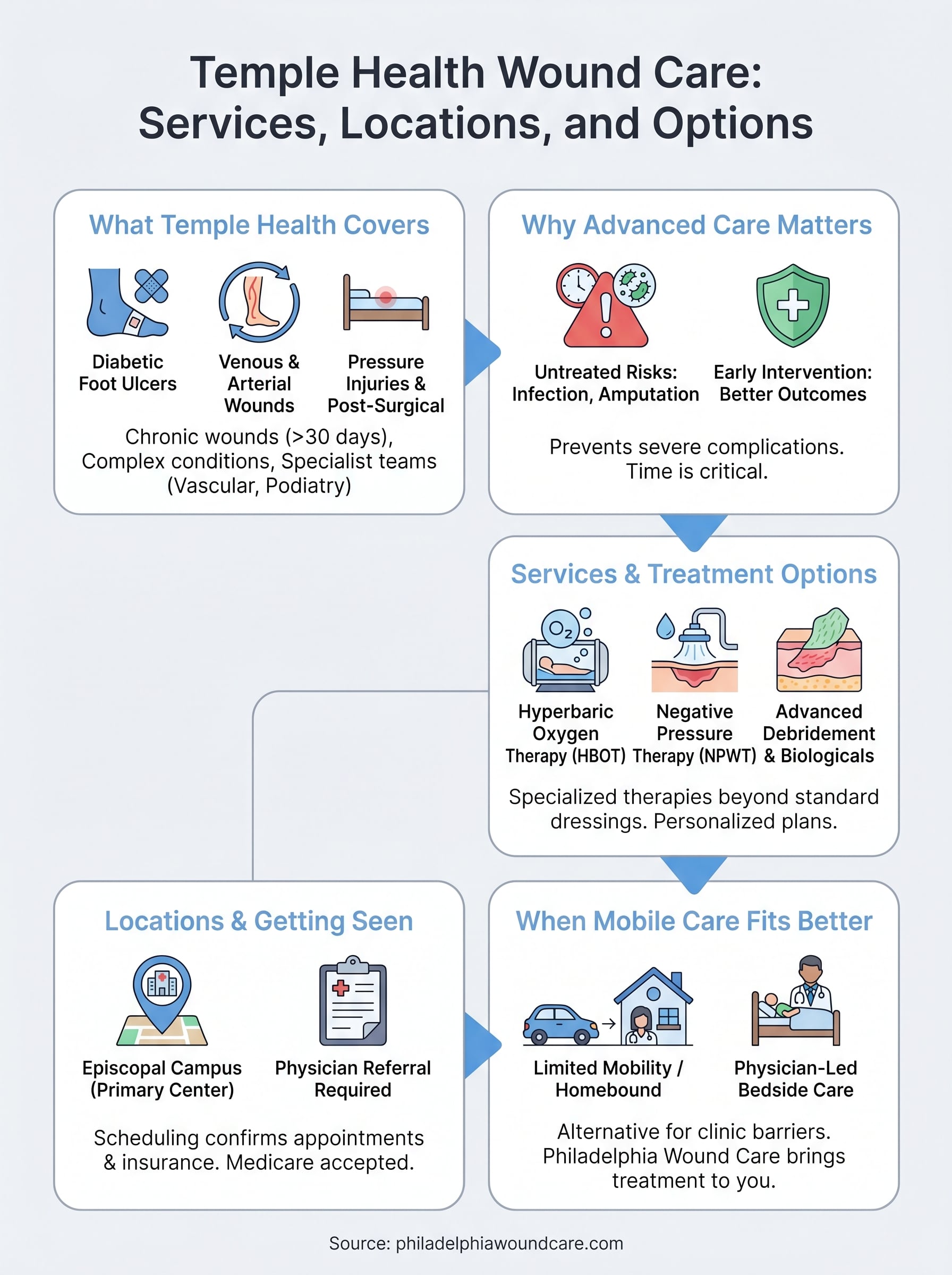
Temple Health wound care focuses on wounds that have not responded to standard treatment, typically those present for more than 30 days or those complicated by an underlying condition like diabetes or vascular disease. The program is designed for patients who need more than a primary care provider can offer, and it brings together wound care specialists, vascular surgeons, and podiatrists under one clinical umbrella to address complex cases.
Wound types the program addresses
The program treats a range of chronic and acute wound types that require specialist-level intervention. You can expect the clinical team to evaluate the wound’s underlying cause before recommending a treatment path, since the same wound in two different patients may need two entirely different approaches depending on circulation, infection status, and tissue viability.
Common wound types treated include:
- Diabetic foot ulcers and lower-extremity wounds
- Venous stasis ulcers caused by poor circulation in the legs
- Pressure injuries (also called bedsores or decubitus ulcers)
- Post-surgical wounds with delayed or complicated healing
- Traumatic wounds that fail to close on their own
Therapies available at Temple Health
One of the program’s notable offerings is hyperbaric oxygen therapy (HBOT), a treatment where you breathe pure oxygen inside a pressurized chamber. This increases oxygen delivery to damaged tissue, which can stimulate healing in wounds where blood supply is compromised. Not every patient qualifies for HBOT, but Medicare covers it for specific wound types like diabetic foot ulcers that meet clinical criteria.
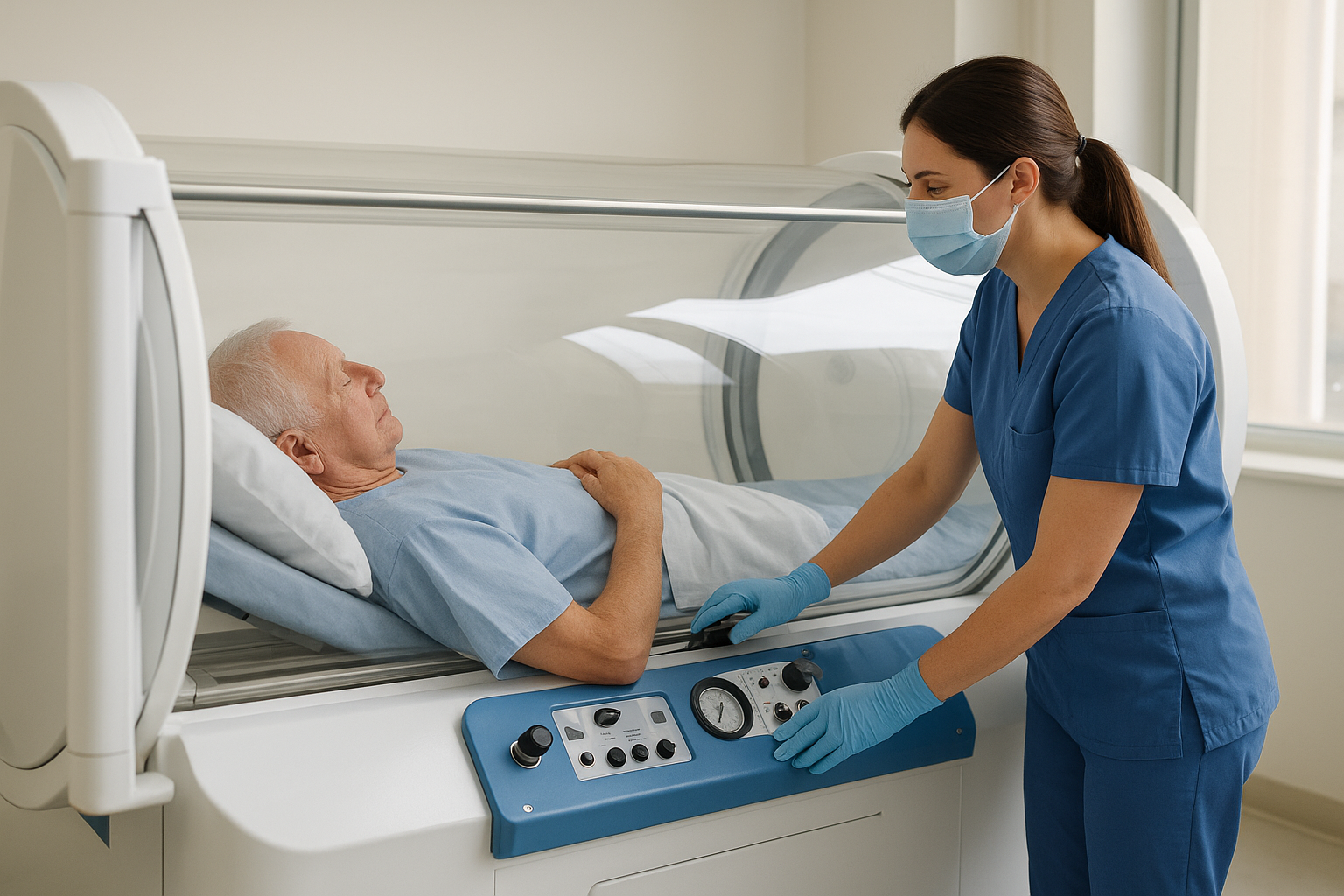
Hyperbaric oxygen therapy is only effective when it’s used alongside proper wound debridement, infection control, and offloading, not as a standalone fix.
The program also uses advanced debridement techniques, bioengineered skin substitutes, and compression therapy depending on what your wound requires.
Why advanced wound care matters
A wound that stays open for weeks or months is not just a skin problem. Chronic wounds create a continuous infection risk, and in patients with diabetes or vascular disease, a single unmanaged ulcer can progress to deep tissue damage, bone infection (osteomyelitis), or in severe cases, amputation. Getting into a structured program like temple health wound care or a comparable specialist service early changes what’s possible for your recovery.
The longer a chronic wound stays untreated by a specialist, the narrower your treatment options become and the higher your risk of serious complications.
What happens when wounds go untreated
Delayed treatment leads to biofilm formation, a layer of bacteria that becomes resistant to standard antibiotics and blocks healing at the tissue level. Your body cannot break this cycle without clinical intervention, and that means debridement, targeted dressings, and in some cases systemic treatment to clear the infection and restart the wound healing process.
Who needs specialist-level care
You need specialist involvement when a wound has not improved after four weeks of basic wound care, when you notice signs of spreading redness or odor, or when an underlying condition like peripheral artery disease or uncontrolled diabetes is likely slowing tissue repair. Primary care alone is rarely enough at that stage.
Temple Health services and treatment options
Temple Health wound care programs combine clinic-based evaluation with a range of treatments that go well beyond standard wound dressings. The clinical team builds a treatment plan specific to your wound type, factoring in your underlying conditions, circulation status, and how the wound has responded to any prior care.
What separates a wound care program from a general practitioner is the depth of tools available, not just the expertise.
Specialized therapies on offer
Beyond hyperbaric oxygen therapy, the program provides negative pressure wound therapy (NPWT), which uses controlled suction to pull fluid from the wound bed and promote tissue growth. Your care team can also apply cellular and tissue-based products, including skin grafts and biological dressings that are engineered to replace damaged tissue layers. Compression systems for venous ulcers and vascular assessments for arterial disease round out the treatment toolkit.
Each of these therapies requires careful patient selection based on your wound type, health history, and current circulation status. Your provider will run vascular studies or imaging before recommending HBOT or surgical debridement, confirming the treatment matches your clinical picture before moving forward.
Locations and how to get seen at Temple Health
Temple Health’s primary wound care center operates at the Episcopal Campus, located at 100 East Lehigh Avenue in North Philadelphia. This is the main site where you’ll find the full range of wound care services, including hyperbaric oxygen therapy and specialist consultations. Temple Health also operates additional outpatient locations across the region, so your access point may depend on where you live and what your referring provider recommends.

How the referral process works
Getting into temple health wound care typically starts with a physician referral from your primary care doctor, a hospital discharge team, or a specialist already managing your underlying condition. Once your referral is submitted, the scheduling team will contact you to confirm your appointment and verify insurance coverage before your first visit.
Bring your current medications list, wound photos, and any prior treatment notes to your first appointment to speed up the intake process.
Medicare and most major insurance plans are accepted at Temple Health wound care locations, which covers most patients in the Philadelphia region who need advanced wound treatment. Your referring provider can submit the referral directly, and same-week appointments are sometimes available for patients with urgent or rapidly worsening wounds.
When another option may fit better in Philadelphia
Temple health wound care at the Episcopal Campus is a strong choice if you can get to a clinic regularly, but not every patient in Philadelphia can. If you have limited mobility, a recent hospital discharge, or live in a skilled nursing facility, traveling to a wound care center for repeat appointments may not be realistic. In those cases, a clinic-based model creates friction that can delay treatment and interrupt the consistent follow-up that wounds require.
Consistent, frequent wound care is what drives healing. If getting to a clinic is a barrier, that consistency breaks down fast.
What mobile wound care offers instead
Philadelphia Wound Care brings physician-led wound evaluations and advanced treatments directly to your location, whether that’s your home, a nursing facility, or a hospice setting. A board-certified General Surgeon performs the assessment and manages your care plan on-site, so you get the same clinical depth as a hospital-based program without the travel. Treatments like allograft therapy and advanced dressings are available bedside, and Medicare Part B covers eligible services. If a clinic visit simply does not work for your situation, mobile care keeps your treatment on schedule without compromising the quality of care you receive.
What to do next
If you’re comparing options like temple health wound care at the Episcopal Campus with mobile services closer to home, the right choice depends on what your situation actually allows. Both paths provide specialist-level wound management, but one requires you to travel and one comes directly to you.
Start by talking to your primary care provider or discharge planner about a referral. If your wound is complex and you can make regular clinic visits, Temple Health is a solid destination. If mobility, transportation, or facility placement makes that unrealistic, Philadelphia Wound Care delivers the same level of physician-led treatment at your bedside.
You don’t need to figure this out alone. Request mobile wound care in Philadelphia to get a physician evaluation without leaving your home or facility. Same-week appointments are available for urgent cases, and Medicare Part B covers eligible treatments, so cost does not have to stand between you and the care your wound needs.