

Wound Care Solutions for SNF: Bedside Programs That Work
Chronic wounds affect a significant portion of skilled nursing facility residents, and when those wounds stall or worsen, the consequences hit hard, prolonged suffering for patients, increased readmission risk, and mounting operational pressure on staff. Finding effective wound care solutions for SNF settings means looking beyond routine dressing changes and toward structured bedside programs led by physicians who specialize in complex wound management.
The challenge most facilities face isn’t a lack of effort. It’s a gap in access. Advanced treatments like allograft therapy and regenerative interventions often seem out of reach outside hospital walls. At Philadelphia Wound Care, we close that gap by bringing physician-led mobile wound care directly to SNF residents, performing specialist evaluations and treatments at the bedside, coordinating with facility staff, and billing through Medicare and major insurance so cost doesn’t become another barrier.
This article breaks down what makes a wound care program actually work inside a skilled nursing facility, from the clinical components that drive healing outcomes to the operational structure that reduces rehospitalizations. If you manage or refer patients within an SNF, this is the practical framework worth reading.
What wound care solutions for SNFs include
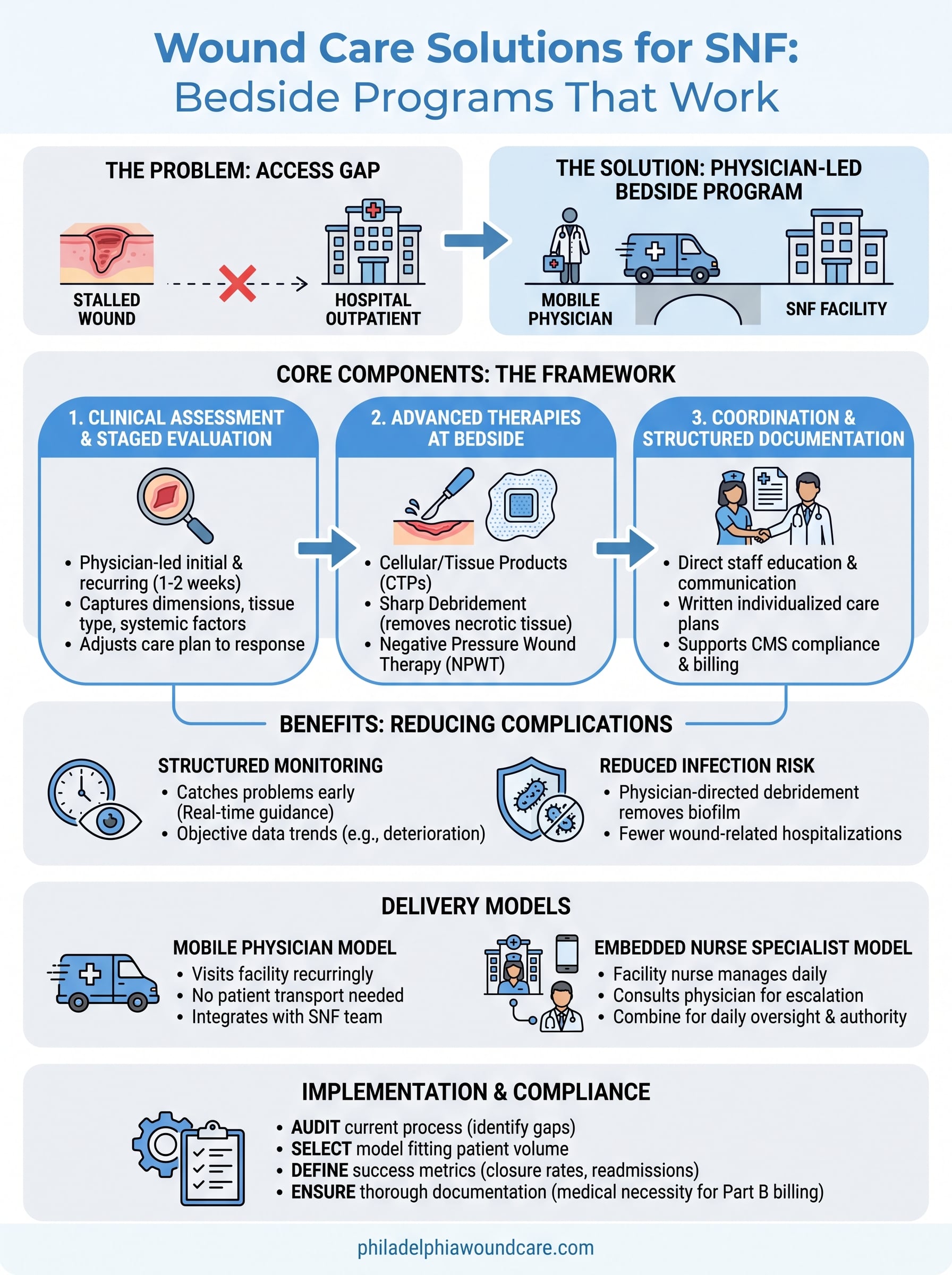
A complete wound care program inside a skilled nursing facility covers far more than changing dressings on a schedule. Effective wound care solutions for SNF settings combine clinical assessment, advanced treatment delivery, staff coordination, and structured documentation into one accountable system. Each component serves a specific function, and when one piece is missing, wound progression stalls, complications climb, and readmission risk follows.
Clinical assessment and staged wound evaluation
Every strong program starts with a thorough initial evaluation performed by a qualified clinician, ideally a physician with specialized wound care experience rather than a generalist nurse practitioner working from a standing order. That evaluation needs to capture wound dimensions, tissue type, exudate level, signs of infection, and contributing systemic factors such as diabetes, vascular disease, or nutritional deficits. Without a documented baseline, you have no reliable way to measure whether a treatment plan is producing results or when to change course.
A wound evaluation that misses underlying factors like vascular insufficiency or uncontrolled blood glucose will consistently produce poor outcomes, regardless of which dressing product you apply.
Staged wound evaluation also means reassessing on a defined schedule. A clinician who completes one visit and disappears leaves your nursing staff managing complex wounds without updated guidance. Recurring physician assessments every one to two weeks allow the treating provider to adjust the care plan based on how the wound actually responds, rather than locking residents into a fixed protocol that does not reflect current clinical status.
Advanced therapies available at the bedside
Many facilities assume that therapies like allograft skin substitutes and regenerative biologics belong exclusively in hospital outpatient departments. That assumption leads to delayed referrals, longer wound duration, and unnecessary suffering for residents who could receive effective intervention without leaving the building. A mobile physician practice eliminates that delay entirely.
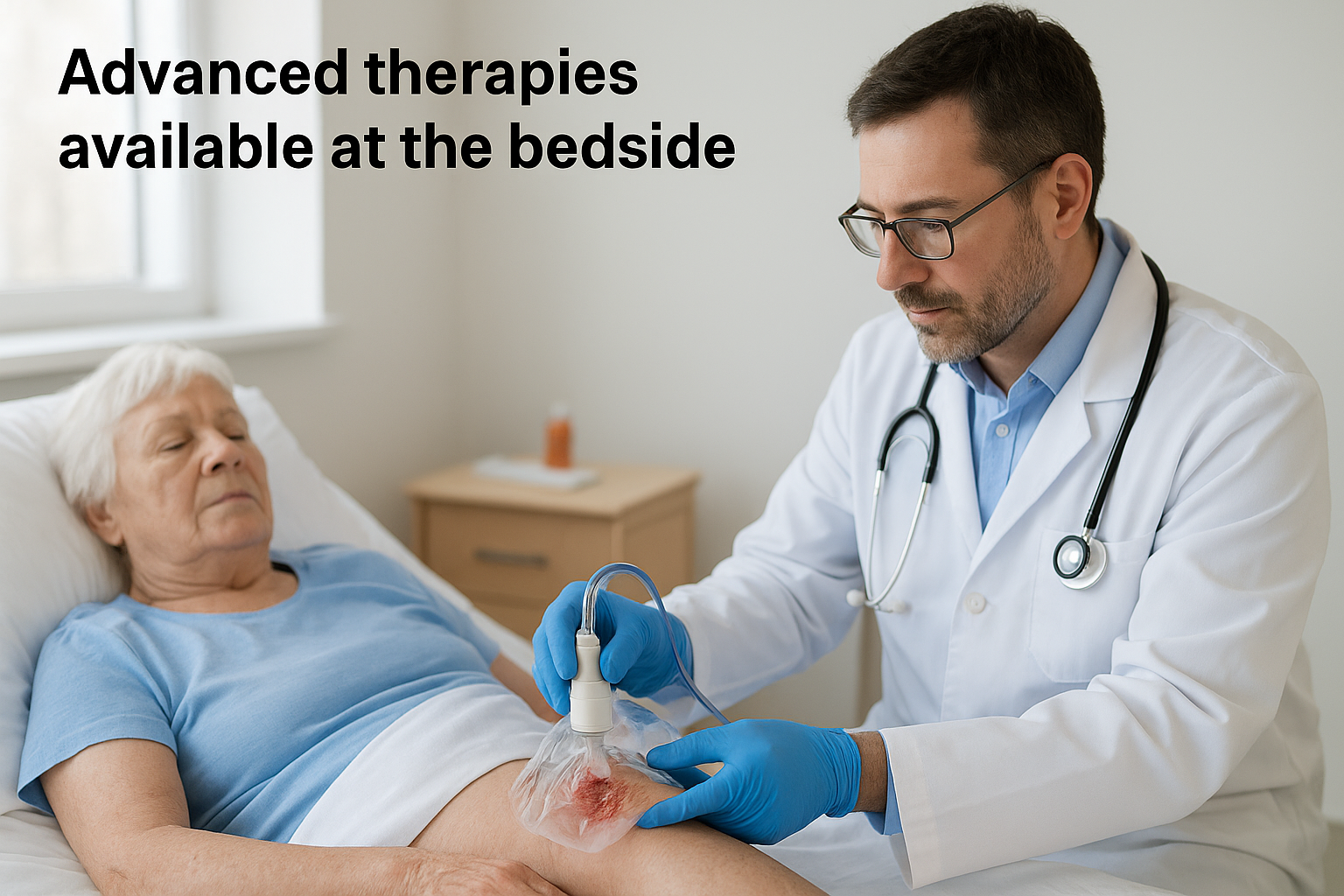
At the bedside, a trained physician can apply cellular and tissue-based products (CTPs), perform sharp debridement to remove necrotic tissue, and initiate negative pressure wound therapy without requiring patient transport to an outpatient clinic. These interventions are covered under Medicare Part B when a qualified provider delivers them, which removes the financial barrier that often keeps SNF residents stuck with conservative treatment that simply is not enough for complex wounds.
Coordination between the wound provider and facility staff
Your nursing staff and CNAs interact with wound patients every single day, but they need precise, updated instructions to maintain healing progress between physician visits. A functional wound care program includes written individualized care plans, direct staff education on dressing change technique, and a clear communication channel between the visiting physician and your Director of Nursing. That handoff point is where many facility programs fail in practice.
Facilities that document interdisciplinary coordination alongside clinical wound outcomes also position themselves more effectively for CMS compliance reviews and state survey readiness. Surveyors look for evidence of an accountable, structured process, not just a log of supplies used. Building that documentation framework from day one protects your residents and your facility’s regulatory standing simultaneously.
Why SNF wound programs reduce complications
Wound complications in SNFs don’t usually appear without warning. They develop when assessment gaps and treatment delays accumulate over days or weeks, pushing a manageable wound toward a crisis that sends a resident back to the hospital. A structured wound care program interrupts that cycle early, giving your clinical team the tools and physician oversight to catch deterioration before it escalates into something that requires emergency intervention.
Facilities with dedicated wound care programs consistently report lower pressure injury incidence rates and fewer wound-related readmissions compared to those relying solely on general nursing protocols.
Structured monitoring catches problems before they escalate
When a physician reviews wounds on a defined schedule, your nursing staff gets updated clinical guidance in real time rather than acting on standing orders written weeks prior. Timely reassessment identifies signs of infection, undermining, or tissue breakdown that a busy floor nurse may not be equipped to interpret without specialist support. That clinical feedback loop closes the gap between what is happening at the bedside and what the care plan actually reflects, reducing the chance that a worsening wound goes unaddressed until it reaches a critical stage.
Documented wound measurements and tissue assessments also give your team objective data to act on. When trends point toward deterioration, a physician can escalate treatment immediately, ordering debridement, adjusting the dressing protocol, or initiating a biologic therapy before the wound becomes infected or requires hospital-level intervention.
Reducing infection risk through physician-directed debridement
Infection is the most common driver of wound-related hospitalizations in SNF populations. Necrotic tissue and biofilm create an environment where bacteria thrive, and standard nursing wound care rarely includes the sharp debridement that clears that burden effectively. Physician-led wound care solutions for SNF programs address this directly by bringing debridement capability to the bedside, removing devitalized tissue that blocks healing and triggers systemic complications like cellulitis or sepsis. When your facility eliminates the transport barrier to clinical debridement, residents receive intervention faster, and your rehospitalization data reflects that improvement in a way surveyors and payers both notice.
Bedside care models that work in SNFs
Not every model for delivering wound care inside a skilled nursing facility produces the same results. The structure you choose determines how quickly residents receive specialist-level intervention, how consistently your nursing staff gets updated guidance, and how well your facility positions itself against readmission metrics and regulatory benchmarks. Two models stand out as consistently effective in SNF environments, and understanding both helps you choose the right fit for your patient population.
The mobile physician model
A mobile physician wound care practice visits your facility on a recurring schedule, bringing specialist-level assessment and advanced treatment capability directly to the bedside. This model works because it removes the transport requirement entirely. Residents with limited mobility, complex comorbidities, or cognitive impairment stay in a familiar environment while receiving the same clinical interventions they would access in a hospital outpatient setting, including debridement, biologic therapies, and individualized care plan updates.
The mobile physician model closes the access gap that causes most SNF wound programs to plateau at conservative treatment when residents actually need specialist-level intervention.
As a practical wound care solution for SNF operations, this model also integrates directly with your existing care team. The visiting physician coordinates with your Director of Nursing, updates care plans after each visit, and provides your floor staff with precise, wound-specific instructions that reflect current clinical status rather than a protocol written weeks prior. Facilities using this model typically see improved wound closure rates and measurable reductions in wound-related hospital transfers.
The embedded wound care nurse specialist model
Some larger facilities support a dedicated wound care nurse specialist employed directly by the facility. This nurse manages routine dressing changes, flags deteriorating wounds, and maintains documentation between physician visits. The model works best when the specialist has direct access to a supervising wound physician, whether through a consulting agreement or a mobile provider relationship, to handle cases that exceed nursing-level scope.
Combining an embedded specialist with an external physician consultant gives your facility both daily wound oversight and the clinical authority to escalate treatment when conservative measures fall short.
How to build or upgrade a bedside program
Building a functional bedside wound program inside your facility does not require a complete operational overhaul. What it requires is an honest assessment of where current care falls short and a deliberate plan to close those gaps through the right clinical partnerships, clear protocols, and measurable goals your team can track over time.
Start with a wound program audit
Before adding any new service or resource, review what your facility already has in place. Map out how wounds are currently identified, documented, and escalated, then identify where delays or inconsistencies occur. Common gaps include missing baseline assessments at admission, standing dressing orders that go unchanged for weeks, and no defined escalation path when a wound fails to progress. Documenting these gaps gives you a foundation to build from rather than layering new resources on top of a process that still does not work.
A program audit that surfaces your facility’s actual wound care failures gives any new clinical partner the information they need to fill the right gaps from day one.
Select a clinical model that fits your patient volume
Your patient population determines which wound care solutions for SNF model serves you best. Facilities with a high proportion of diabetic or vascular wound patients benefit most from a mobile physician partner who can deliver advanced interventions at the bedside, including debridement and biologic therapies, without requiring transport. Smaller facilities or those with lower wound acuity may find value in a combination of an embedded wound nurse and an on-call physician consultant who reviews complex cases on a defined schedule. Matching the model to your actual census prevents both under-resourcing and unnecessary overhead.
Define success metrics before you launch
Once your program structure is in place, establish specific outcome benchmarks your clinical and administrative teams will review monthly. Track wound closure rates, wound-related hospital transfers, and pressure injury incidence as your primary indicators. Reviewing these numbers on a regular cadence lets you identify which parts of your program are producing results and where additional adjustment is needed before a gap becomes a regulatory concern.
Documentation, compliance, and billing basics
Strong clinical outcomes in a bedside wound program mean very little if your documentation does not reflect what actually happened. CMS surveyors, Medicare auditors, and state inspectors all evaluate your wound care program through the records your team produces, not through conversations with staff. Getting documentation right from the start protects your facility during surveys and supports every billing claim your physician partner submits.
Wound documentation that survives a survey
Every wound encounter needs a dated, signed clinical note that captures wound dimensions, tissue type, exudate characteristics, and the specific intervention performed. If a physician applies a cellular or tissue-based product, the note must also include medical necessity language that justifies why the standard dressing protocol was insufficient. Vague entries like "wound improving" or "dressing changed per orders" give surveyors nothing to evaluate and leave billing claims vulnerable to denial or recoupment.
Thorough wound documentation is your facility’s strongest defense during a state survey and your physician partner’s clearest path to clean Medicare reimbursement.
Your nursing staff plays a critical role here. Between physician visits, daily wound observations and dressing change records need to follow a consistent format that matches the physician’s care plan. Inconsistencies between nursing notes and physician assessments raise red flags during audits and signal a breakdown in your interdisciplinary coordination process, which surveyors treat as a compliance concern.
Billing through Medicare Part B
Most advanced wound care solutions for SNF residents bill under Medicare Part B rather than the SNF consolidated billing bundle, which means your physician partner bills independently for specialist services like debridement and allograft application. Your facility does not absorb those costs. Understanding this distinction lets you access advanced therapies for residents without creating budget conflicts with your facility’s per diem structure.
Confirm that your physician partner uses the correct CPT codes and modifier combinations for each service delivered at the bedside. Billing errors in wound care claims attract auditor attention, and a pattern of incorrect coding can trigger a pre-payment review that delays reimbursement and creates administrative burden for your team.
Next steps for your facility
Your SNF residents with complex wounds need more than routine nursing protocols. They need physician-led, specialist-level care delivered at the bedside without the transport barriers that delay treatment and push complications toward rehospitalization. The right wound care solutions for SNF settings exist, and building or upgrading your program starts with a clear-eyed look at where your current process falls short and which clinical partner can fill those gaps consistently.
Start by mapping your facility’s wound-related readmission data and your current escalation process for non-healing wounds. Those two numbers will tell you exactly where physician oversight is missing. Bringing in a mobile wound care physician gives your team the clinical authority, advanced treatment access, and documentation support that transforms a fragmented process into a structured program that produces measurable results.
Philadelphia Wound Care works directly with SNFs across the Philadelphia region. Request a wound care consultation for your facility and get your program moving in the right direction.