

Certified Wound Care LPN: How To Get Certified Fast In 2026
Demand for a certified wound care LPN continues to grow as healthcare systems lean harder on skilled nursing facilities, home health, and long-term care settings to manage complex wounds. At Philadelphia Wound Care, we work alongside LPNs in these environments every day, and the ones who hold wound care certification consistently deliver better patient outcomes and earn greater clinical trust from referring physicians and facility administrators.
If you’re an LPN looking to specialize, getting certified doesn’t have to take years or drain your bank account. But the process does involve meeting specific eligibility requirements, choosing the right program, and preparing for a certification exam, and the details vary depending on which credential you pursue. Skip a step or pick the wrong program, and you could waste months of effort.
This guide breaks down exactly how to earn your wound care certification in 2026, including the top certification bodies, eligibility criteria, online and in-person training options, and a realistic timeline so you can plan accordingly.
What wound care certification means for LPNs
Wound care certification is a formal credential that validates your clinical knowledge in wound assessment, treatment selection, and patient management. For a certified wound care LPN, it signals more than just extra training on your resume. It tells physicians, facility directors, and patients that you have met a national standard of competency in a specialty area that directly affects patient safety and long-term recovery outcomes.
Certification doesn’t replace your nursing license, but it significantly expands the clinical trust placed in you by the interdisciplinary care team.
The credentials available to LPNs
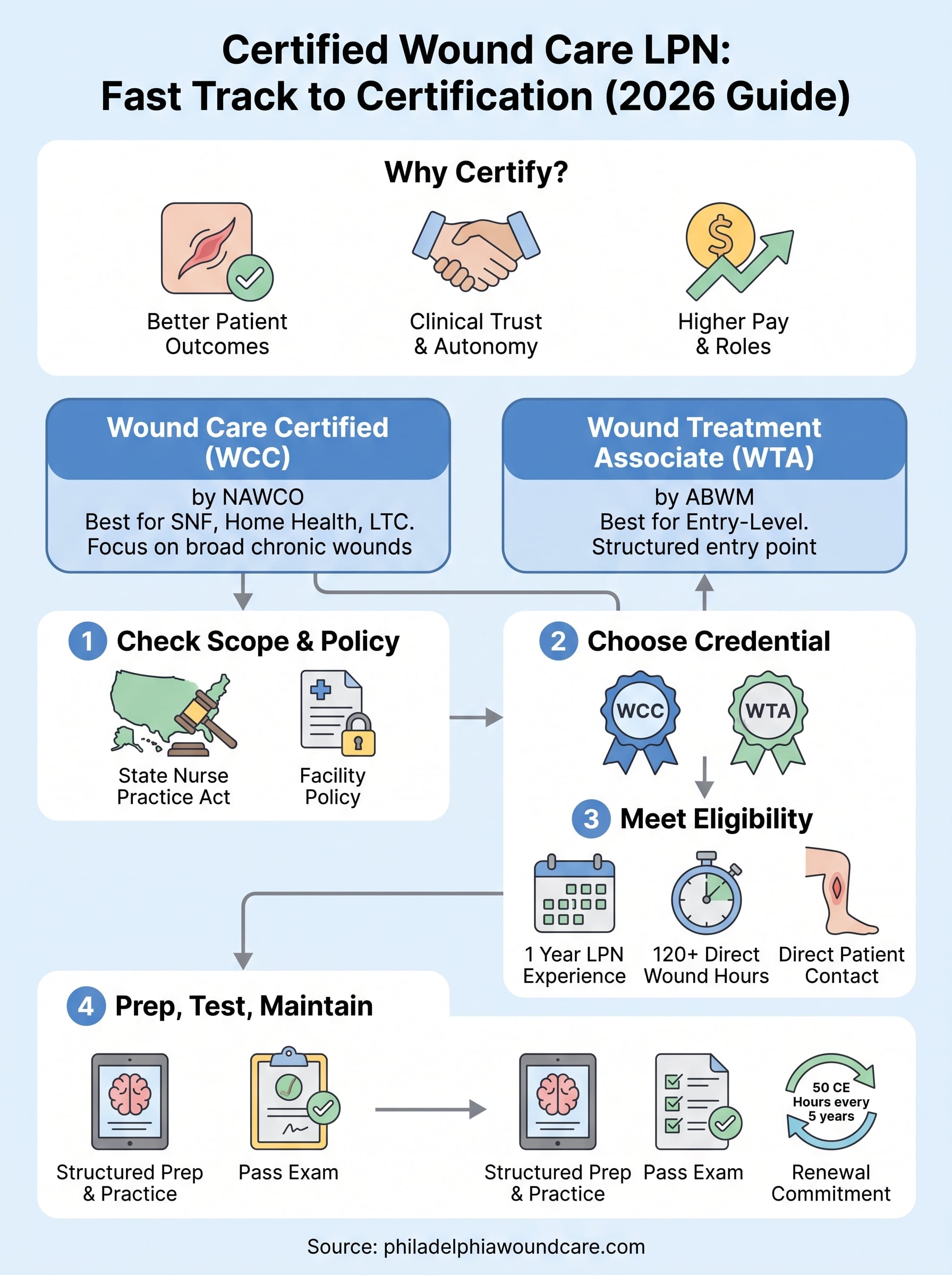
Not every wound care credential is open to LPNs, so knowing which ones apply to your license level matters before you invest time or money. The two most accessible options for LPNs are the Wound Care Certified (WCC) credential through the National Alliance of Wound Care and Ostomy (NAWCO) and the Wound Treatment Associate (WTA) credential through the American Board of Wound Management (ABWM). Both are designed to recognize LPN-level wound care practice and do not require a registered nurse or advanced practice license to qualify.
What certification actually changes day to day
Holding a wound care credential changes how you function inside a care team. You gain documented authority to lead wound assessments, recommend dressing protocols, and communicate directly with physicians about treatment escalation without waiting for a higher-level clinician to initiate the conversation. In skilled nursing facilities and home health settings, certified LPNs frequently take on formal wound care coordinator roles that come with higher pay, more autonomy, and direct accountability for patient healing outcomes. Facilities also benefit because regulatory surveyors look favorably on credentialed staff when reviewing wound-related quality measures, which means your certification strengthens the entire team’s position.
Step 1. Check your state scope and facility policy
Before you register for any program or exam, confirm what wound care tasks your state nurse practice act permits an LPN to perform. Scope varies by state, and some states restrict LPNs from independently assessing wounds or applying advanced dressings without RN oversight. Skipping this step as a certified wound care LPN means earning a credential you cannot fully use in your current role.

Contact your state board of nursing directly to get written clarification on LPN wound care scope before committing to a certification path.
Check your facility’s internal policies
Your employer’s internal policies can be more restrictive than state law, even when broader LPN wound care practice is permitted in your state. Request your facility’s wound care policy document from your director of nursing or clinical manager. Look for specific language around independent wound assessment, dressing selection authority, and documentation responsibilities for LPNs. Getting this in writing sets a clear baseline for what your credential will actually allow you to do on the floor.
| Document to request | Where to get it |
|---|---|
| State nurse practice act | State board of nursing website |
| Facility wound care policy | Director of nursing or HR |
| Wound coordinator job description | Clinical manager |
Step 2. Pick the right credential for your role
Once you confirm your scope allows it, choosing between the WCC and the WTA comes down to your current clinical setting and where you want your career to go. Both credentials recognize certified wound care LPN practice at the national level, but they differ in focus, exam structure, and cost.
Matching the credential to your actual job responsibilities before you register saves you study time, exam fees, and potential frustration.
WCC vs. WTA: understanding the difference
The WCC (Wound Care Certified) credential from NAWCO fits LPNs working in skilled nursing facilities, home health, or long-term care where you manage a broad range of chronic wound types daily. The WTA (Wound Treatment Associate) from ABWM works better as a structured entry point if you are building your wound hours and want a foundational credential first.
| Credential | Best setting | Exam length | Approximate cost |
|---|---|---|---|
| WCC (NAWCO) | SNF, home health, LTC | 110 questions | $285-$335 |
| WTA (ABWM) | Entry-level wound roles | Shorter format | $200-$250 |
How to make your final choice
Review the exam content outlines for both credentials on their respective organization websites before committing to a study plan. If your daily work involves independent wound documentation and dressing selection, the WCC aligns more directly with those responsibilities and carries stronger name recognition among facility directors and referring physicians.
Step 3. Meet eligibility and build wound hours
Every certified wound care LPN pathway requires you to meet baseline eligibility criteria before submitting an application. For the WCC through NAWCO, you need an active LPN license, a minimum of one year of clinical experience, and at least 120 hours of direct wound care practice within the past year. The WTA through ABWM requires similar clinical hours but may allow a shorter overall experience window.
Document your wound hours as you accumulate them rather than reconstructing records at the last minute, which is harder and less accurate.
What counts as qualifying wound hours
Your hours must come from direct patient contact involving wound assessment, dressing changes, or treatment planning. Administrative time, training modules, and wound care inservices do not count toward the clinical hour requirement. Keep a running log that captures the date, patient setting, wound type, and intervention performed for each qualifying encounter.
| Hour type | Counts toward eligibility |
|---|---|
| Wound assessment and documentation | Yes |
| Dressing application and changes | Yes |
| Online wound care training modules | No |
| Staff inservices or orientation | No |
Getting hours if your current role is limited
If your facility rarely assigns you wound patients, request a formal rotation through the wound care team or offer to shadow the current wound care coordinator. Speaking directly with your director of nursing about building dedicated wound exposure shows initiative and often results in a structured plan.
Step 4. Prep, test, and keep your certification
Once you confirm your eligibility, structured preparation is the fastest path to passing on your first attempt. Both the WCC and WTA exams test clinical application, not memorization, so your study plan should prioritize case-based practice questions over reading dense reference materials from start to finish.
Set a firm exam date before you begin studying so you work toward a real deadline rather than drifting through materials without a target.
Build a study plan that matches the exam
NAWCO publishes a free WCC exam content outline on its website, and that document should anchor your preparation. Divide the content areas by week, allocating extra time to topics where your daily practice is thinner. Aim for four to six weeks of focused review, completing 20 to 30 practice questions per session to build stamina.
| Study week | Focus area | Daily goal |
|---|---|---|
| Weeks 1-2 | Wound assessment and documentation | 20 practice questions |
| Weeks 3-4 | Treatment selection and dressing protocols | 25 practice questions |
| Weeks 5-6 | Full practice exams and weak area review | 30 practice questions |
Maintain your credential after you pass
Earning your certified wound care LPN credential requires ongoing commitment beyond exam day. The WCC demands 50 continuing education hours every five years to renew, and you must hold an active nursing license throughout that entire period. Track your CE hours in a dedicated digital folder and check your renewal deadline at least six months early to avoid any lapse in standing.
Next steps
You now have a clear path from eligibility check to exam day to renewal. Start by pulling up your state nurse practice act and your facility’s wound care policy this week, then decide between the WCC and WTA based on your current role and clinical hours. Once you confirm your eligibility, set a firm exam date and build a six-week study plan anchored to the official content outline.
Becoming a certified wound care LPN takes focused effort, but the credential pays off in clinical autonomy, stronger care team relationships, and better patient outcomes. Every step in this guide is actionable right now, so avoid waiting until your schedule clears up because it rarely does.
For patients and families in the Philadelphia area who need expert wound care at home rather than in a clinical office, our team brings physician-led treatment directly to you. Learn more about our mobile wound care services in Philadelphia.