

Top 7 Wound Care Management Program Choices for 2026
Choosing the right wound care management program can reshape your clinical career, and directly improve outcomes for the patients who need you most. With chronic wounds affecting nearly 6.5 million Americans each year, the demand for trained wound care specialists continues to outpace the supply, especially in home-based and post-acute settings where complex cases often go underserved.
At Philadelphia Wound Care, we see this gap firsthand. As a physician-led mobile practice treating diabetic ulcers, pressure injuries, venous wounds, and post-surgical complications across the Philadelphia region, we know that advanced training is what separates adequate care from exceptional healing outcomes. Every clinician on our team relies on specialized education and credentials to deliver the kind of bedside expertise our patients deserve, whether they’re recovering at home, in a skilled nursing facility, or under hospice care.
If you’re a nurse, physician, or allied health professional ready to deepen your wound care expertise, the number of available programs can feel overwhelming. Accreditation bodies differ, curricula vary widely, and not every program prepares you equally for real-world clinical challenges. That’s why we put together this guide. Below, you’ll find seven standout wound care management programs for 2026, each evaluated for its curriculum quality, certification pathways, flexibility, and relevance to today’s most pressing wound care needs.
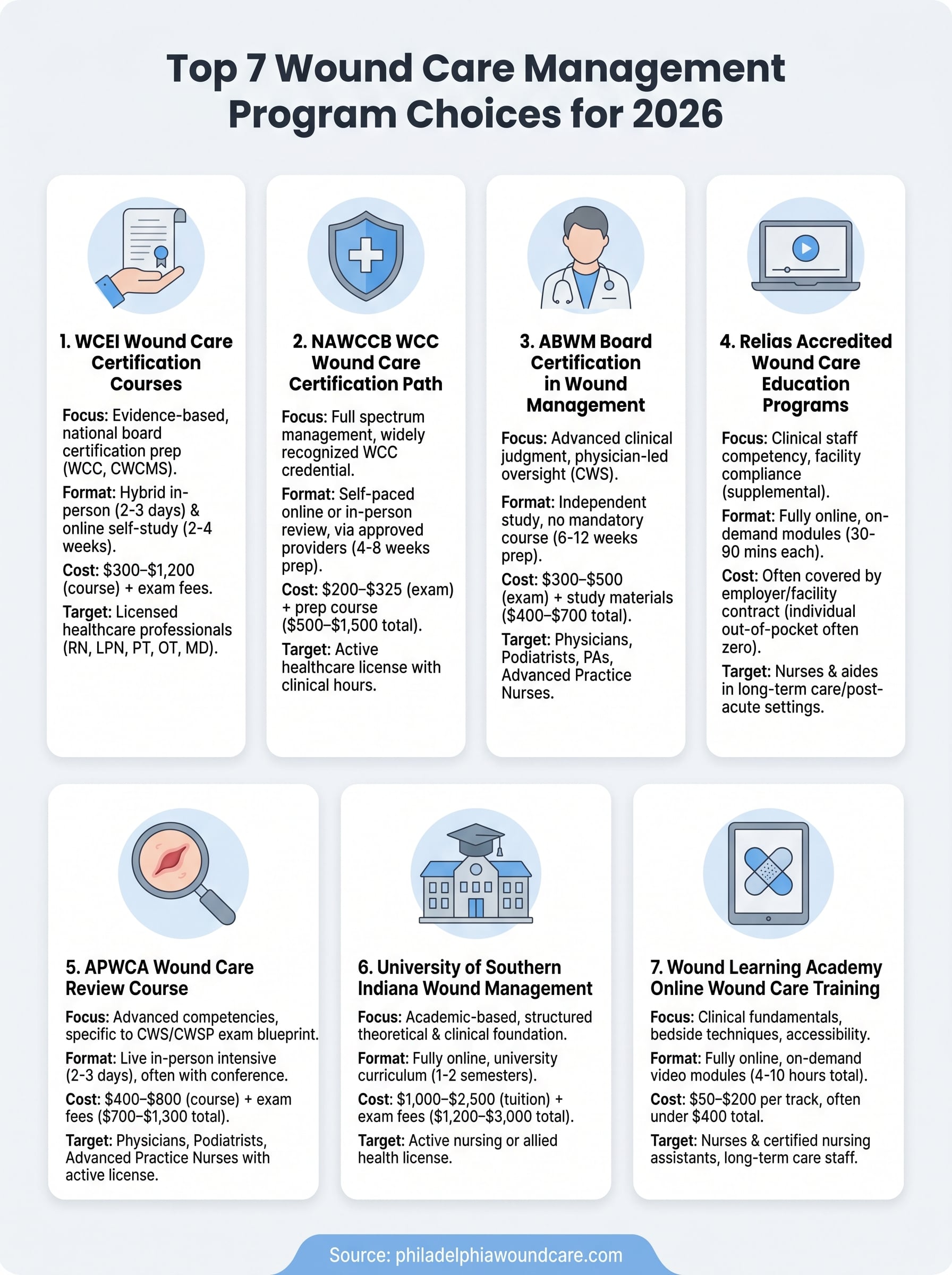
1. WCEI wound care certification courses
The Wound Care Education Institute (WCEI) is one of the most recognized training organizations for nurses and allied health professionals in this field. If you’re looking for a structured wound care management program that builds both foundational knowledge and exam-ready confidence, WCEI’s course catalog is a strong starting point.

Program focus
WCEI builds its curriculum around evidence-based wound care principles, covering wound assessment, etiology, treatment selection, infection management, and clinical documentation. Every module ties directly to real clinical application rather than abstract theory. The courses are designed specifically to prepare you for national board certification exams, particularly credentials offered through the National Alliance of Wound Care and Ostomy (NAWCO).
Key clinical areas the curriculum covers include:
- Diabetic foot ulcers and lower extremity wound management
- Pressure injury staging and prevention protocols
- Wound debridement techniques and infection control
- Documentation standards for reimbursement and compliance
Format and time commitment
You get both in-person hybrid courses and fully online self-study options through WCEI, giving you flexibility depending on your schedule and learning style. The flagship in-person prep course typically runs two to three days, held at conference venues in cities across the country throughout the year. Online modules let you work at your own pace, and most candidates complete the digital prep content within two to four weeks before sitting for the exam.
Candidates who combine the in-person course with the online self-study modules consistently report higher first-attempt pass rates on their certification exams.
Eligibility and credential outcomes
To enroll in WCEI’s board certification prep tracks, you generally need to be a licensed healthcare professional, such as an RN, LPN, PT, OT, or physician. Some programs also require a minimum number of documented clinical hours in wound care before you can sit for the associated exam, so confirm current prerequisites with WCEI directly before registering. Credentials earned through this pathway are widely accepted across hospitals, skilled nursing facilities, and home health agencies.
Credential options tied to WCEI prep courses include:
- WCC: Wound Care Certified, the most broadly recognized credential
- CWCMS: Certified Wound Care Management Specialist, suited to clinical leadership roles
- DMEPOS: Bundled with select prep tracks for equipment-related practice settings
Typical cost range
WCEI’s in-person prep courses typically run between $700 and $1,200, depending on location and whether printed materials are included. Online self-study options are generally more affordable, often landing between $300 and $600. Exam fees through the certifying body are separate and typically add another $200 to $400. Many larger health systems and SNFs reimburse these costs through continuing education benefits, so check with your employer before paying out of pocket.
2. NAWCCB WCC wound care certification path
The National Alliance of Wound Care and Ostomy Certification Board (NAWCCB) administers the Wound Care Certified (WCC) credential, one of the most widely recognized designations for clinicians working in wound management. If you’re building a career in wound care and want a credential that travels across care settings, the NAWCCB path deserves a close look.
Program focus
The WCC certification covers the full spectrum of wound care management, including wound assessment, wound bed preparation, infection control, and advanced treatment modalities. Rather than offering a single training course, NAWCCB functions as the certifying body, meaning you prepare through an approved education provider before sitting for the actual exam. This structure gives you flexibility in how you approach your wound care management program without compromising the rigor of the final credential.
Format and time commitment
You can prepare for the WCC exam through self-paced online study or in-person review courses, depending on your preferred provider and schedule. Most candidates spend four to eight weeks on focused preparation before scheduling their exam date. The exam itself is computer-based and available through accredited testing centers at flexible times throughout the year.
The WCC is accepted across hospitals, home health agencies, and skilled nursing facilities, making it one of the most portable credentials in this specialty.
Eligibility and credential outcomes
To sit for the WCC exam, you must hold an active healthcare license and document a minimum number of clinical hours in wound care practice. Passing earns you the WCC designation, which remains valid for five years and renews through continuing education credits.
Typical cost range
Exam fees through NAWCCB typically fall between $200 and $325, depending on your membership status. Add your prep course costs on top of that, and your total investment generally lands between $500 and $1,500.
3. ABWM board certification in wound management
The American Board of Wound Management (ABWM) takes a different approach than most nursing-focused programs by targeting physicians, podiatrists, physician assistants, and advanced practice nurses who want formal recognition of their wound care expertise. This credential carries significant weight in clinical and hospital settings where physician-led oversight is the standard of care.
Program focus
The ABWM’s flagship designation is the Certified Wound Specialist (CWS), a credential built around advanced wound care management program competencies. The curriculum framework covers chronic wound pathophysiology, tissue repair mechanisms, debridement methods, and multi-disciplinary treatment planning. The focus is on clinical decision-making at a level suited to practitioners who carry independent patient management responsibilities.
Format and time commitment
There is no single mandatory preparatory course required before sitting for the CWS exam. ABWM encourages candidates to use independent study materials and peer-reviewed clinical resources to prepare at their own pace. Most candidates report spending six to twelve weeks in focused preparation before scheduling their exam date through an accredited testing center.
The CWS credential is one of the few wound care designations specifically designed to reflect advanced clinical judgment rather than entry-level competency.
Eligibility and credential outcomes
Your eligibility depends on holding an active license in a qualifying healthcare profession and documenting a minimum number of clinical hours in direct wound care practice. Passing the exam earns you the CWS designation, which remains valid for five years and renews through continuing education requirements.
Typical cost range
Exam fees through ABWM typically fall between $300 and $500, depending on your membership status. Your total investment, including study materials, generally lands between $400 and $700.
4. Relias accredited wound care education programs
Relias operates as a healthcare workforce training platform used by thousands of care facilities across the United States, including skilled nursing facilities, home health agencies, and assisted living communities. If your organization already partners with Relias, its wound care course library can serve as a practical, accessible wound care management program without requiring you to seek out a separate training provider.
Program focus
Relias wound care content focuses heavily on clinical staff competency, covering wound assessment, pressure injury prevention, diabetic foot care, and documentation practices. The courses are structured to meet compliance and staff education requirements at the facility level, making them particularly useful for nurses and aides who work within long-term care or post-acute environments rather than pursuing independent board certification.
Format and time commitment
All Relias wound care courses are delivered fully online, and most individual modules run between 30 and 90 minutes. You can complete them on your own schedule within your organization’s assigned training windows, which makes this format well-suited to busy clinical staff who cannot step away for multi-day seminars.
Relias courses are frequently assigned as mandatory facility training, which means your employer may cover the cost entirely.
Eligibility and credential outcomes
Relias does not require any pre-existing credentials to access its wound care modules. Completion generates continuing education credits and a certificate of completion, though these do not qualify as standalone board certification. You should view Relias training as supplemental education rather than a primary credentialing pathway.
Typical cost range
Individual access to Relias content is generally priced through enterprise facility contracts, so your out-of-pocket cost as an individual clinician is often zero if your employer holds an active subscription.
5. APWCA wound care review course
The American Professional Wound Care Association (APWCA) offers a focused review course built around preparing clinicians for the Certified Wound Specialist (CWS) and Certified Wound Specialist Physician (CWSP) exams. If you want a structured wound care management program with a direct line to respected clinical credentials, the APWCA review course is worth serious consideration.
Program focus
The APWCA review course targets advanced wound care competencies, including wound pathophysiology, tissue assessment, treatment selection, and chronic wound management strategies. The curriculum aligns closely with the ABWM exam blueprint, making it one of the most exam-specific preparation tools available for physician-level and advanced practice clinicians who want to validate their expertise through board certification.
Format and time commitment
APWCA delivers its review course primarily as a live in-person intensive, often hosted in conjunction with its annual wound care conference. The format spans two to three days of structured instruction led by practicing wound care specialists. Some supplemental digital content is available for follow-up study after the live event concludes.
Attending the live format gives you direct access to faculty who can answer case-specific questions that self-study materials rarely address.
Eligibility and credential outcomes
You need to hold an active clinical license to participate, and most participants are physicians, podiatrists, or advanced practice nurses preparing for the CWS or CWSP exams. Completion of the course does not itself confer a credential, but it positions you well for passing the certifying exam administered through ABWM.
Typical cost range
Registration for the APWCA review course typically runs between $400 and $800, which often includes conference access. Add exam fees, and your total investment lands between $700 and $1,300.
6. University of Southern Indiana wound management
The University of Southern Indiana (USI) offers one of the few academic-based wound care management programs available through an accredited university. This program stands apart from commercial training providers by grounding its curriculum in a formal higher education framework, which appeals to clinicians who want academic rigor alongside practical clinical skills.
Program focus
USI’s wound management program covers wound assessment, healing physiology, debridement techniques, and infection management within a structured academic context. The curriculum is designed for nurses and allied health professionals who want to build a strong theoretical foundation while also preparing for national certification exams.
Format and time commitment
The program is delivered fully online, giving you the flexibility to complete coursework around your existing clinical schedule. Most students finish the core content within one to two semesters, depending on their pace and current course load.
Online delivery through an accredited university gives this program a level of academic credibility that many commercial prep courses cannot match.
Eligibility and credential outcomes
You need to hold an active nursing or allied health license to enroll. Completing the program positions you to sit for recognized wound care credentials and earns you continuing education units (CEUs) that count toward license renewal in most states.
Typical cost range
Tuition for USI’s wound management coursework typically runs between $1,000 and $2,500 for the full program, depending on credit hours and current university tuition rates. Your total investment, including any associated exam fees, generally falls between $1,200 and $3,000, which remains competitive for university-level clinical specialty training.
7. Wound Learning Academy online wound care training
Wound Learning Academy is a digital-first training provider built specifically for nurses and clinical staff who need accessible, affordable wound care education without the logistical burden of traveling to in-person seminars. If your schedule leaves little room for structured classroom time, this platform offers a practical entry point into a recognized wound care management program.
Program focus
Wound Learning Academy concentrates on clinical fundamentals and bedside-applicable techniques, covering wound assessment, skin integrity, moisture-associated skin damage, pressure injury prevention, and basic debridement principles. The content targets nurses and certified nursing assistants who work in long-term care and post-acute environments, where consistent wound management competency has a direct impact on patient outcomes and regulatory compliance.
Format and time commitment
All courses run fully online through on-demand video modules, which means you control when and how fast you move through the material. Most individual course tracks take between four and ten hours to complete in total, making them easy to fit into evenings or off-shift hours without disrupting your primary clinical responsibilities.
This format works especially well for facility staff who need targeted wound care education without committing to a multi-day live event.
Eligibility and credential outcomes
There are no strict licensing prerequisites to access most Wound Learning Academy courses, which lowers the barrier for nursing aides and early-career nurses. Completion earns you a certificate of completion and continuing education credits, though the platform does not position its courses as standalone board certification pathways.
Typical cost range
Individual course pricing typically falls between $50 and $200 per track, making Wound Learning Academy one of the most affordable options on this list. Your total investment for a full curriculum rarely exceeds $400.
Next steps
The seven programs above each offer a legitimate path into a recognized wound care management program, but the right choice depends on your current credentials, career goals, and the clinical setting where you work. If you’re primarily focused on bedside competency, a platform like Relias or Wound Learning Academy gives you a fast, affordable starting point. If you want board-level credentials that open doors in advanced clinical roles, programs tied to WCEI, NAWCCB, or ABWM deserve your attention.
Your patients ultimately benefit most when the clinician treating them brings specialized, credentialed expertise to every wound assessment and treatment decision. That’s the standard we hold to at Philadelphia Wound Care. If you’re a patient, caregiver, or referring provider in the Philadelphia region looking for physician-led mobile wound care, connect with our team today through our mobile wound care services in Philadelphia page to learn more or schedule a consultation.