

Aetna Home Health Care Providers: How To Find In-Network
Finding Aetna home health care providers who are verified, in-network, and equipped to deliver the level of care your loved one actually needs can feel like a second job. Between navigating Aetna’s online directories, confirming coverage eligibility, and understanding what services fall under your specific plan, the process is far from straightforward, especially when you’re already managing a health crisis at home.
At Philadelphia Wound Care, we work with families and facilities across the Philadelphia region every day who are dealing with exactly this challenge. As a mobile, physician-led wound care practice, we understand how critical it is to connect patients with qualified in-network providers quickly, and how insurance logistics can delay care that shouldn’t wait another week.
This guide walks you through how to find in-network home health care providers under your Aetna plan, verify their coverage before scheduling, and avoid the most common mistakes that lead to surprise bills. Whether you’re a caregiver coordinating post-surgical wound care or a case manager lining up services for a facility resident, you’ll have a clear process to follow by the end.
What counts as home health care with Aetna
Before you start searching for Aetna home health care providers, you need to understand what Aetna actually covers under the home health benefit. Aetna distinguishes between different categories of home-based care, and the service type determines both which providers qualify and how your coverage applies. Getting this wrong at the start leads to denied claims later.
Covered services under a standard home health benefit
Aetna generally covers home health care when a physician certifies that you are homebound and require skilled care. The services must be medically necessary, ordered by a licensed physician, and delivered by a Medicare-certified or Aetna-approved agency in most plan types. Coverage typically extends to a defined set of clinical services.
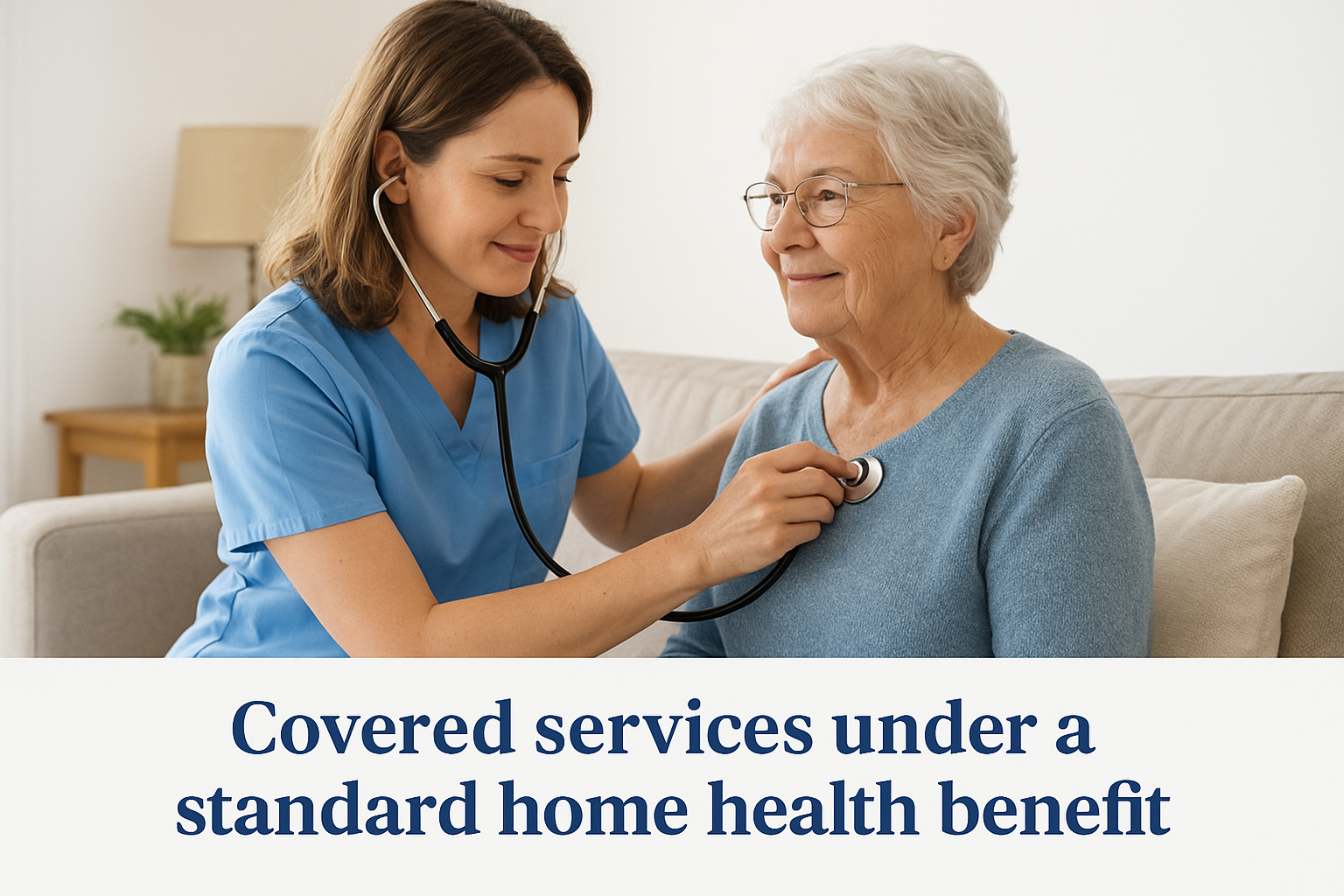
Covered services commonly include:
- Skilled nursing visits for wound care, medication management, post-surgical monitoring, and injections
- Physical, occupational, and speech therapy when tied to a documented treatment plan
- Medical social services to support care coordination and discharge planning
- Home health aide services for personal care, but only when delivered alongside skilled nursing or therapy, not as a standalone benefit
Aetna does not cover home health aide services on their own in most plans. The aide visits must be tied directly to an active skilled nursing or therapy need.
What Aetna typically does not cover under home health
Aetna draws a firm line between skilled medical care and custodial care. Custodial care includes help with bathing, dressing, meal preparation, and companionship. These services are not covered as home health benefits, even if a family member considers them essential to daily function. If a provider primarily delivers custodial services, they will not qualify as a covered home health agency under your Aetna plan.
Specialty services, like advanced wound care using regenerative therapies or allograft applications, may fall under a separate benefit category rather than the standard home health benefit. If your situation involves a chronic or non-healing wound, the medical visits and procedures may be billed under Medicare Part B physician services rather than a home health agency benefit, which changes which providers you need to look for and how you verify in-network status.
Before you search, gather plan details
Searching for Aetna home health care providers without reviewing your plan documents first is a reliable way to waste time. Aetna offers multiple plan types, including HMO, PPO, and Medicare Advantage options, and each structures home health benefits differently. Pulling your specific plan details before you open any provider directory saves you from calling agencies that accept Aetna but are not contracted under your particular plan.
What to pull from your Aetna plan documents
Your plan documents contain the specifics you need to search accurately. Log into your Aetna member portal at aetna.com and download your Summary of Benefits and Coverage, or call the member services number on the back of your insurance card to request it. Look for these details:
- Your plan name and ID number, which determines which provider network applies to you
- The home health benefit section, including visit limits and any prior authorization requirements
- Whether your plan requires a primary care physician referral before home health services begin
- Your deductible, copay, and coinsurance for home health visits
If your plan includes a prior authorization requirement for home health, you must get that approval before care starts or Aetna can deny the claim entirely.
What to confirm about your current situation
Before contacting any provider, clarify two clinical facts: whether your physician has documented homebound status for you, and whether the care you need qualifies as skilled care under Aetna’s definition. These two conditions determine whether your benefit applies at all, regardless of which agency you choose. Confirm both before moving forward:
- Homebound status: Your doctor must have noted in your records that leaving home requires considerable and taxing effort due to your condition
- Skilled care need: The services required must go beyond basic custodial assistance and involve licensed clinical judgment
Find in-network providers using Aetna tools
Once you have your plan details in hand, you can use Aetna’s built-in tools to locate in-network home health agencies with real accuracy. Aetna’s provider directory is available through your member account at aetna.com, and it lets you filter specifically for home health agencies rather than pulling up a broad list of unrelated providers.
Use Aetna’s online provider directory
Log into your Aetna member account and navigate to the "Find Care" section. From there, select "Home Health Agency" as the provider type rather than searching by name. Enter the patient’s home zip code and a search radius to pull agencies operating in the actual service area. This matters especially when you are looking for Aetna home health care providers in a specific zip code or borough within Philadelphia.
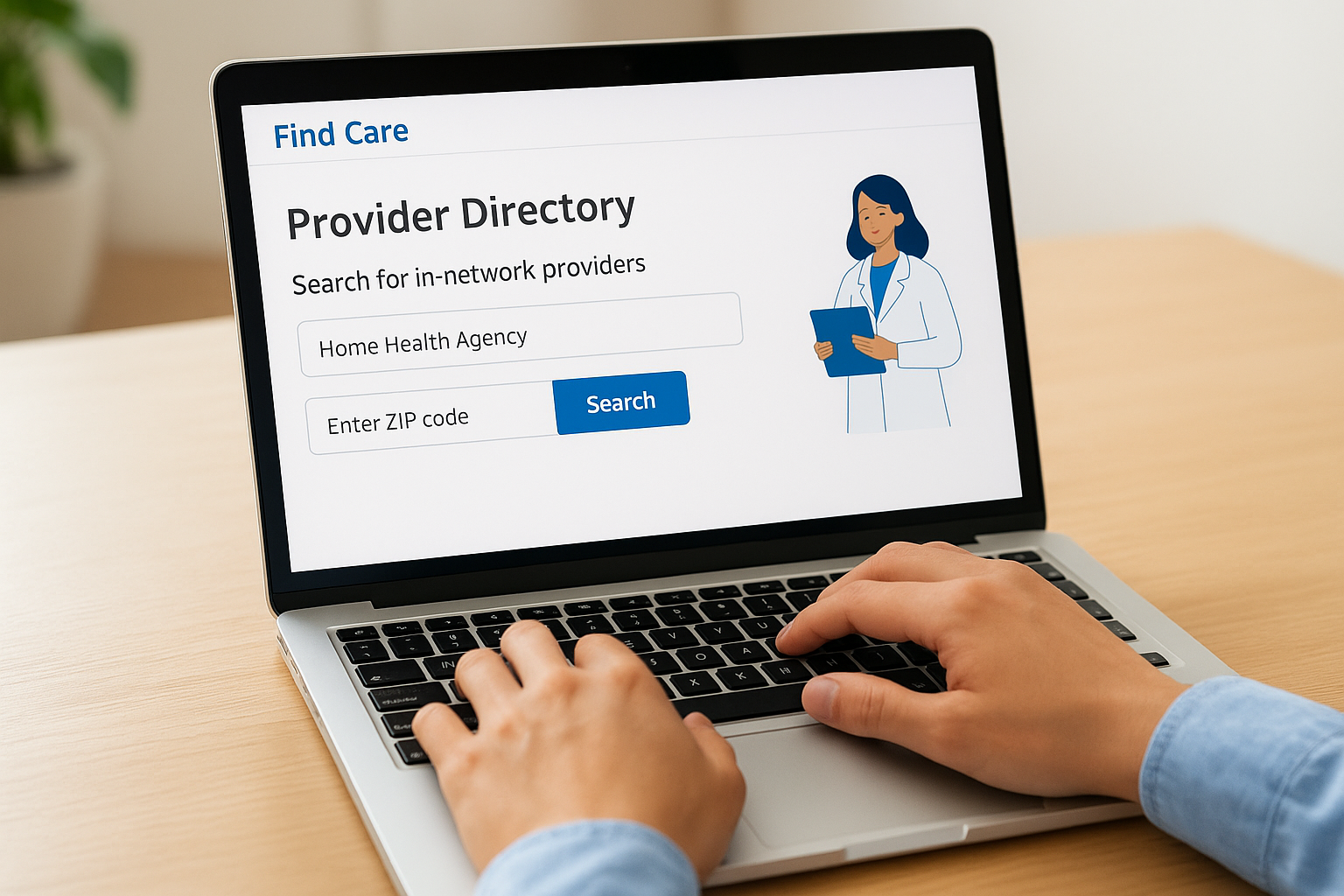
Always search using the patient’s home address, not a hospital or billing address, to get accurate in-network results for the actual care location.
Follow these steps in order:
- Log in at aetna.com and click "Find Care"
- Select "Home Health Agency" as the provider type
- Enter the patient’s zip code and set a 10 to 15 mile radius
- Filter by your specific plan name if the directory offers that option
- Record each agency’s name, phone number, and NPI number before calling
Refine by service type
Not every agency listed covers the same clinical services. Once you have a shortlist from the directory, call each agency directly and confirm they provide the specific service your physician ordered, such as skilled wound care nursing or post-surgical monitoring, before you request a visit or referral.
Verify the agency and your coverage
Finding an agency in Aetna’s directory is not the same as confirming they will actually accept your specific plan and deliver the service your physician ordered. Before anyone schedules a visit, you need to complete a two-step verification: one call to the agency and one call to Aetna. Skipping either step is the most common reason families end up with unexpected out-of-pocket bills after care begins.
Call the agency directly
When you call the agency, do not simply ask "do you accept Aetna?" That question is too broad. Different Aetna plans use different contracted networks, and an agency can accept some Aetna products while being out-of-network for others. Ask specific, plan-level questions to get a useful answer.
Use this verification script when you call:
- "Are you contracted with Aetna under the [your exact plan name] plan?"
- "Do you provide skilled wound care nursing as part of your services?"
- "Can you bill Aetna directly, or do I need to pay upfront and file for reimbursement?"
- "What is your NPI number so I can confirm your in-network status with Aetna?"
Confirm coverage with Aetna
After speaking with the agency, call the member services number on the back of your Aetna card and read them the agency’s NPI number. Ask Aetna to confirm that the agency is in-network for your plan and that the specific service type ordered by your physician is covered under your current benefit.
Get a reference number from the Aetna representative and write down the date of the call. If a claim is denied later, that reference number is your documentation that coverage was verbally confirmed before care started.
Verifying Aetna home health care providers this way takes under 30 minutes and protects you from billing disputes that can take months to resolve.
If you can’t find care in your area
If Aetna’s directory returns no results for your zip code, or the agencies listed cannot provide skilled wound care or post-surgical nursing, you still have real options. Aetna has a process for handling gaps in provider availability, and knowing how to use it prevents you from hitting a dead end when care is urgent.
Request an out-of-network exception
When no in-network Aetna home health care providers are available in your area, you can file a request for an out-of-network exception directly with Aetna. This process allows Aetna to authorize coverage at in-network rates for a provider outside their contracted network, specifically because a covered service is unavailable locally. Call member services and ask for a network gap exception or continuity of care request.
Document that you made a good-faith effort to find in-network care first. Keep notes from each call, including dates, agency names, and reasons they could not fulfill the order.
To support your exception request, gather the following:
- Your physician’s written order specifying the exact service type needed
- A list of at least two or three in-network agencies you contacted and their confirmed inability to serve you
- Your plan name, member ID, and the date care was ordered
Ask your treating physician to escalate
Your physician can contact Aetna’s medical management team directly to advocate for expedited authorization if your wound or condition puts you at clinical risk without timely home care. Physician-to-physician escalation often moves faster than member-initiated requests. Ask your doctor’s office to call Aetna’s provider services line rather than routing the request through standard member services.
A simple plan for getting care started
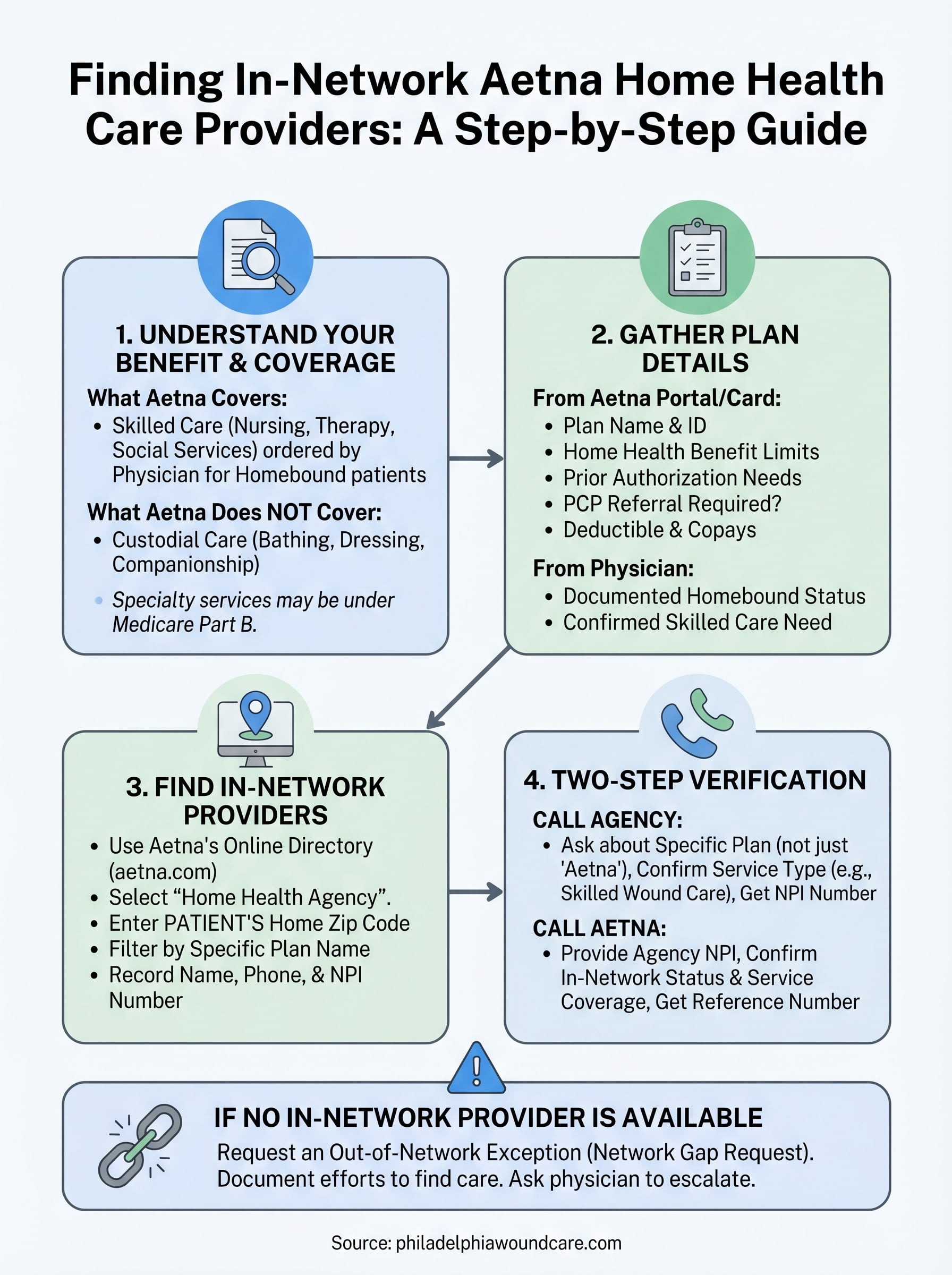
You now have a complete process for finding and verifying Aetna home health care providers without guesswork. Pull your plan documents first, use Aetna’s provider directory filtered to the patient’s zip code, confirm coverage with both the agency and Aetna directly, and escalate through a network gap exception if local options fall short. Each step builds on the last, so skipping one creates a gap that tends to show up as a denied claim later.
When your situation involves a chronic or non-healing wound requiring physician-led care at home, specialized mobile care is often the fastest path forward. Philadelphia Wound Care brings board-certified surgical expertise directly to patients across the Philadelphia region, with direct billing to Medicare, Medicare Advantage, and major commercial insurers. You don’t need to travel to a clinic to access that level of wound management.
Submit a referral for mobile wound care in Philadelphia and we’ll respond within 24 hours.