

Nursing Home Wound Care Philadelphia: Who Provides It?
When a loved one in a nursing facility develops a chronic or non-healing wound, the first question is usually straightforward: who’s going to treat it? The reality of nursing home wound care Philadelphia families encounter is that responsibility often falls across multiple providers, and the level of expertise varies widely. Not every facility has a dedicated wound care specialist on staff, which means patients with diabetic ulcers, pressure injuries, or surgical wounds may not receive the targeted treatment they need.
That gap is exactly why mobile physician-led services exist. At Philadelphia Wound Care, our General Surgeon brings advanced wound management directly to nursing home bedsides, working alongside facility staff rather than replacing them. We operate as a specialized resource that nursing homes can call on when wounds aren’t responding to standard care, with Medicare and major insurance coverage built into the process.
This article breaks down who actually provides wound care inside Philadelphia-area nursing homes, what each role looks like, and how to identify when a facility resident needs outside specialist involvement. If you’re a family caregiver or facility administrator trying to figure out your options, you’re in the right place, we’ll walk through what matters most for getting better outcomes.
What nursing home wound care includes
Wound care in a nursing home setting covers a range of clinical activities, from routine dressing changes to highly specialized interventions for chronic or deteriorating wounds. The goal is to stop tissue breakdown, prevent infection, and promote healing in patients whose wounds haven’t responded to basic nursing treatments. When you’re trying to understand what your family member or resident is actually receiving, it helps to break it down by category.
Routine nursing-level care
Most nursing homes handle wound assessment and basic dressing changes as part of their standard nursing duties. Nurses document wound size, depth, and appearance, apply prescribed dressings, and flag changes to the attending physician. This level of care works well for minor skin tears, superficial abrasions, or post-operative wounds that are progressing normally. It’s the baseline, and for many patients, it’s enough.
For wounds that stay on a predictable healing path, consistent nursing documentation and a responsive attending physician are usually sufficient to manage the case without outside involvement. The facility’s internal team handles it.
Advanced wound interventions
When a wound stalls, deepens, or shows signs of infection, the situation calls for more than a standard dressing change. Advanced interventions include debridement (removing dead or infected tissue), application of bioengineered skin substitutes or allograft materials, negative pressure wound therapy, and vascular assessment. These treatments require a licensed physician or specialist, not just a nursing staff member.
In the context of nursing home wound care Philadelphia families navigate, the difference between routine nursing care and specialist-level intervention can determine whether a wound heals or leads to a hospital readmission.
Documentation and ongoing monitoring
Wound care documentation isn’t just paperwork. It’s how a clinical team tracks whether a treatment plan is working. Proper monitoring includes serial wound measurements, photography, and treatment response notes that inform any adjustments to the care plan.
Without this layer, interventions become guesswork rather than evidence-based medicine. You should expect clear, updated records each visit.
Who provides wound care in Philadelphia nursing homes
Inside a typical Philadelphia nursing home, wound care responsibility is split between the facility’s internal clinical team and any outside providers brought in for complex cases. Knowing who handles what helps you ask the right questions and identify gaps in your loved one’s care.
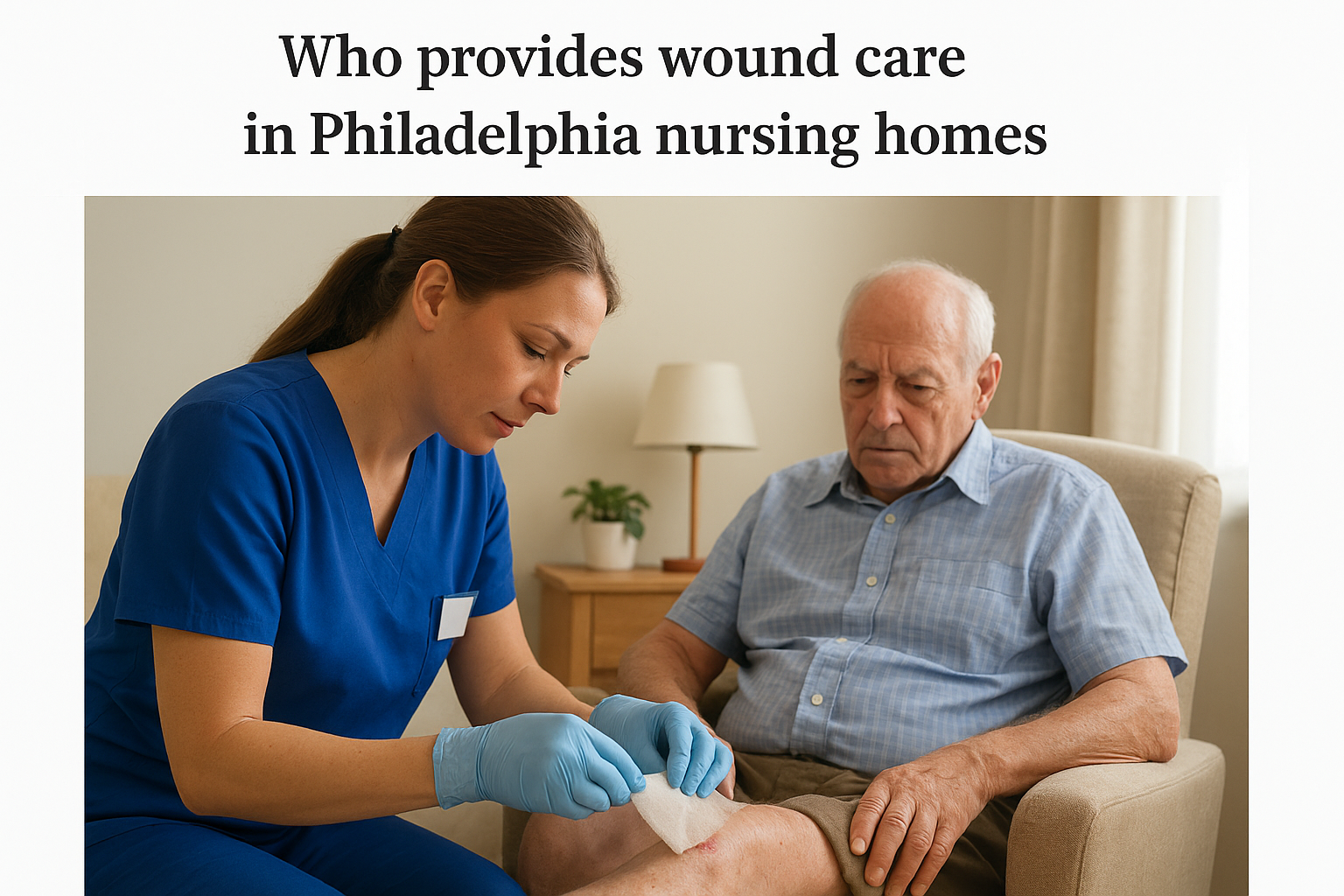
Internal facility staff
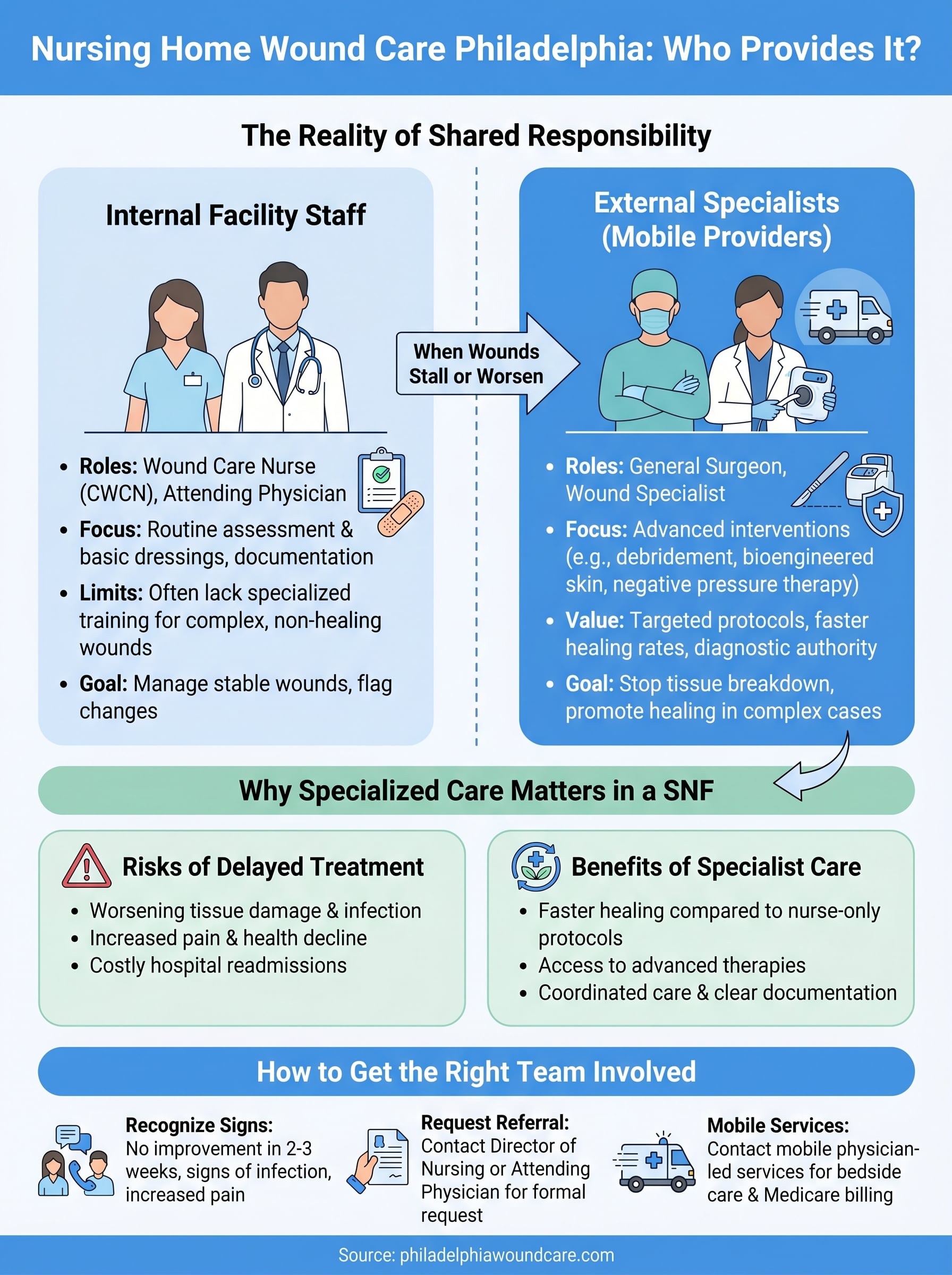
Most facilities assign a Wound Care Nurse or Certified Wound Care Nurse (CWCN) to manage routine assessments and dressings. Attending physicians sign off on care plans, but they often lack the specialized training needed for advanced wound management. This creates a real ceiling on what internal staff can address when wounds stall or worsen.
For families navigating nursing home wound care Philadelphia options, knowing that internal staff have limits is the first step toward advocating for better care.
External specialists and mobile providers
When internal resources fall short, facilities can bring in outside wound care specialists, including mobile physician services. A General Surgeon or wound specialist visits the patient’s bedside, performs debridement or applies advanced therapies, and coordinates directly with nursing staff.
External providers also handle documentation and care plan updates, keeping the facility’s clinical records current so nothing falls through the cracks between visits.
Why specialized wound care matters in a SNF
Nursing home residents carry higher-than-average wound risk due to limited mobility, poor circulation, and systemic conditions like diabetes. When a skilled nursing facility relies solely on internal staff to manage complex wounds, outcomes often stall. Specialist involvement closes that gap with targeted clinical protocols that internal teams are simply not equipped to deliver on their own.
The cost of delayed treatment
A wound that does not receive appropriate specialist attention within a reasonable timeframe rarely improves on its own. Delayed treatment allows tissue damage to deepen, infection to spread, and the patient’s overall health to decline. For facilities managing nursing home wound care Philadelphia residents depend on, a stalled wound frequently ends in a hospital readmission, which is costly for both the patient and the facility.
Pressure injuries that advance from Stage 2 to Stage 4 can require months of intensive treatment, yet early specialist intervention can stop that progression before it starts.
The link between specialist care and healing outcomes
Research consistently shows that physician-led wound management produces faster healing rates compared to nurse-only protocols. Specialists bring debridement skills, access to advanced biological therapies, and the diagnostic authority to order imaging or labs when a wound’s underlying cause remains unclear.
How to get the right wound team involved
Getting the right specialist involved starts with recognizing the signs that internal staff have hit their limit. If a wound shows no measurable improvement after two to three weeks of standard care, or if it has deepened, begun showing signs of infection, or caused significant pain, requesting outside specialist involvement is the right call.
Waiting for a wound to turn the corner on its own rarely works. Ask for a specialist referral before the situation gets worse.
Who to contact and how
Start with the facility’s Director of Nursing or attending physician and request a formal referral to an external wound care provider. For families managing nursing home wound care Philadelphia situations, mobile physician services like Philadelphia Wound Care can typically respond within 24 hours and bill Medicare directly.
Your referring physician can also submit the request directly, which speeds up the intake process and keeps the patient’s attending doctor in the loop throughout treatment.
What to expect on the first visit
The initial specialist evaluation covers wound staging, tissue assessment, and a review of prior treatments. From there, the provider builds a targeted care plan the nursing staff can execute between visits.

After that first evaluation, you should receive clear written documentation of the findings and a follow-up schedule so you can track progress and hold the care team accountable.
Questions to ask and red flags to watch for
When evaluating nursing home wound care Philadelphia residents receive, knowing the right questions puts you in a position to catch problems early. Ask the facility’s wound care nurse or attending physician how often wounds are formally reassessed, what the protocol is when a wound fails to improve, and whether outside specialists are available. Clear answers signal a competent, organized team.
If staff cannot tell you who is responsible for wound assessments or how often they happen, treat that as a serious warning sign.
Red flags that demand immediate action
Wound deterioration is the most obvious red flag, but several other warning signs deserve equal attention. Watch for foul odor, increasing wound size, or new drainage that staff have not documented or addressed. A lack of written wound measurements across visits is another serious concern, since it means the team has no reliable baseline for tracking whether the patient is improving or declining.
If you notice that dressing changes are being skipped or that the facility is not consulting outside providers for non-healing wounds, escalate the concern directly to the Director of Nursing or the attending physician without delay.
A simple next step
If you’ve worked through this article, you already know what good nursing home wound care Philadelphia families and facilities should look like, and you have a clear picture of where the gaps tend to appear. The practical question now is what to do with that information. Whether you are a family caregiver watching a wound stall or a facility administrator who needs a reliable outside specialist, the next move is the same: get a qualified physician involved before the situation escalates.
Philadelphia Wound Care brings physician-led wound management directly to nursing home bedsides, with 24-hour response times and direct Medicare billing so there are no logistical barriers standing between your patient and the right treatment. Your referring physician can submit a request in minutes, and our team handles the coordination from there. Start by visiting our mobile wound care services page to learn exactly what we offer and how to get started.