

Types and Stages of Wound Care: A Complete Overview
A wound that isn’t closing the way it should raises a lot of questions fast. Is it healing on schedule, or has it stalled? Understanding the types of stages of wound care gives you a real framework for answering that, instead of just watching and hoping.
Every wound moves through four biological phases: hemostasis, inflammation, proliferation, and maturation. On top of that, clinicians also stage wounds by severity, especially pressure ulcers, which range from Stage 1 (skin redness) to Stage 4 (deep tissue loss). Knowing where a wound sits in both systems tells you whether it’s progressing normally or needs a specialist’s attention, which matters most for diabetic ulcers, venous wounds, and post-surgical sites that don’t follow a textbook timeline.
This overview breaks down each healing phase in plain terms, walks through the staging classifications used for pressure and other chronic wounds, and explains what stalled healing at any point usually signals. We’ll also cover when in-home evaluation, rather than another trip to an outpatient clinic, becomes the practical next step for patients who can’t easily travel.
Why the stages of wound healing matter
A wound isn’t just "healing" or "not healing." It’s moving through a predictable biological sequence, and knowing which phase it’s in tells you whether progress looks normal or whether something has gone wrong. Tracking wound stages gives caregivers and clinicians a timeline to measure against, instead of guessing based on how a wound looks on any given day. Without that framework, a stalled wound can go unnoticed for weeks, which is exactly when small problems turn into hospital admissions.
The four phases your body moves through
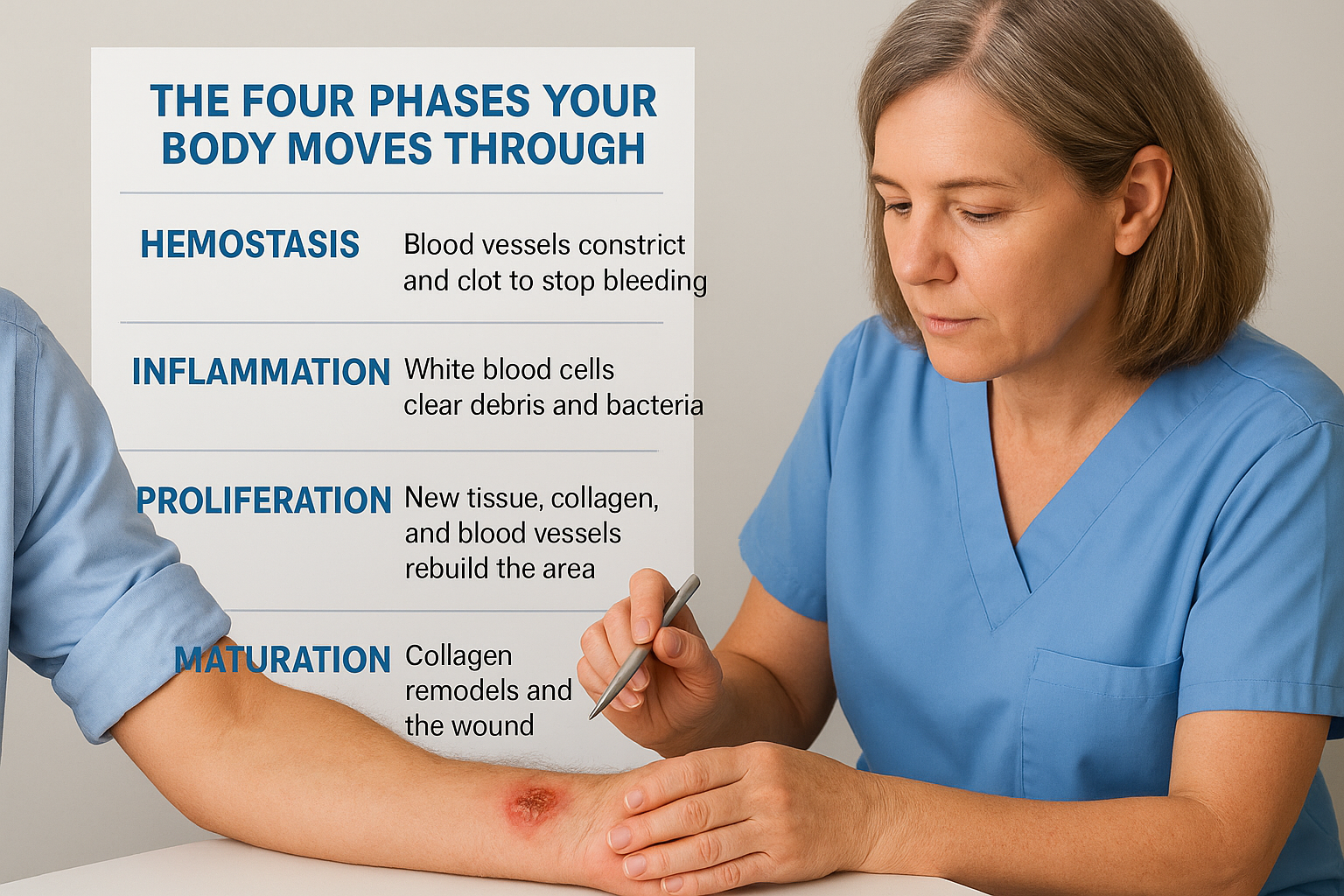
Every wound, from a paper cut to a surgical incision, follows the same four-phase biology. The pace differs based on the person’s age, circulation, and underlying conditions like diabetes, but the sequence itself doesn’t change.
| Phase | Typical Timeframe | What’s Happening |
|---|---|---|
| Hemostasis | Minutes to hours | Blood vessels constrict and clot to stop bleeding |
| Inflammation | 1 to 5 days | White blood cells clear debris and bacteria |
| Proliferation | 5 days to 3 weeks | New tissue, collagen, and blood vessels rebuild the area |
| Maturation | 3 weeks to 2 years | Collagen remodels and the wound gains tensile strength |
Recognizing these windows matters because each phase has an expected duration. If a wound sits in the inflammation phase past day five with ongoing redness, warmth, or drainage, that’s not normal variation. It’s a signal.
What happens when a wound stalls
Chronic wounds, the kind we see most often in diabetic patients and those with vascular disease, frequently get stuck in the inflammation phase and never transition into proliferation. The body keeps sending inflammatory signals, tissue never rebuilds, and the wound sits open for months. This is different from a wound that’s simply slow. A slow wound is still moving forward, just at a reduced pace. A stalled wound has stopped moving altogether, and that distinction changes what treatment should look like.
A wound that hasn’t changed in two to four weeks isn’t healing slowly, it’s stalled, and it needs a different treatment approach.
Catching that stall early is the entire point of understanding these stages. According to the National Institutes of Health, chronic wounds affect millions of Americans annually, and delayed recognition of a stalled healing trajectory is one of the most common reasons minor wounds progress to serious infections or amputations.
Why staging changes the treatment plan
Beyond the four biological phases, clinicians also classify wounds by severity, particularly pressure ulcers, using a staging system from 1 to 4 based on tissue depth. A Stage 1 pressure injury, which looks like persistent skin redness, calls for pressure relief and monitoring. A Stage 4 wound, where muscle or bone is exposed, demands specialist wound care, possibly debridement, and advanced therapies like allografts. Confusing these stages, or missing a wound’s progression from one to the next, leads to undertreatment at exactly the point when aggressive intervention matters most. Getting the staging right isn’t academic. It determines whether a patient gets a bandage change or a physician-led treatment plan.
How to support healing at each wound care stage
Knowing which phase a wound is in only helps if you act on it. Each stage responds to different kinds of support, and applying the wrong intervention, like scrubbing a fresh wound during hemostasis, can undo progress instead of speeding it up. Here’s what actually helps at each point.
Supporting hemostasis and inflammation
During the first days after an injury, the priority is protecting the clot and controlling early inflammation. Gentle cleansing, appropriate dressing changes, and keeping the area free of pressure or friction matter more than anything else at this stage. Caregivers should watch for excessive redness, warmth, or drainage that extends past day five, since that often signals the wound isn’t transitioning into proliferation on schedule.
The best thing you can do in the first week is protect the wound and watch it closely, not intervene aggressively.
Supporting proliferation and maturation
Once new tissue starts forming, nutrition becomes the biggest lever you have. Protein intake, hydration, and blood sugar control (especially for diabetic patients) directly affect how well the body builds collagen and closes the wound bed. Moisture balance matters here too. A wound that’s too dry slows cell migration, while one that’s too wet invites maceration and breakdown of new tissue.
Practical steps that help across every phase
Regardless of which phase a wound sits in, a few habits consistently support healing:
- Offload pressure from the wound area, especially for pressure ulcers on the sacrum, heels, or hips
- Manage blood sugar tightly if diabetes is present, since elevated glucose slows every phase of healing
- Keep dressings appropriate to the wound type, since a dry gauze that’s right for a surgical incision can dry out and damage a chronic ulcer
- Document changes weekly, including size, color, and drainage, so a stall gets caught early instead of after weeks of no progress
- Involve a physician promptly if a wound looks unchanged for more than two weeks
These steps aren’t a substitute for clinical evaluation, but they buy time and prevent small setbacks from becoming major ones while professional care gets arranged.
Types of wounds and how they are staged
Not every wound gets measured the same way. Pressure ulcers follow a strict depth-based staging system, while diabetic ulcers, venous wounds, and surgical incisions each use different classification tools built around their specific causes. Knowing which system applies to your wound type keeps everyone, from the family caregiver to the referring physician, speaking the same language about severity.
Pressure ulcer staging from 1 to 4
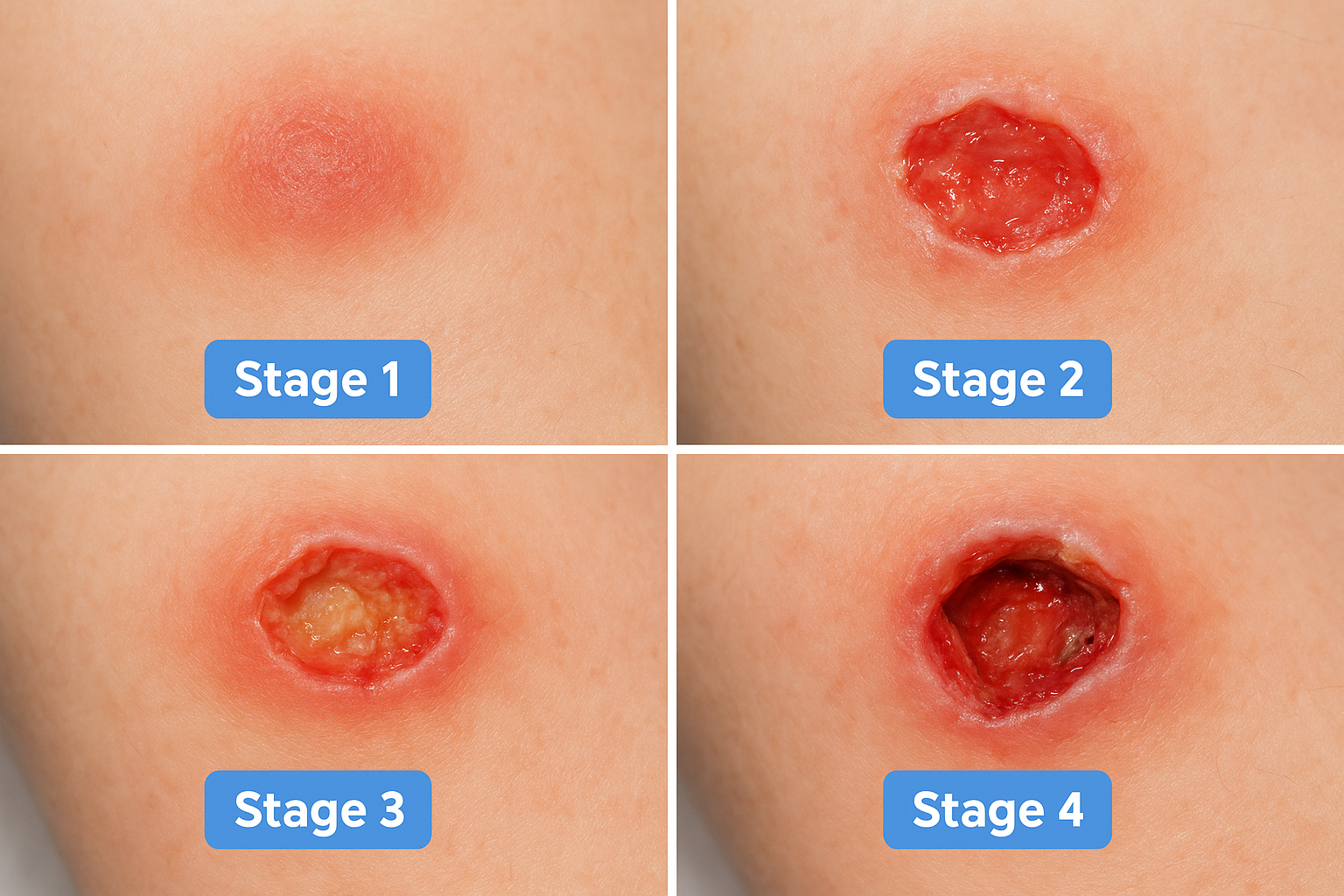
Pressure injuries develop from sustained pressure on skin over bony areas like the sacrum, heels, and hips, and clinicians stage them by how deep the tissue damage goes.
| Stage | Presentation | Typical Response |
|---|---|---|
| Stage 1 | Intact skin, persistent redness | Pressure relief, repositioning schedule |
| Stage 2 | Partial-thickness skin loss, shallow open wound | Moist dressing, continued offloading |
| Stage 3 | Full-thickness loss, fat visible | Debridement, advanced wound care |
| Stage 4 | Muscle, tendon, or bone exposed | Physician-led treatment, possible allografts |
A Stage 1 pressure injury and a Stage 4 wound require completely different treatment plans, so accurate staging matters as much as spotting the wound itself.
Diabetic and venous ulcers use different markers
Diabetic foot ulcers get classified using systems like Wagner or the University of Texas scale, which weigh depth, infection, and blood flow rather than pressure exposure alone. Venous ulcers, by contrast, are assessed by size, drainage volume, and the condition of surrounding skin, since poor circulation rather than direct pressure drives these wounds. A diabetic ulcer that looks shallow can still carry a serious infection risk if circulation is compromised, which is why staging alone never tells the full story.
Surgical and traumatic wounds follow healing intent
Surgical wounds get classified by how they’re expected to close: primary intention (edges stitched together), secondary intention (left open to heal from the bottom up), or tertiary intention (closed after a delay). This classification predicts the healing timeline more than the four biological phases alone can. Traumatic wounds, meanwhile, often get evaluated by contamination level and tissue viability before any staging system applies. Understanding which classification fits your wound determines what "normal progress" actually looks like, and that’s the detail generic advice online almost always skips.
When a wound needs professional attention
Caregivers can manage a lot at home, but some signs mean it’s time to stop watching and start calling. Waiting too long past a warning sign is the single biggest reason a manageable wound turns into a hospitalization. Recognizing these red flags early is just as important as understanding the healing phases themselves, because the stages only matter if you act on what they’re telling you.
Red flags that signal it’s time to call a specialist
Certain changes should prompt an immediate call to a physician or wound care specialist rather than a wait-and-see approach:
- Increasing size or depth of the wound over any two-week period
- Foul odor or new drainage, especially if it’s thick, green, or has a strong smell
- Spreading redness or warmth around the wound edges, which can signal cellulitis
- Fever or chills, which point to a systemic infection risk
- Exposed muscle, tendon, or bone, which classifies as a Stage 3 or Stage 4 pressure injury
- No visible change for more than three to four weeks, regardless of wound type
If a wound looks the same today as it did three weeks ago, that’s not a slow healer, it’s a wound that needs a specialist’s eyes on it now.
Why mobility limits change the calculation
For homebound or mobility-impaired patients, the standard advice to "see a wound care clinic" ignores the real barrier: getting there. A trip to an outpatient center means an ambulance, a wheelchair van, or a family member taking a day off work, and that delay often pushes evaluation back by a week or more. In that window, a Stage 2 pressure injury can progress to Stage 3. According to the Centers for Medicare & Medicaid Services, Medicare Part B covers medically necessary wound care services, including many delivered in the home, which removes the financial barrier that keeps some patients from seeking help sooner.
What a physician-led home evaluation adds
A general surgeon evaluating a wound at bedside can assess staging, order debridement, and initiate advanced therapies like allografts on the spot, without the delay of a referral chain. That immediacy, not just convenience, is what separates a wound that stalls for months from one that gets back on track within weeks.
Understanding your healing journey
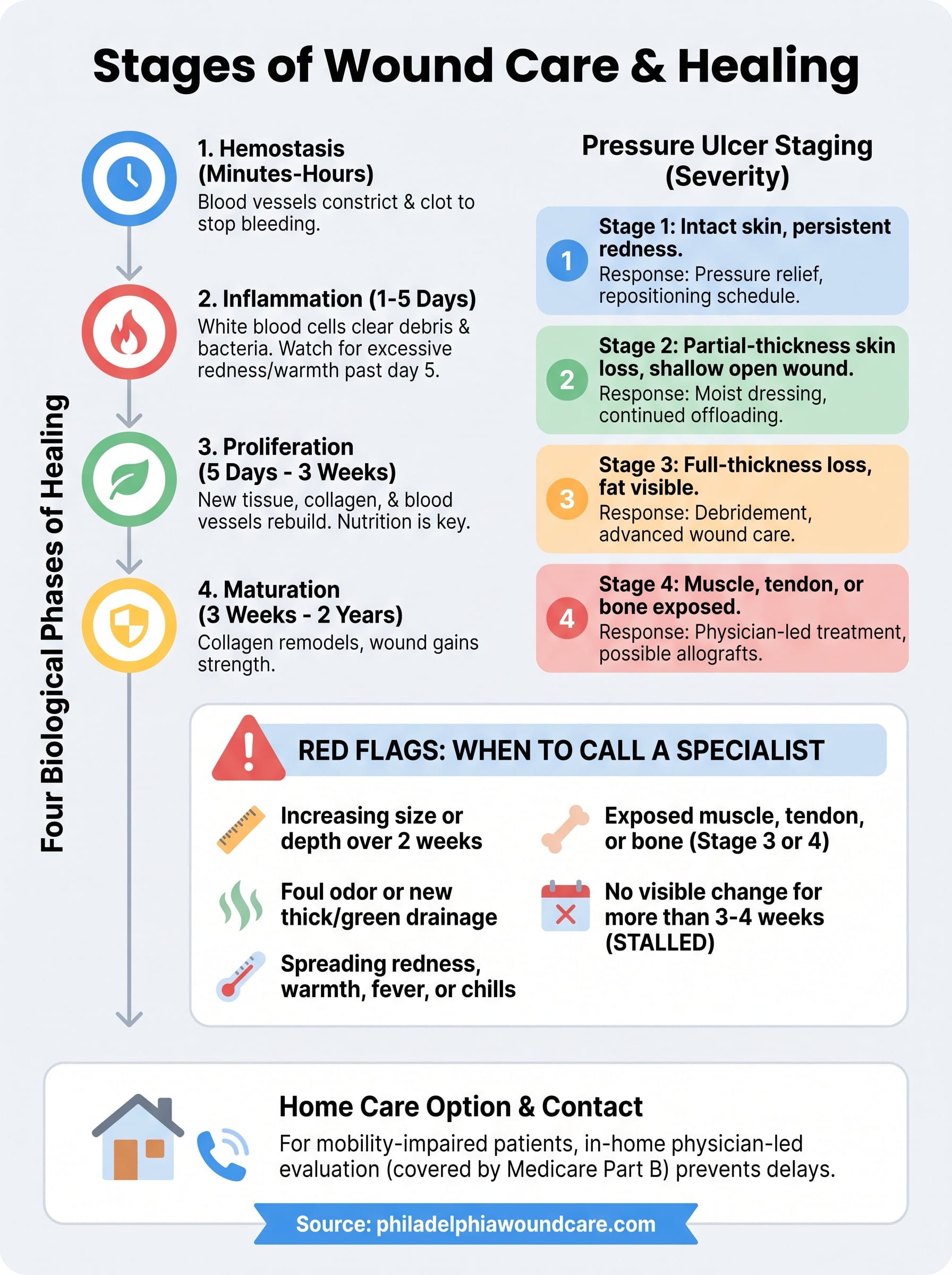
Knowing the stages of wound care turns a confusing situation into something you can actually track. You now know what hemostasis, inflammation, proliferation, and maturation should look like, how pressure ulcers get staged from 1 to 4, and which warning signs mean a wound has stalled rather than just slowed. That knowledge doesn’t replace clinical judgment, but it tells you when to trust the process and when to pick up the phone.
Patients who can’t easily get to a clinic shouldn’t wait weeks for an appointment while a wound quietly progresses to a deeper stage. Philadelphia Wound Care brings physician-led evaluation and treatment, including allograft therapy covered under Medicare Part B, directly to the bedside. If a wound in your care hasn’t changed in two weeks or more, don’t keep watching it. Reach out through our mobile wound care services in Philadelphia and get a specialist’s eyes on it now.