

National Association For Home Care And Hospice: Quick Guide
The National Association for Home Care and Hospice (NAHC) has shaped policy, standards, and advocacy for home-based healthcare providers for decades. If you’re a caregiver, facility administrator, or referring physician trying to understand what this organization does, and how its recent merger changed things, you’re in the right place. NAHC’s work directly affects how patients receive medical care outside of hospitals, which matters to anyone connected to home health services.
At Philadelphia Wound Care, we operate as a mobile physician-led practice bringing advanced wound management to patients in their homes, skilled nursing facilities, and hospice settings across the Philadelphia area. Organizations like NAHC help define the regulatory and quality framework that guides providers like us. Understanding who they are gives you a clearer picture of how the home care industry is organized and held accountable.
This guide breaks down NAHC’s mission, its merger into the National Alliance for Care at Home, membership resources, and why the organization matters for patients and providers alike. Whether you’re exploring home care options for a loved one or working within the industry, here’s what you need to know, without the jargon.
What NAHC is and what it represents
The National Association for Home Care and Hospice was founded in 1982 and quickly became the largest trade association dedicated to representing home care agencies, hospice providers, and home health aides across the United States. It operates as a national voice for organizations that deliver medical and supportive care to patients in their homes, giving those providers a unified platform for advocacy, education, and policy influence. For over four decades, it worked to ensure that home-based care remained a viable and well-regulated option for patients who could not or chose not to receive treatment in a clinical setting.
NAHC’s core mission
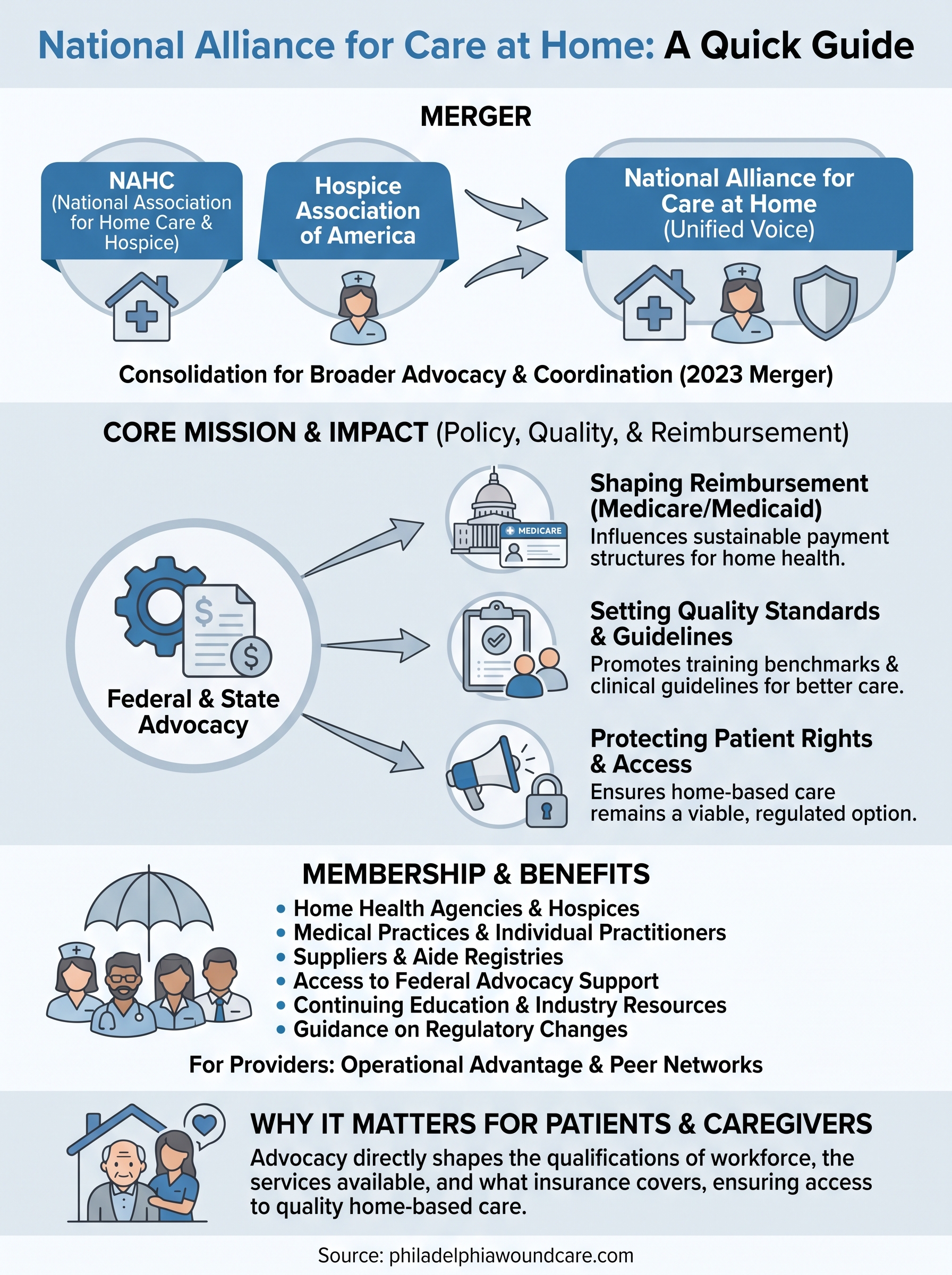
NAHC’s primary focus has always been federal and state advocacy. The organization works directly with Congress and regulatory agencies to shape legislation that affects Medicare and Medicaid reimbursement, licensing standards, and patient rights in home-based care settings. When new rules emerged affecting how home health agencies bill for services, NAHC was consistently at the center of those conversations, pushing for policies that protect both providers and the patients they serve.
When advocacy shapes reimbursement policy, it directly affects what treatments patients can access at home, and how providers can afford to deliver them.
Who NAHC represents
Membership in this organization has historically covered a broad range of stakeholders in the home care space. Home health agencies, hospice organizations, home care aide registries, and medical equipment suppliers have all operated under its umbrella. This diversity means the organization does not speak for just one type of provider but instead reflects the full spectrum of care delivered outside hospital walls.

For patients and family caregivers, that representation matters because it influences the quality standards and workforce regulations that determine who shows up at your door. Understanding which organizations shape those rules helps you ask better questions when evaluating any home care provider.
What changed with the National Alliance for Care at Home
In 2023, the national association for home care and hospice merged with the Hospice Association of America to form a new organization called the National Alliance for Care at Home. This consolidation brought two of the home care industry’s largest advocacy bodies under one structure, creating a broader and more unified voice for providers working outside hospital settings. The merger reflected a recognition that home health and hospice share overlapping policy goals and face many of the same regulatory challenges at the federal level.
What the merger means for providers and patients
The new organization preserved the core advocacy priorities of both predecessor groups while expanding its membership base and coordination capacity. Providers who held membership under either organization transitioned into one unified structure, which simplified access to lobbying resources, continuing education, and industry guidance. For patients and family caregivers, this shift means that the groups working to protect your access to home-based care now operate through a single coordinated platform rather than parallel efforts.

A consolidated advocacy organization carries more weight in legislative conversations than two separate groups making similar arguments independently.
Rebranding did not eliminate the work. It concentrated it.
Why this organization matters in home-based care
The national association for home care and hospice and its successor set standards that reach beyond their membership. Federal reimbursement policies, workforce requirements, and patient protection rules all carry fingerprints from this organization’s advocacy work. If you receive or coordinate home-based care, those policies shape what services are available, who can provide them, and what insurance will cover.
Its influence on Medicare policy
Medicare reimbursement rules determine whether providers can afford to bring advanced care to your home. The organization has consistently pushed for payment structures that keep home health economically sustainable, which directly affects how many providers can operate in your area and what treatments they offer.
Without active advocacy, reimbursement cuts can force providers to limit services or exit markets entirely, reducing patient access.
What it means for care quality
Quality standards do not regulate themselves. The organization has promoted training benchmarks and clinical guidelines that influence how home health aides and medical professionals are credentialed.
For you as a patient or caregiver, that means the qualifications of the people entering your home are shaped, in part, by the advocacy and standard-setting work carried out at the federal level.
How to find the official website and key contacts
Locating the right resources starts with knowing where the organization now lives online. Following the 2023 merger, the National Association for Home Care and Hospice transitioned into the National Alliance for Care at Home, and the organization’s primary web presence moved with it. Searching for "National Alliance for Care at Home" will bring you directly to their current official site, where you can access membership information, policy updates, and contact directories.
If you search for the old NAHC name directly, many results will redirect you to the updated organization, but going straight to the new name saves time.
Where to look for direct contact
The official site carries regional contact information and staff directories organized by department, including policy, education, and membership services. Your best starting point is the "Contact Us" or "About" section, which lists phone numbers and email addresses for specific inquiries. If you need to connect about a policy question or a referral for home health resources in your state, those directory pages give you direct access without routing through general intake forms.
For time-sensitive needs, the organization also maintains a government affairs team you can contact around legislative and regulatory matters affecting home-based care providers.
Membership, benefits, and who should consider joining
The National Alliance for Care at Home inherited the membership structure from the national association for home care and hospice, making it accessible to a broad range of providers in the home-based care space. Membership gives organizations access to federal advocacy support, industry research, and continuing education resources that are difficult to replicate through general healthcare channels. These benefits become especially relevant when regulatory changes affect how your services are billed and delivered.
Joining a national advocacy body puts your organization’s concerns in front of lawmakers who directly control reimbursement and licensing policy.
Who benefits most from membership
Home health agencies, hospice providers, and medical practices with a home-based focus gain the most from membership. If you run or work within a practice that delivers care outside hospital walls, the policy guidance and workforce training resources offered through membership translate directly into operational advantages.
Providers looking to stay current on Medicare regulations or build peer networks benefit consistently from active membership. Individual practitioners can also join, giving you access to clinical guidelines, legislative updates, and industry events that keep your work aligned with current federal and state standards.
Conclusion
The national association for home care and hospice built the foundation that the National Alliance for Care at Home now operates on, and that history still shapes how home-based care is delivered, regulated, and reimbursed across the country. Whether you’re a patient, family caregiver, or healthcare provider, understanding this organization helps you make sense of the policies and standards that govern the care delivered outside clinical walls.
Knowing who advocates for home-based care matters when you’re deciding who to trust with a complex wound or post-surgical recovery. At Philadelphia Wound Care, our physician-led mobile practice operates within these standards every day, bringing advanced wound management directly to patients in their homes, skilled nursing facilities, and hospice settings across the Philadelphia area. If you or someone you care for needs specialized wound care without leaving home, request mobile wound care services in Philadelphia and we’ll respond within 24 hours.