

Main Line Health HomeCare: Services, Locations, And Ratings
Finding the right home health provider in the Philadelphia region matters, especially when a patient is recovering from surgery, managing a chronic illness, or living with a complex wound. Main Line Health HomeCare is one of the most established options in the area, offering skilled nursing, rehabilitation, and hospice services directly in patients’ homes and care facilities across several Pennsylvania counties.
At Philadelphia Wound Care, we regularly coordinate with home health agencies like Main Line Health HomeCare to ensure patients with non-healing wounds receive consistent, specialized treatment between visits. Understanding what a home health provider covers, and where its services may have gaps, helps families and referring clinicians make informed decisions about a patient’s full circle of care. That’s particularly relevant for wound care patients who need physician-level oversight alongside standard home health support.
This article breaks down Main Line Health HomeCare’s service offerings, the locations it covers, its quality ratings, and how its care model fits into the broader home health picture in the Philadelphia area. Whether you’re a family caregiver evaluating options or a case manager coordinating a discharge plan, you’ll find the practical details you need to determine if this provider aligns with your patient’s needs.
What Main Line Health HomeCare is
Main Line Health HomeCare is the home health and hospice division of Main Line Health, a nonprofit academic health system based in southeastern Pennsylvania. The organization operates under the larger Main Line Health network, which includes several hospitals and specialty centers across the Philadelphia suburbs, including Lankenau Medical Center, Bryn Mawr Hospital, Paoli Hospital, and Riddle Hospital. The home care arm of this system was designed to extend clinical services beyond those hospital walls and into the places where patients actually live.
Main Line Health HomeCare brings the clinical infrastructure of an established hospital system directly into the patient’s home, which sets it apart from independent home health agencies that operate without that institutional backing.
How the Organization Is Structured
Operating as a hospital-based home health agency, the organization has a direct connection to the parent health system rather than functioning as a freestanding private company. This structure gives the agency access to shared clinical protocols, electronic health records, and physician networks that many independent agencies cannot match. When a patient discharges from a Main Line Health hospital, the coordination between the inpatient and home health teams tends to be more streamlined as a result.
The agency holds Medicare and Medicaid certifications, which means it meets the federal standards required to bill those programs and accept patients covered by them. Certification also requires ongoing compliance with quality reporting, making performance data publicly available through Medicare Care Compare. That transparency is something you can use directly when evaluating whether this provider fits your patient’s needs.
Who It Serves
Main Line Health HomeCare serves patients of all ages, though its caseload skews heavily toward older adults managing chronic conditions, recovering from orthopedic procedures, or living with illnesses that limit their ability to travel to outpatient appointments. Family caregivers frequently interact with the agency as well, since care coordination and caregiver education are built into the service model. If you are arranging care for a parent or spouse who recently left the hospital, this provider is worth understanding in detail before making a placement decision.
Patients referred directly by primary care physicians and specialists outside the Main Line Health system are also eligible for services, so you do not need to have received prior hospital care within the Main Line Health network to access their home health programs.
Services offered: home health, palliative, hospice
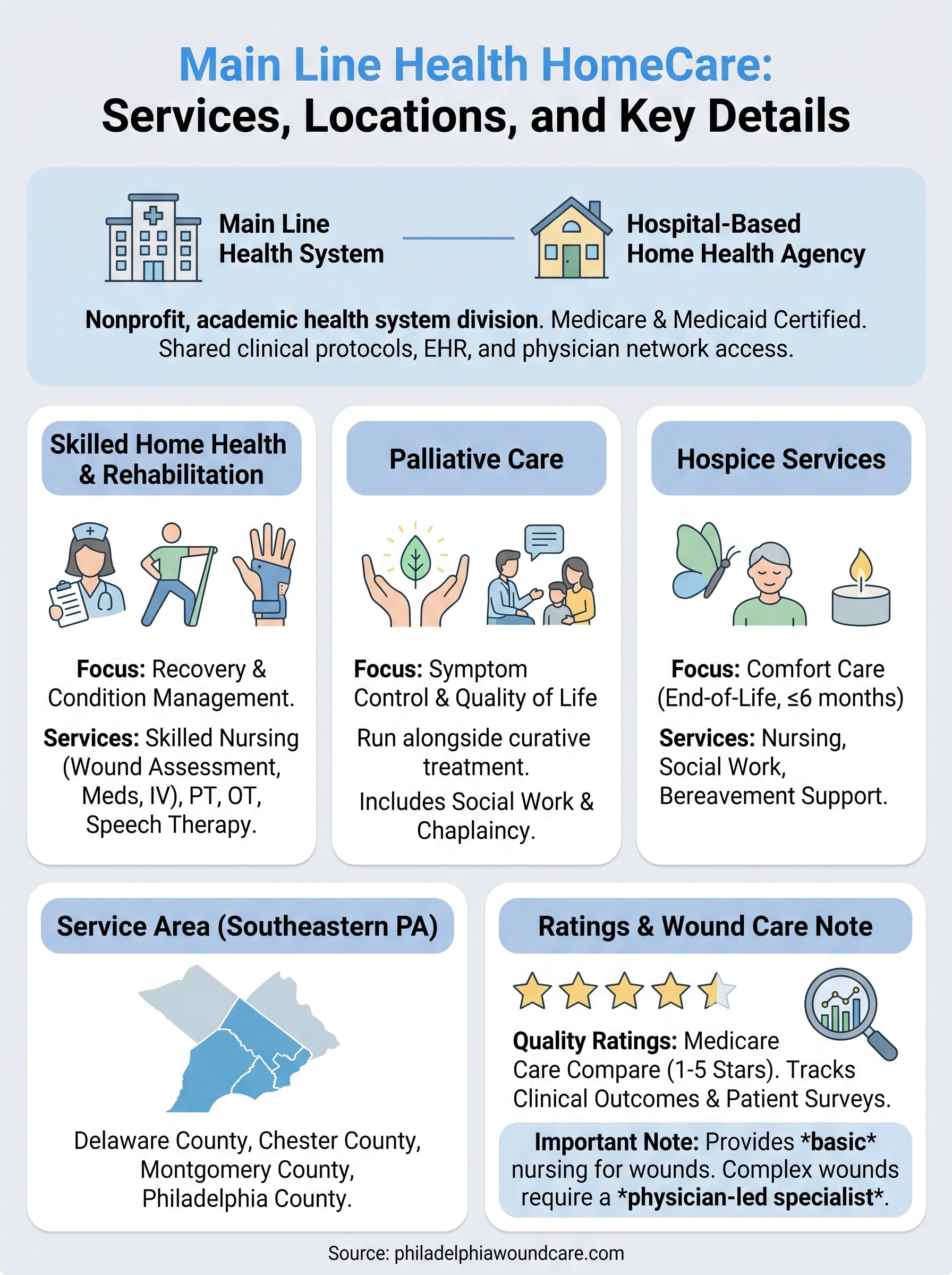
Main line health homecare organizes its clinical programs into three core areas: skilled home health, palliative care, and hospice services. Each program targets a different point along a patient’s care journey, from active recovery after a procedure to comfort-focused support at the end of life. Understanding which program applies to your patient’s situation helps you ask the right questions when you contact the agency.

Choosing the wrong program tier can delay the appropriate level of care, so confirming the exact service type at the time of referral is critical.
Skilled Home Health and Rehabilitation
Skilled nursing visits form the foundation of the home health program. Registered nurses provide wound assessment, medication management, IV therapy, and patient education on chronic disease management. The rehabilitation side covers physical therapy, occupational therapy, and speech therapy, all delivered in the patient’s home. These services require a physician order and are covered by Medicare Part A when the patient meets the homebound criteria.
Palliative and Hospice Services
Palliative care is available to patients managing serious illness who are still pursuing active treatment. The focus is on symptom control and quality of life rather than curative intervention, and it can run alongside other medical care rather than replacing it. Hospice, by contrast, is designed for patients with a terminal diagnosis and a life expectancy of six months or less who have chosen comfort care over curative treatment. Both programs include social work, chaplaincy, and bereavement support as part of the standard care team, which extends the clinical support well beyond nursing visits alone.
Locations and service area in southeastern PA
Main line health homecare operates primarily across southeastern Pennsylvania, anchoring its service footprint around the hospital campuses that make up the parent health system. The agency’s coverage is concentrated in the Philadelphia suburbs, where the population density and the system’s existing clinical presence make coordinated home health delivery practical and efficient.
Understanding the exact counties covered before submitting a referral saves significant time, especially when a patient lives near a county boundary.
Counties Within the Primary Service Area
The agency covers patients in Delaware, Chester, Montgomery, and Philadelphia counties, which represent the core suburban corridor where Main Line Health hospitals are located. These four counties together include densely populated communities like Ardmore, Wayne, Newtown Square, Haverford, Broomall, and Norristown, as well as more rural pockets toward the western edges of Chester County. When you are coordinating a discharge for a patient in any of these areas, the agency can typically assign a clinical team without geographic delays.
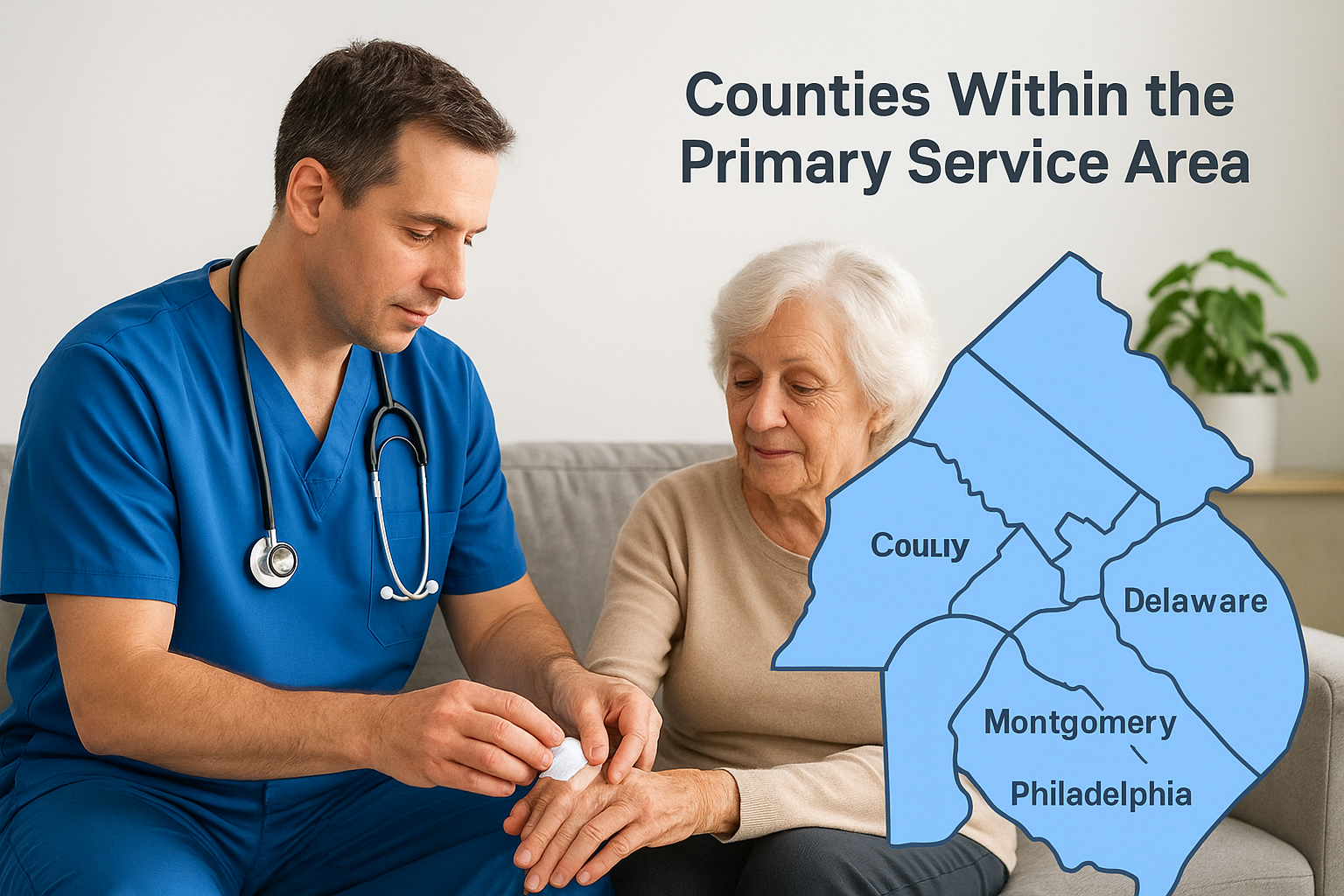
Some referrals outside the primary four-county area may still be accepted depending on patient circumstances and staffing availability, so it is worth asking directly if your patient lives in an adjacent county. Lancaster County and parts of Bucks County fall outside the standard coverage map, but edge cases do get reviewed.
What Coverage Means for Wound Care Patients
Patients with complex or non-healing wounds who live in the service area can receive skilled nursing visits for wound assessment and basic dressing changes through the home health program. However, physician-led wound management and advanced interventions like allograft therapy require a specialist provider rather than a standard home health nurse, regardless of which agency covers the territory.
How to contact them and submit a referral
Reaching main line health homecare to initiate a referral is straightforward whether you are a hospital case manager, a physician’s office coordinator, or a family member arranging care for a relative. The agency accepts referrals by phone and through direct coordination with the Main Line Health hospital network, so the entry point depends on where your patient’s care currently sits.
Getting the referral submitted promptly after a discharge decision is made reduces the gap in care and keeps wound healing progress from stalling.
Referral Process for Healthcare Providers
Healthcare professionals submitting a referral need to provide basic patient demographics, a current diagnosis, insurance information, and the referring physician’s contact details. The agency’s intake team reviews each case to confirm the patient meets homebound criteria and has a qualifying skilled need, which is required for Medicare coverage. If you are coordinating a complex wound care case, including a brief clinical summary with the referral helps the intake nurse assign the right clinical team from the start. Direct coordination with hospital discharge planners at Lankenau, Bryn Mawr, Paoli, or Riddle can also expedite the intake process when the patient is already within the Main Line Health system.
Contact Options for Families and Patients
Families initiating contact directly can reach the agency by calling Main Line Health’s central patient access line, which routes to the appropriate home health coordinator based on the patient’s location. You should have your insurance card and the name of the patient’s primary physician ready when you call, since both are required during the intake conversation. If a physician referral has not yet been written, the intake team can guide you on how to request one through your provider.
Ratings and quality metrics on Medicare Care Compare
Medicare Care Compare is the federal database where you can look up performance data for any certified home health agency in the country, including main line health homecare. The site publishes quality scores based on clinical outcomes, patient survey results, and timely initiation of care, giving you an independent benchmark that does not come from the agency itself.
Checking Medicare Care Compare before finalizing a referral takes less than five minutes and gives you objective data that no marketing material can replicate.
How Medicare Care Compare Works
The platform rates agencies on a five-star scale across several categories, including managing pain and treating symptoms, preventing harm, and preventing unplanned hospital care. Scores are calculated from Medicare claims data and patient-reported outcomes, so they reflect real care episodes rather than self-reported metrics. You access the tool by searching the agency name or zip code directly on the Medicare website at medicare.gov.
What the Scores Mean for Your Decision
When you review an agency’s ratings, pay close attention to the quality of patient care star rating and the separate patient survey star rating, since the two measure different things. The quality score captures clinical outcomes, while the survey score reflects whether patients felt their care team communicated clearly and responded to their needs.
Agencies rated three stars or above generally meet federal benchmarks for safe, effective home care. If a score in any category falls significantly below the national average, it is worth asking the agency directly what steps they have taken to address those gaps before you move forward with a referral.
Key Takeaways
Main Line Health HomeCare provides skilled nursing, rehabilitation, palliative care, and hospice services across Delaware, Chester, Montgomery, and Philadelphia counties. If your patient lives in the primary service area and needs home-based clinical care following a hospital discharge, this provider gives you a well-structured option backed by a large regional health system. The agency’s Medicare certification and hospital-system connections make care coordination smoother, particularly when a patient transitions out of one of the Main Line Health hospitals.
Standard home health nursing, however, does not replace physician-led wound management for patients with chronic or non-healing wounds. If your patient needs advanced interventions beyond routine dressing changes, a specialist fills that gap directly. Philadelphia Wound Care partners with home health agencies across the region to deliver the physician-level oversight complex wounds require. To learn more or request a specialist visit, explore our mobile wound care services in Philadelphia.